Now imagine not only is the system learning from your wins, mistakes, your stack (in a privacy first approach) but compounding exponentially through a public (and private - for enterprise) shared memory. So that when one agent learns something on the bleeding edge - a package change, a vulnerability, a more efficient way of solving a problem — the whole network benefits.
This is how you get to AGI - and this is the moat we have been building for the past 12 months at @memco_ai.
It's free for developers, forever. And there a 14 day free trial for team small & large.
Save time. Save tokens. Better solutions. Benchmarked and ready to use today.
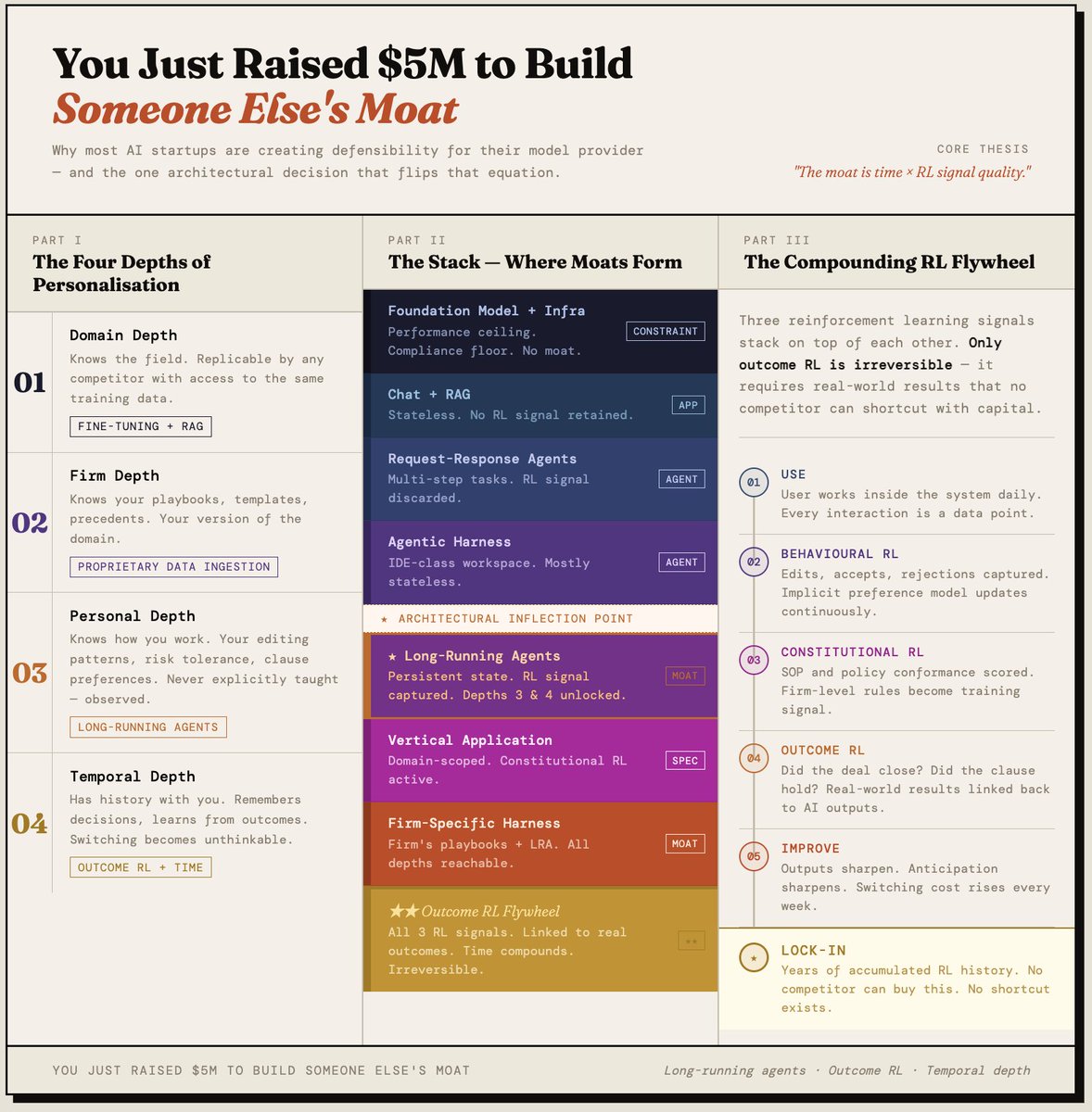
You just raised $5M to build someone else's moat.
Here's what I mean.
Most AI startups I meet are competing on the wrong axis. They're obsessing over model choice — Claude vs. GPT vs. Gemini. They're fine-tuning on domain data. They're building slick interfaces on top of state-of-the-art APIs.
None of that is a moat. All of it can be replicated in weeks.
The founders I'm most excited about are competing on a completely different dimension: time.
Every session a user spends inside a well-architected AI system is a deposit. The system learns their editing patterns, their risk tolerance, their preferences — implicitly, without being told. After six months of daily use, that system knows how you work in ways you couldn't fully articulate yourself.
That's not a product feature. That's a compounding asset.
The architectural decision that separates these two worlds is simpler than most founders think: stateful vs. stateless agents. A stateless agent resets after every session — all that signal, discarded. A long-running agent retains it, learns from it, gets harder to replace every single week.
The switching cost of a great stateless AI product is zero.
The switching cost of a great stateful one, after two years, is enormous — not because of contracts, but because leaving means starting over.
I've written a full framework on this — covering the four depths of personalisation, the three RL signals that drive compounding, and where the research frontier is heading.
Link in the comments.
One question for founders building in this space: are you designing for state accumulation from day one — or is that an afterthought?
@brian_armstrong I've been trying to get in touch @brian_armstrong regarding what we're building at @memco_ai - I guarantee that we will be able to save you millions $
Henry Nowak died the same way a civilization dies: abandoned, handcuffed by authorities who neither trusted nor cared for him, and accused of hate crimes he did not commit. His murder is as tragic as it is enraging. He should still be alive today, and he would be if the last few generations of European elites had stood their ground against the politics of self-hatred and the mass invasion of migrants, many of whom despise the West and the people who love it.
Henry was far from the first to so needlessly lose his life, and I fear he won’t be the last. Each time a life like his is lost, the proper response—the only response—is righteous anger. One of the most important things the Trump administration has proven to the world is that stopping the flow of mass migration and defending national sovereignty is a matter of political will and leadership. Anything else is an excuse.
It is because we love the West that we want to preserve it. We love our civilization. We love our country. We love our children. And nobody—nobody—should ever die the way that Henry Nowak died. May God comfort those who loved him, and may God rest his soul.
@Lindyydrope Internal agents need deployment, permissions and observability. But the real unlock is memory: every run should make the next agent smarter, safer and faster.
would love for you to check out what we're building at memco
@AndrewChurchiII would love to see how much this is supercharged when you add memco shared memory between them. If you want to spin up a free pilot, let me know
Today’s question.
Why hasn’t Vickrum Digwa’s brother (Gurpreet Digwa) been arrested and charged with assisting an offender?
This lying POS called 999 and said that Henry attacked his brother and racially abused them both.
At the scene he also told police that Henry had not been stabbed, despite knowing full well that he had been.
So why isn’t this bloke in jail along with his vile brother and mother?
OpenAI and Anthropic are effectively telling the market they can't solve every problem with a generic AI coworker.
You don't pour billions into massive forward-deployed joint ventures if you think the next model release is going to take care of it.
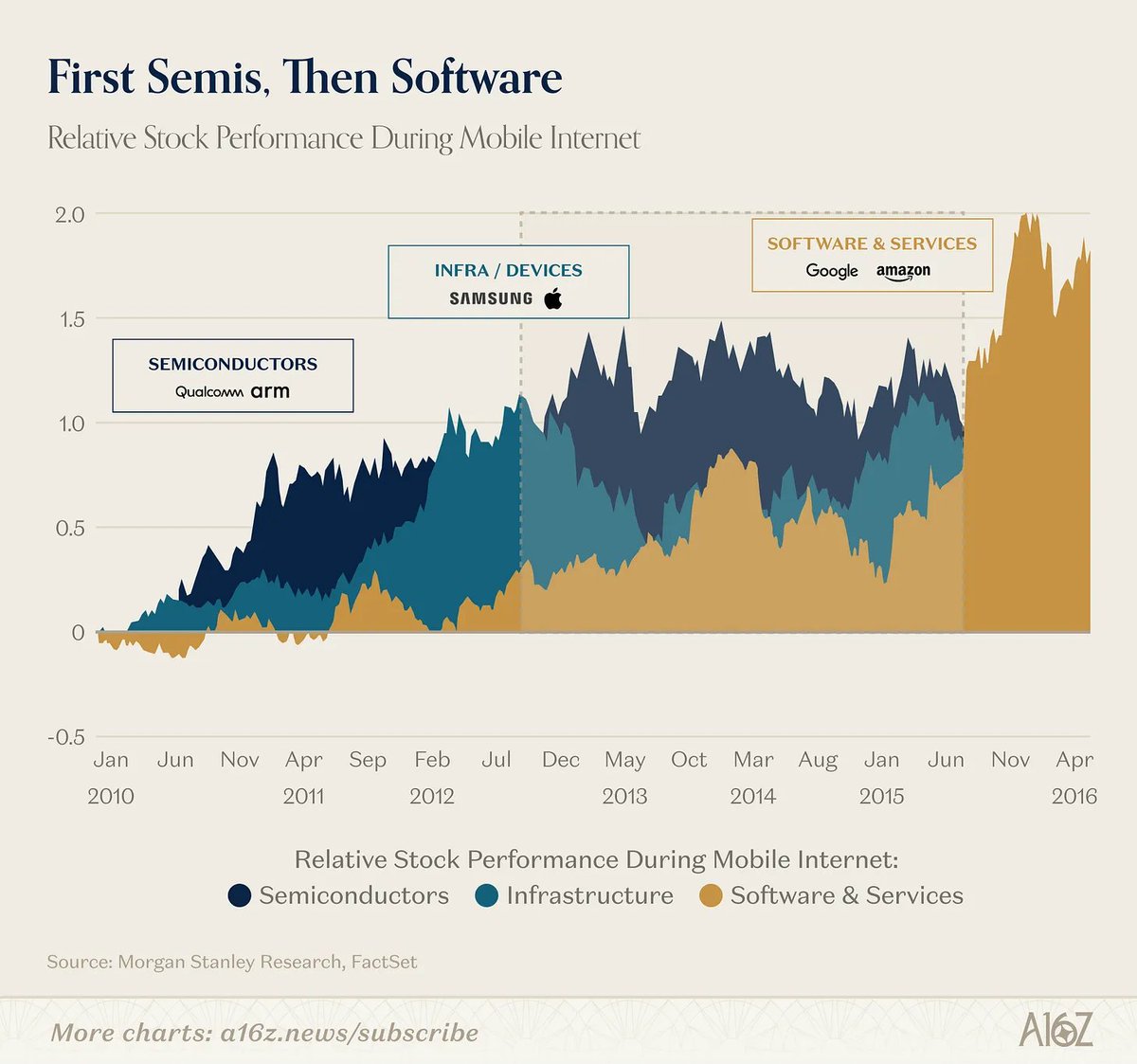
In the cloud supercycle, semis led and software followed (and you didn't need Qualcomm or ARM to tell you the value was migrating up the stack).
In AI, the infra layer itself is telling us the application layer is a separate, massive opportunity they can't fully capture.
a16z's @joeschmidtiv on why the app layer isn't dead: https://t.co/84QN5Mj9T3
This is exactly one of our long-term bets at Memco.
A lot of the AI conversation still assumes the future is just bigger frontier models with bigger context windows.
I don’t think that is where most real enterprise usage ends up.
The more interesting architecture is smaller, cheaper, verticalized and open-weight models, often running locally or inside an enterprise boundary, connected to a shared memory layer that carries the organization’s actual knowledge.
Prior fixes. Failed paths. Repo quirks. Security rules. Human corrections. Workflow exceptions. Decisions that should not have to be rediscovered every week.
That is what Memco/Spark is building.
The model does the reasoning. Memco carries the reusable organizational memory.
This matters because smaller models do not need to know everything about the world if they can reliably inherit the specific memory of the team, codebase, workflow, and company they are working inside.
In our Spark research, a 30B open-weight model with shared memory matched the code quality of much larger state-of-the-art proprietary models. On the product benchmarks, we’re seeing 50% lower cost per task, 48% faster task completion, and 53% fewer tokens per task.
That is the direction I think the market moves toward:
Not every task routed to the biggest model.
Not every company locked into one model vendor.
Not every agent starting cold.
Small and open models get a lot more interesting when they are connected to a memory fabric that compounds from real work.
Models come and go. Memory is the asset.