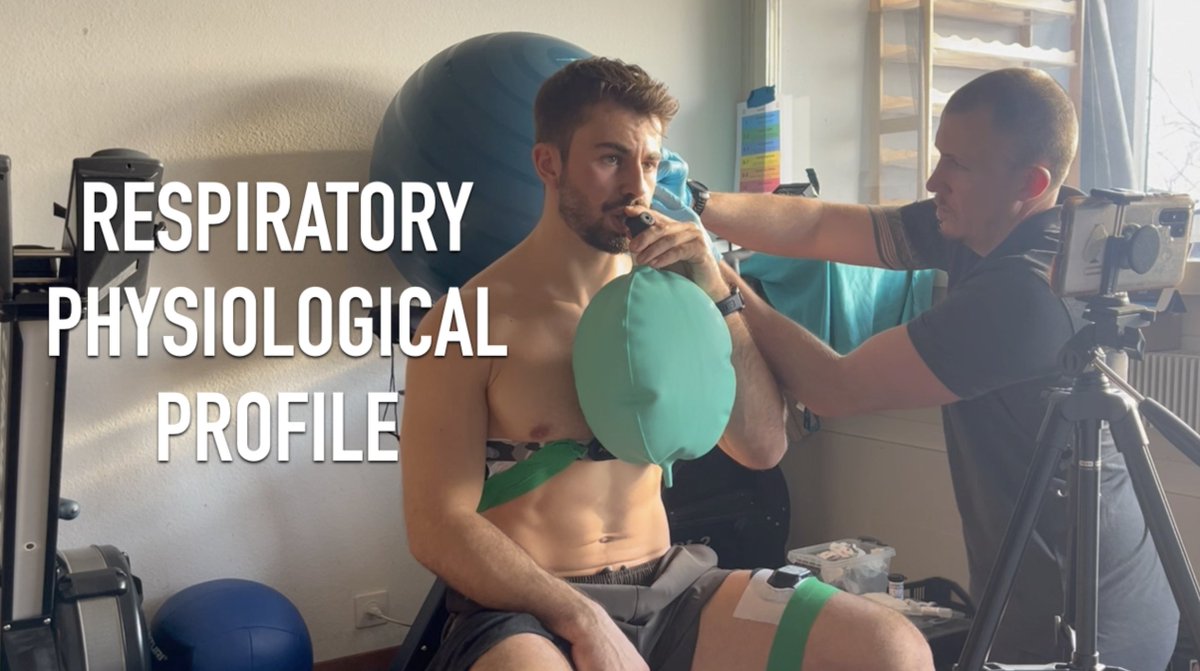
Do respiratory muscles display similar metabolic inflection points as what we find in cycling or running incremental tests?
It sure seems that way..
Let's have a look at some N=1 data I collected this week.
1/n
Altitude or heat training to increase haemoglobin mass and endurance exercise performance in elite sport - Lundby - @JPhysiol - Wiley Online Library https://t.co/xnv5DFvUaH
Where Eric Topol brings scientific rigor into the protein discussion and quashes harmful bro-science BS. Topol is the reverse Peter Hypochondria Attia.
120 g/h Carbs in Trail Running is Dead (maybe?). Lessons from winning UTMB.
This weekend 2 of my nutrition clients, @TomEvansUltra and @ruthcrofty, won UTMB. We developeda different strategy, and it worked. Often high carb, but never 120 g/h, even going down to 80 g/h at times.
Interested in mathematical modelling for sport applications? Here's an interactive on-line course I am building for sports science students.
https://t.co/8PwrKLMBOI
🫁VO2 and [La] kinetics
🚲MTB suspensions
💪Muscle F-L-v relationships
... and so on!
Yes, Wbal model also👍
🚨 The last paper of my PhD is out in @MSSEonline
Regular Long Runs and Higher Training Volumes are Associated with Better Running Economy Durability in Performance Matched Well-Trained Male Runners
🙏🏻 @rich_blagrove & J. Folland
🆓 Download
🔗 https://t.co/jBsYy0KBlF
🧵 1/7
Creatine - therapeutic applications beyond athletic performance
Creatine, a well-established ergogenic aid in sports, is now being investigated for its potential therapeutic applications in various medical domains, including neuropsychiatric disorders, heart failure, etc.
Current and “forward-looking” insights:
🧠 Mental health - recent evidence suggests that creatine supplementation may exert antidepressant effects by enhancing brain energy metabolism and modulating neurotransmitter systems. Some studies suggest it may (*key word) have potential as an adjunctive treatment for major depressive disorder, particularly in cases resistant to a single therapy.
🧠🩸Stroke Management - in preclinical models, creatine has demonstrated neuroprotective properties, including the reduction of infarct size and the preservation of mitochondrial function during ischemic events (i.e., an event in which an organ or body part is not getting enough blood/oxygen). preclinical findings to date suggest that creatine could be used to mitigate occurrence and damage of ischemic events, by stabilizing ATP levels and lowering oxidative damage.
🫀Heart Failure - heart failure is characterized by a mismatch between ATP supply and demand in cells of the heart. Creatine's role in the Cr/PCr/ATP shuttle offers a targeted approach to restoring cellular energetics in failing cells. Although clinical studies present mixed results, the mechanistic rationale supports further investigation into creatine as a complementary therapy in heart failure management.
As the body of evidence grows, creatine's transition from a sports supplement to a therapeutic agent in clinical practice appears increasingly plausible.
My position on this topic is that the health benefits of physical activity just lie in improving fitness. To achieve this, we need a high volume, but also at an intensity relevant enough to stimulate.
Officially pubbed in @MSSEonline.
1. Minimum dose RT promotes muscular gains in trained individuals
2. Failure promotes modestly superior hypertrophy results vs 2RIR, but both conditions increase muscle
3. Strength gains similar between failure vs 2RIR
https://t.co/x2i9BnXqZV
Recently we published a comprehensive analysis of overtraining syndrome in athletes and recreational exercisers.
Of the CPET variables, decreased VO2max, peak blood lactate and VO2@VT1&2 significantly predicted overtraining syndrome. https://t.co/aYj37xnpk4
Ankle Tag! 🏉💪🏻🔥
Balance, coordination and muscular endurance all intertwined in this full activator!
Rotate partners, roles and repeat!
More content over on Tik Tok too!
Follow WTPE on Tik Tok today:
https://t.co/XbGLmbmf6J
Are you lifting but neglecting movement work?
DON’T.
Here are 12 upper & lower movements you should do
1. Half kneeling pigeon rock
2. Half kneeling wall t-spine rotation
3. V sit-up
4. Half kneeling t spine to pec opener
5. Hand supported SL RDL to hip sweep
6. Seated t-spine rotation w/ board
7. SL Hip gate (w/ IR) w/ overhead hold
8. Thread the needle w/ foam roller
9. Med ball rocking 90/90
10. Chin-up dead hang
11. Inchworm to side lunge
12. Thread the needle w/ KB
Let's be honest, athletes want to hear they are overtraining and are thrilled that aerobic work is removed from their program. It allows them to leave earlier, not work as hard, and this enables the coach to be the good cop, thus conditioning is discarded.
The simplest way to improve your health and fitness: pick an aerobic activity, keep your heart rate around 100–130 bpm, and go for 1–2 hours.
Anyone can do it. All it takes is time and maybe a bit more laundry.
Once you build this habit, you become an endurance machine.
“When developing young athletes the goal should be long term success while equipping them with the adaptability to perform where the game is going not just look good today.”