Learning to remove noise from images yields fantastic image generators. Here's how you can use diffusion models to solve Combinatorial Optimization problems by removing noise from solutions that you don't even have! To be presented @ICML 2024, 🧵👇
Presenting our spotlight paper on trust regions for optimal control at NeurIPS, https://t.co/YS1VkDYBEB. We show that KL-equipspaced measure transport can be interpreted as geometric annealing with adaptive step sizes, leading to major performance gains on hard control problems.
If you’re at NeurIPS in San Diego next week, we’d love to connect and discuss our work.
Joint work with:
@lugruber0, Christoph Bartmann, @HochreiterSepp, @sebaLeh
🚀 Excited to share our new paper on scaling laws for xLSTMs vs. Transformers.
Key result: xLSTM models Pareto-dominate Transformers in cross-entropy loss.
- At fixed FLOP budgets → xLSTMs perform better
- At fixed validation loss → xLSTMs need fewer FLOPs
🧵 Details in thread
🔥 New workshop at @NeurIPSConf!
DiffCoALG bridges the gap between classic algorithms & differentiable learning.
Think: LLM reasoning, routing, SAT, MIP — neurally optimized end-to-end.
📌 Submit by Aug 22!
🔗 https://t.co/OiKDhVcaSo
#NeurIPS2025
General relativity 🤝 neural fields
This simulation of a black hole is coming from our neural networks 🚀
We introduce Einstein Fields, a compact NN representation for 4D numerical relativity. EinFields are designed to handle the tensorial properties of GR and its derivatives.
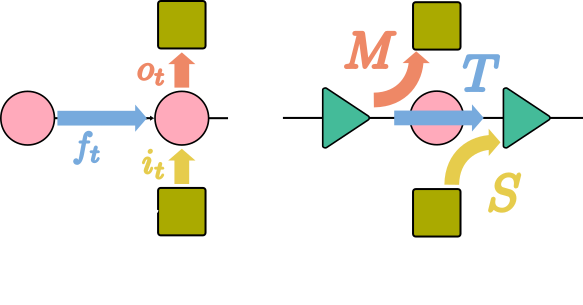
Ever wondered how linear RNNs like #mLSTM (#xLSTM) or #Mamba can be extended to multiple dimensions?
Check out "pLSTM: parallelizable Linear Source Transition Mark networks". #pLSTM works on sequences, images, (directed acyclic) graphs.
Paper link: https://t.co/nU7626uHWK
Happy to introduce 🔥LaM-SLidE🔥!
We show how trajectories of spatial dynamical systems can be modeled in latent space by
--> leveraging IDENTIFIERS.
📚Paper: https://t.co/6s3zIhXJ5o
💻Code: https://t.co/b6LePjMgIb
📝Blog: https://t.co/V1Mtmu4jqn
1/n
10/11 🏆 Our method outperforms autoregressive approaches on Ising model benchmarks and opens new avenues for applying diffusion models to a wide range of scientific applications in discrete domains.








[Paper Link](https://t.co/cuiVvNALnq)
--- https://t.co/wXud3EBeQ2](https://pbs.twimg.com/media/GpSd9YJbYAA3vGz.jpg)


