Chuffed to finally share my PhD thesis. If you're interested in learning more about creating proper distribution shift-aware DeepGP for reliable anomaly detection or how to create inverse-free Sparse GPs through a probabilistic framework, do check it out: https://t.co/21P2bU7mXj
@langer_han@miniapeur Due to the mean function given by PCA in each hidden layer, this should be less of a problem for DGPs compared to DNNs. It is a strong assumption but I think it's needed if you want OOD capabilities. I propose making the layers Lipschitz so that it's respected.
@langer_han@miniapeur I explored a bit the OOD problem with DGPs here: https://t.co/32tSAwrOCD
What I found was that using Optimal Transport inspired kernels to be crucial to maintaining a sense of what an outlier is across layers.
However, the OOD capabilities diminish above 5-6 layers.
@langer_han@miniapeur Have you seen any recent work dealing with the "depth-pathology"? The latest paper that I remeber dealing with this was "Compositional uncertainty in deep gaussian processes". Has been some years that I didn't touch base on this though.
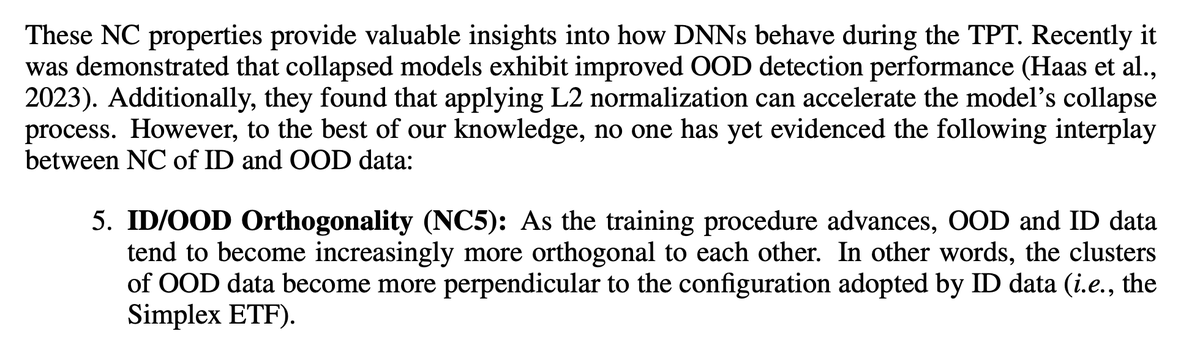
What if you pass out-of-distribution data into NNs showing neural collapse? How's that useful?
Turns out, the out-of-distribution data become orthogonal to in-distribution data & you can then use that to detect those OOD points.
Glad to have contributed to this paper exploring how to use the geometry imposed by Neural Collapse on over-parametrized neural networks and how we can exploit it for out-of-distribution detection. Check it out at #ICLR2024
New publication alert🔖⚠️:"Distributional Gaussian Processes Layers for Out-of-Distribution Detection." By S G Popescu, D J Sharp, J H Cole, @kostaskamnitsas, @glockerben. Free to read: https://t.co/Ek0enUh6m9
Introducing *Neural Diffusion Processes (NDPs)*: a novel approach, based upon diffusion models, that learns to sample from a distribution over functions.
Work with @alandanielsaul, @ZoubinGhahrama1, @frgsimpson
[1/11]
Wondering how to perform matrix inversion-free inference in Student-T Processes? Come to our poster tonight at https://t.co/dIPdQAmhOp #AABI2022 Full paper: https://t.co/59SMSUFH2x
An extended version of this paper will soon be published, including some interesting theoretical function-space properties of the newly introduced module, additional architectures and results on generic OOD tasks plus other medical imaging modalities.
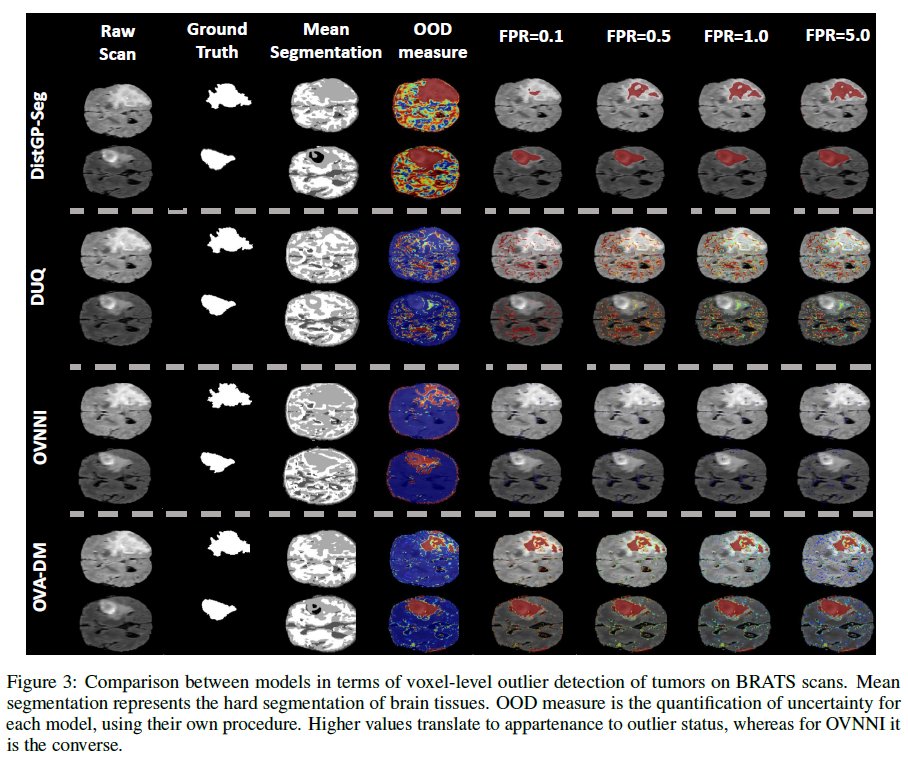
Our work "Distributional Gaussian Process Layers for Outlier Detection in Image Segmentation" on using Lipschitz filters + Distributional GP layers for uncertainty quantification in medical image segmentation has been accepted as an oral at @ipmi2021
https://t.co/PNIjVj342e
We trained our network to segment white matter, gray matter and cerebrospinal fluid on healthy T2 scans (normative data).
At testing time, we used BRATS (T2 scans with tumors) to assess the capability of our model to detect tumors as outliers.
The former encapsulates uncertainities still present within the data manifold (after taking into consideration aleatoric unc.), while the latter measures the departure from normative data (out-of-distribution detection)
Our Segmentation network is capable to separate two types of uncertainties, the within-data uncertainty (associated to parametric part of DistGP)
and distributional uncertainty (non-parametric part of DistGP).
Through this formulation, the "heavy-lifting" convolutional part is performed by the Lipschitz constrained affine layer, while the DistGP is tasked
to devise non-linearities and propagate uncertainty.
"Measure preserving DistGP layer" consists of convolving a filter on the first two moments of the previous layer.
Subsequently, we introduce an "activation function" as defined by a Distributional GP (building on work introduced in https://t.co/GQSuZRylAr).




![vdutor's tweet photo. Introducing *Neural Diffusion Processes (NDPs)*: a novel approach, based upon diffusion models, that learns to sample from a distribution over functions.
Work with @alandanielsaul, @ZoubinGhahrama1, @frgsimpson
[1/11] https://t.co/dVWwxiiVTp](https://pbs.twimg.com/media/FUz0r-VXwAAZ5P9.jpg)