Partially. While skills are worth more than a degree in most cases, one component is missing here: Your network (= people you know)
Networking matters more than you might think. There is a saying that I know from my teenage years in Germany, which goes, translated, "Contacts just hurt those who have none", and over the years I realized more and more how true that is.
No matter in what tech sector you are working, the most important thing nowadays isn't your degree, not even your skills; but your network.
Verifiability is the most important edge of crypto.
Bitcoin and Ethereum gave us verifiable money and finance. The next step related to verifiability is different from 2 previous steps.
The thing with Bitcoin and Ethereum innovations is that both of these types of verifiability exist within the crypto environment, more precisely, on-chain environment.
After people truly explored the power of on-chain verifiability, there was a time when people tried to build everything on-chain. Games, messengers, utilities, music, news, every type of classic application was put (or almost put) on-chain.
During that mania, few people said: "Why does it have to be on the blockchain?".
A lot of people from TradFi and IT sectors started building the same stuff they were building in their industries, but on the blockchain. Most of them didn’t work out, more accurately, almost none of them worked out.
That question became a meme. The main answer to this question was: "it doesn’t have to be on the blockchain". I believe both the question and the answer were wrong.
1. First reason: people didn’t understand the core value proposition of crypto.
The core idea was just to put something onchain, not thinking about benefits that onchain deployment brings.
Therefore, the core value proposition at that time is that something on-chain is already better than something not on-chain, solely because it’s built on decentralized infrastructure.
• The core advantage is clear — application is using decentralized architecture.
• The core disadvantages are also clear — expensive and slow computations compared to centralized architecture.
So that’s it, right? No.
The main value that apps gain from being on the blockchain is not decentralized infrastructure itself, but verifiability that this decentralized infrastructure brings. Building the whole application logic on-chain is painful and irrational, because of multiple reasons:
• You’re limited to specific software that only works within certain VM (virtual machine)
• You’re limited to specific hardware for your application needs
• You’re limited to the consensus protocol of the blockchain
• You’re limited to interactions with outside world and getting external data
Yes, smart contracts can get external data via oracles, but they have their own trust issues and this data is public. Blockchains operate on the premise of transparency, so getting external public data is not hard, but getting private data is way more difficult (don’t forget about trust assumptions).
Following this logic, it may seem that we should stick to only what the on-chain industry offers and build within these limits, right?
Of course not!
The biggest advantage that crypto has is verifiability: every user can independently verify the correctness, integrity, authenticity of every action. Most importantly, they can be sure they’re not cheated on & prevent themselves from cheating on other users.
However, as I said before, not everything can be put onchain, because it’s either slow, expensive, or simply impossible.
You cannot just put expressive and complex instructions (code) onchain. Copy and paste doesn’t work in that case.
That’s why previous solutions didn’t work: they tried putting the whole infrastructure onchain, which naturally limits the functionality of the application, because web3 dev tools are way narrower than web2 tooling (at least for now).
2. If we can’t build the whole infra on-chain, can we build at least a part of it?
Do all applications need verifiability? No, but most of them.
Let’s take a platform where you’re currently reading this writing — Twitter. As noted by @shilpi_jc, twitter needs verifiability for:
• ad revenue calculations (because creators want to be sure they’re paid fairly)
• real user views (to make sure views are not botted)
• trending topics (because it has massive power over public discourse)
• etc.
"Why are we discussing twitter? nobody is going to put twitter on a blockchain".
Yes, nobody is going to do that, because it’s impossible:
• you can’t call APIs
• you can’t run bot detection algorithms
• you can't do anything complex
What you can do is to write a simple function that calculates payouts based only on view count which can be easily botted.
If we consider complex systems such as AI, @_jasonwei wrote about Verifier’s Law: “The ease of training AI to solve a task is proportional to how verifiable the task is.”
If something is easy enough to solve (like transfers), it can be verifiable on-chain. Training complex AI models takes a lot of resources, therefore the verification of this model will take a lot of resources as well which current blockchain infra is just not ready to allocate.
• We can’t put complex app logic on-chain, but maybe we can put at least the core part of this logic to update state and facilitate value transfers?
• You can’t run bot detection algorithms to calculate the real number of views, but can we at least have payouts for these views on-chain?
We can, we can also store and update the final state on-chain, it’s not that computationally expensive.
So, we decided that we can keep consensus-related logic on-chain, but what about more complex computations?
To give you an idea of how far we’re from putting everything on-chain, @0xbodu noticed that:
• It would take 1000s of MegaETH chains to replicate Uber's global functionality.
• And it would take 100s of MegaETH chains to do the same just for NYC.
3. Can we keep basic logic onchain & make complex logic verifiable?
We definitely want to keep basic logic on-chain, but what about other more complex logic?
The first natural thought is using something like AWS and its microservices. Yes, we can, but it lacks verifiability which is crucial for a lot of both consumer and infra applications.
What should we do?
We have to find a way to make this complex logic verifiable. We already have lots of verifiability for digital assets & smart contracts, but now we want to apply this to more complex infrastructure.
4. EigenCloud?
@eigencloud recently rebranded to EigenCloud to increase a focus on verifiability. Even though EigenLayer was mostly known as the restaking protocol on Ethereum, this perception is not exactly correct.
Restaking subconsciously means verifiability, if something can be slashed — it can be verified. Restaking is part why verifiability is possible, but adding slashing to the infrastructure doesn’t automatically make it verifiable.
All applications consist of multiple components. The core learning behind the EigenCloud product is that not every component of the application has to be verifiable, and if they need verification, there are different levels of that.
There are 3 different levels of verifiability in most of the applications:
• Simple logic (transfers): on-chain verifiability
• Complex logic (API, algorithms, AI/ML): off-chain verifiability
• Routine logic: no verifiability
EigenCloud focuses on off-chain verifiability where complex systems and components of complex systems must be verified.
There have been countless articles about EigenCloud architecture, off-chain verifiability and how it works and I don’t wanna repeat them.
What I want to do is give 3 examples of how important verifiability of complex systems is and how even non crypto systems can benefit from EigenCloud.
I’ll take 3 different cases: gaming, robotics (inspired by @jinglingcookies), and future cyberpunk relationship between agent and human.
5. Verifiability in gaming & how to make the game more fair.
I spent 7 years of my life (more precisely 12,000 hours) playing Team Fortress 2 (TF2) which is a multiplayer shooter game. I’ve seen enough and I know how every mechanic of the game works.
However, there were things that made me deeply upset. I didn’t realize why until I started learning more about verifiability and applying it to my previous experience.
• We had the problem of hacker bots flooding the servers and 13 out of 24 players were bots.
• Bots were kicking real players by voting, because they’re a majority.
• They destroyed servers and made the game literally unplayable for a certain period of time.
Yes, anti-cheat systems exist, but those anti-cheat systems weren’t able to identify that these were bots and hackers, they kept playing the game unfairly.
If anti-cheat systems verified that the player is a bot, hacker, or using cheats, they wouldn’t be able to play. If anti-cheat systems falsely accused real players of cheating — those systems would be slashed.
Another interesting feature of TF2 is random crits.
Random crits happen randomly when the player shoots the weapon and it gives 3x more damage than they’d usually get from normal hit.
• Problem: there are some weapons in the game that constantly give more random crits than other weapons.
• When the base random crit chance is 2%, some weapons gave 20% chance and used unfair advantage over other players.
If the logic responsible for random crits would be realized in EigenCloud, it would be verifiable and the weapon would eventually be nerfed.
Obviously, TF2 doesn’t need verification for everything, but some components really need this.
The logic for storing and trading items within the game can be stored on-chain and be fully verifiable, because this logic is pretty trivial. I’d play another couple years if they fixed those problems (maybe).
6. Verifiability in robotics industry & why it's way more important than you think.
The robotics industry is developing pretty rapidly and there are lots of problems as well, especially related to secure interoperability between 2 robots.
• Imagine you have a robodog that patrols your house.
• Robodog detects something weird and suspicious.
• Robodog alerts your humanoid robot at home about what it saw.
The process of informing is the data transfer, that data has to be secure and verifiable, otherwise it could literally risk your life.
In that case, both robots can even operate as mini-blockchain storing a shared state of memory, where every piece of information is verifiable.
For the verification process (EigenVerify) data has to be stored somewhere (EigenDA), to make sure it’s available for verification for every period of time within a timeframe.
• When we deal with robots, we have to be sure that each robot is verifiable.
• If we deal with multiple robots, we have to make sure the messaging (interoperability) between these robots are also verifiable.
Misalignment and unfair behavior could have far worse consequences than bots in computer games.
7. Verifiability in future zero-employee companies run by AI agents.
@shayonsengupta wrote an amazing article at the beginning of 2025 about the Human-Agent Relationship. According to the article, in the future there will be companies with zero employees where there are single or multiple agents operating.
It will be funded by humans and agents will allocate capital for actions it can't do or be intelligent enough to think about what it needs to grow the company.
The assumption is that agents can do the same in the future and will be so intelligent that any human input will ruin the outcome and trend towards zero.
(The same happened before with chess bots where minimal human impact makes the system perform worse than it would without human touch)
If there's really the world we will be living in, we really need verifiability of each action that agent will do.
Especially in this connection between agents and humans. Agents will give tasks to the humans and reward them after completion.
• how to verify that task was indeed completed?
• how to verify if an agent rewarded the human?
• how to verify if an agent rewarded the right human?
• how to verify if an agent rewarded the right amount of money to the right human?
There are infinite questions and only one answer:
Everything has been verified to make sure the system is not malicious and harmful.
Crypto rails are the best fit in this case as payments can be facilitated on-chain, while more complex infrastructure of agents and human-agent coordination can be off-chain.
8. Usage of verifiability outside crypto industry.
Infrastructure will trend towards being globally applied to the wider crypto ecosystem and then to outside of crypto.
• For example: EigenCloud is not limited to Ethereum, this infra can be used for other L1s like Solana or other L2s with or outside Ethereum.
• Same with EigenDA, it’s not just middleware between L2 and L1, it can be applied to any components where computation inputs and outputs must remain accessible for verification.
Crypto verifiability can even be used in sports judging events.
• In sports like figure skating or gymnastics, judges subjectively score performances on artistry and technique, often leading to varied scores.
• Outlier scores may invite scrutiny or bias accusations.
• Judges might align with the majority to avoid criticism.
An AI model could standardize evaluations using predefined metrics (e.g. motion tracking), with penalties only for operators who manipulate the model’s inputs or outputs.
Each action of this AI model must be verifiable, otherwise it can also be biased towards certain outcomes and it just doesn’t make any sense.
There are 3 levels of verification:
• Blockchain (on-chain): handles payments, non-custody, and simple logic
• EigenCloud (off-chain): handles complex systems that really need verifiability
• Traditional Cloud: handles content storage, user interfaces, etc.
While most apps genuinely require verifiability, they don't have to be entirely verifiable. This is because some aspects simply don't need verification, and there's no need to include it merely for the sake of verifiability.
The core idea behind EigenCloud and the broader edge of crypto is to provide verifiability where it's truly needed, not for everything that exists.
Crypto has enabled significant progress in zero-knowledge proofs — a concept that existed previously but received less attention. The same will happen with verifiability, in fact, it's already happening.
This is alpha. 🎯
We just dropped a piece of our playbook building the future of Web3 threat intel with #OpenCTI:
• Real-time intel sharing
• STIX-compatible threat data (not just Telegram noise)
• Graph visualization to map threat actor networks
https://t.co/AQXc9yZATn
I'm still seeing a lot of projects hiring audit firms not for security, but for marketing purposes. They're okay with deploying even when multiple critical and high-severity issues are found(not hiring a second auditing firm). 🤯
WE, as a community, should prioritize security above all else. 🔐
The Major Turning Point! 🔄
Eth/Bitcoin Dominance chart has officially reversed. Is alt season here!?
🦉Like
🦉Comment
🦉Repost
Set Reminders 🔔
https://t.co/yHN8xBZuDU
Elon didn’t fix your DMs... so I did.
Launching InboXr: a chrome extension that hides spam so you can focus on DMs that are importat.
Its free, RT if you find this helpful (link in tweet below).
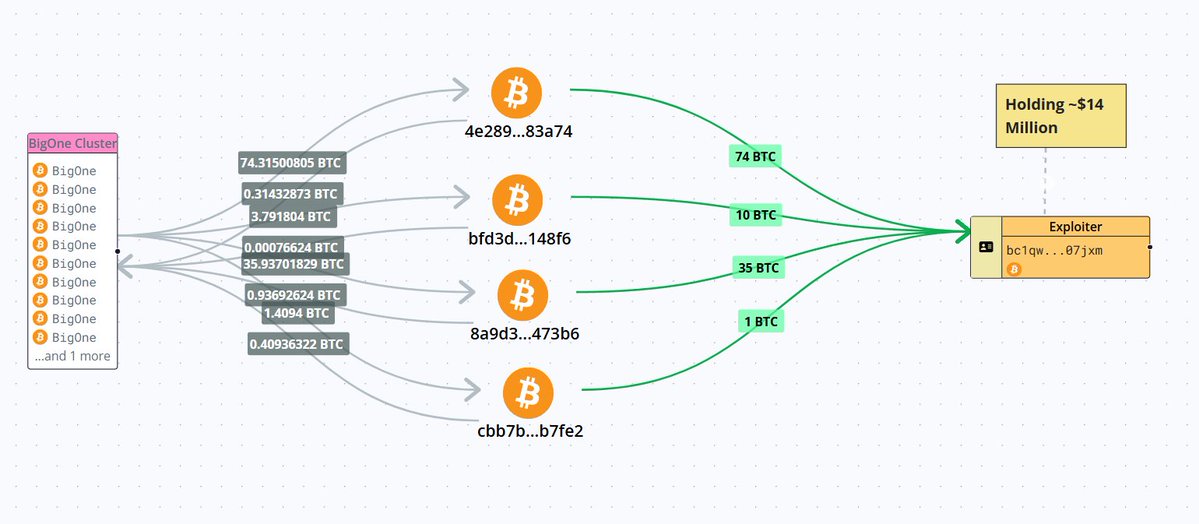
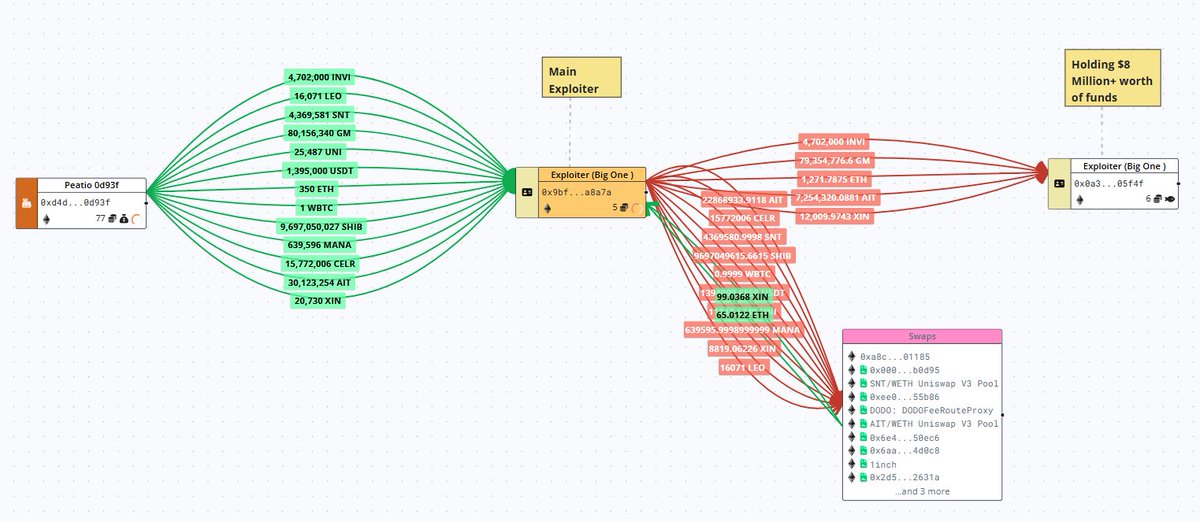
🚨 @BigONEexchange hot wallet was compromised in the early hours of July 16, following abnormal activity detection. The exploit has been confirmed: https://t.co/I3BdrgAgVq
Blockscope’s initial assessment reveals a multichain exploit with losses exceeding $28M:
🔹Bitcoin: ~$14M | bc1qwxm53zya6cuflxhcxy84t4c4wrmgrwqzd07jxm
🔹Ethereum: ~$8M |
0x9Bf7a4dDcA405929dba1FBB136F764F5892A8a7a
🔹TRON (USDT-TRC20): ~$7M |
TKKGH8bwmEEvyp3QkzDCbK61EwCHXdo17c
🔹BSC: ~$106K | 0x9Bf7a4dDcA405929dba1FBB136F764F5892A8a7a
🔹Solana: ~$420K | HSr1FNv266zCnVtUdZhfYrhgWx1a4LNEpMPDymQzPg4R
We continue to monitor fund movements and stand ready to assist the @BigONEexchange team in any way possible.
Thank you @MYX_Finance for your trust and recognition! ❤️
On July 9th, the SlowMist team received an urgent request for assistance from MYX. We immediately launched an emergency response🚨, swiftly analyzed the affected protocol, devised a rescue plan🛡️, and successfully assisted MYX in securing the at-risk funds and mitigating the vulnerability. As of now, all protocol funds are safe.🔒
This incident fully demonstrated the professionalism and efficient collaboration between the white-hat community and security teams. We also want to express our gratitude to all the white-hat partners and security teams who participated in this rescue operation—together, we protected users’ assets and the broader ecosystem.💪
SlowMist remains committed to providing professional security services to the Web3 industry. Please feel free to reach out to us at any time—we look forward to building a safer and more trustworthy crypto ecosystem together.🚀
"you are under the misconception that the blacklist() function is meant to stop hackers. it is not. what it is, really, is a way for us to gaslight regulators and lawmakers into believing that we are the most compliant stablecoin"
Every single non-RAILGUN protected Ethereum transaction is a potentially disastrous data leak.
Use RAILGUN to reclaim self-custody over your data as well as your assets.
🚨 ALERT: Fake "Euler finance" ads top Google search results right now!
⚠️ These phishing ads are designed to drain your wallet through malicious transaction signatures.
👇 Notice how they use Punycode to disguise the real domain
If they can’t know, let me introduce mymself:
Daniel LLigMa Balls,
co-founder of Open AI, Anthropic
as well as the 11th co-author on the 5th transformers paper
during a vacation in China I’ve accidently created DeepSeek
I graduated from Harvard and then entered it again just to drop out. On my way to the airport I also graudated from MIT.
I code simultaneously in Python with one hand and in Rust with the other, while compiling the code jointly in my mind
Open for work.
🚨 Web3 Security Monthly Recap
Crypto hacks hit hard in May and June 2025. Cork Protocol faced scrutiny after its $12M breach, and Nobitex wallets leaked $82M.
Even security platforms weren't safe, Hacken lost $250K in private keys!
Really good collab!
https://t.co/pwCOI0yDJd