Risk analysis, Sector rotation, Weatlthbuilder, and total return stocks. Tweets are not recommendations. Request sample Sector Alert to [email protected]
Unfortunately the universities are not teaching how to learn either. They are more interested in telling you how to think like them. A dangerous totalitarian tendency.
Come on. No question pricing is ridiculous and extortionary. But, an LLM can't teach you the people and life skills that you gain in college. It can help with what you can learn, but it can't teach you how to learn. It can't teach you to stand up in front of a class and make a presentation, to show some semblance of responsibility and it can't hold you accountable for anything.
AI should definitely be part of every college experience. It can ampllify it in new and unique ways.
But, it won't ever hold your legs in a keg stand
Goes without saying that this is a broadly positive development.
US is thinking seriously about the more technical aspects of a nuclear agreement.
Suggests that the next phase is expected to begin soon--even as an initial agreement remains elusive.
New 52-week Lows exceeded New Highs on the NYSE by one issue yesterday. If New Lows are dominant again today, that will stop out the current buy signal from this indicator. It won’t generate a sell signal today – but could be a return to a neutral status.
When the market is overbought, there are some potholes, like yesterday, Dow down 600. Then it roars back nearly 900 points today just to leave the sellers behind. Healthcare XLV is responding well to our oversold buy from last week. XLV, RXL, IHE, IHI, IHF ETFs. For more information on risk-based evaluation, email - [email protected]
There is an unlimited supply of stock when values are rich, the companies need capital and the markets are willing to soak up the new stock. There is not an unlimited supply of money to buy these issues so the money has to come from other stocks, bonds or sovreign wealth funds (oil revenues). I montior IPOs to see what the appetite is for speculation. These are the largest issues ever. It will be interesting to see how the stock market absorbs the supply. For more information on our risk based research email - [email protected]
Google is raising $80 billion of equity a week before SpaceX is trying to raise $75 billion a few months before Anthropic and OpenAI are trying to raise $100 billion from investors and you’re laughing???
This is a cataclysmic exit liquidity avalanche
Steel production is up 8% from last year and continues to rise week to week. In the week ending on May 30, 2026, domestic raw steel production was 1,872,000 net tons while the capability utilization rate was 81.1 percent. The current week production represents an 8.8 percent increase from the same period in the previous year. Production for the week ending May 30, 2026 is up 0.1 percent from the previous week ending May 23, 2026 .
Berkshire doesn't know how to trade short-term because they don't want to. On the other hand, Buffett's measurement of market and company risk is a form of 'using the data'. The time frame may be different. Buffett's success is owed partly to the huge tax savings of owning stocks long term and through an insurance company; the long-term bet is on management constantly upgrading businesses and finding new ways to make things work. For example, buying KO during the 'new Coke' fiasco set them up for decades to receive increasing dividends for decades. Portfolio managers can use a similar long-term compass and valuations to 'buy low'. Berkshire also trades a lot more than most are led to believe. Sometimes adding to or trimming positions, but also selling entire positions or buying entire companies. Individuals and portfolio managers can balance short-term needs and market fluctuations using a risk management approach rather than 'chasing the rabbits around the bushes. A tortoise can beat the hare by remaining focused on the long-term goals and not buying high and selling low as emotions tip the scales. For more information and portfolio management tools, email [email protected] or message this X account.
Warren Buffett and Charlie Munger on why they won't hire a quant, even though Jim Simons proved it works:
A questioner points out that Jim Simons' Medallion Fund returned 39% net of fees for three decades, then asks whether Berkshire would consider hiring a quant lieutenant to work alongside Ted or Todd.
Buffett's answer is immediate:
"Well, I'll say no to the second part."
Then he hands the analysis to Munger, who breaks down exactly where quantitative investing worked and where it didn't.
Munger notes that the leading quant fund did fabulously on short-term trading:
"They found little algorithms that worked... they had predictive value, and as long as they kept working, they just kept doing it as long as the money kept coming in."
But the same approach hit a wall when stretched to a longer horizon:
"When they got to using the same system... for long-term stock predictions, the record was not nearly as good."
Munger also highlights a constraint most people miss. The edge had a ceiling built into it:
"In the short-term stuff, they found that if they tried to do it too much, they destroyed their own advantage, so there was a limit on the amount they could make."
His verdict on the people behind it is admiring rather than dismissive: "But they were very, very smart... very smart and very rich."
Buffett echoes the respect, calling Jim Simons "very high grade," before explaining why none of this changes Berkshire's approach:
"We're not trying to make money trading stocks. I mean, the answer is we don't think we know how to do it. If we knew how to make a lot more money trading stocks, we'd probably be trading stocks too, but we don't know how to do it, and we really don't trust anybody else to do it for us. It's that simple."
I've never been at a medical conference where the results have been greeted with a standing ovation
Tremendous breakthrough in pancreatic cancer treatment
Through science
Hard work, rigorous research, clinical trials.
Science
Not the quack pseudoscience of social media
Do not use your energy to worry. Life is too short to worry about stupid things.
Have fun. Fall in love. Regret nothing and do not let people bring you down.
Study, think, create and grow. Teach yourself and teach others.
—Professor Richard Feynman
Jeff Bezos: "There's never been a better time to be an inventor and a pioneer than right now because the world is on fire with new ideas and with AI. And we're in the middle of multiple golden ages right now with a rapid rate of change."
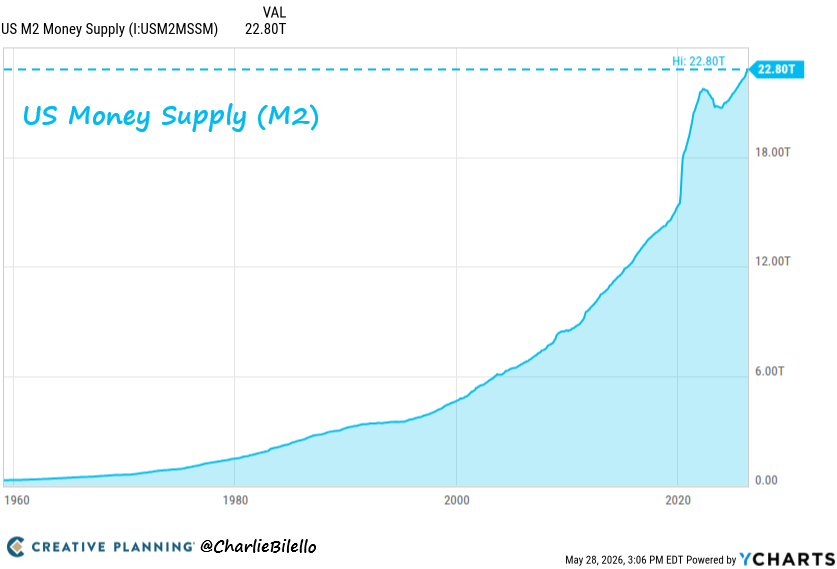
The Fed expanded the money supply by nearly $9 trillion under Powell.
Inflation has averaged >4% per year over the past 6 years.
Powell's explanation? It was nearly all due to rolling “supply shocks" over which the Fed has no control.
The truth: this inflation was made in Washington as it always is - from too much government borrowing/spending and too much government creation of money.
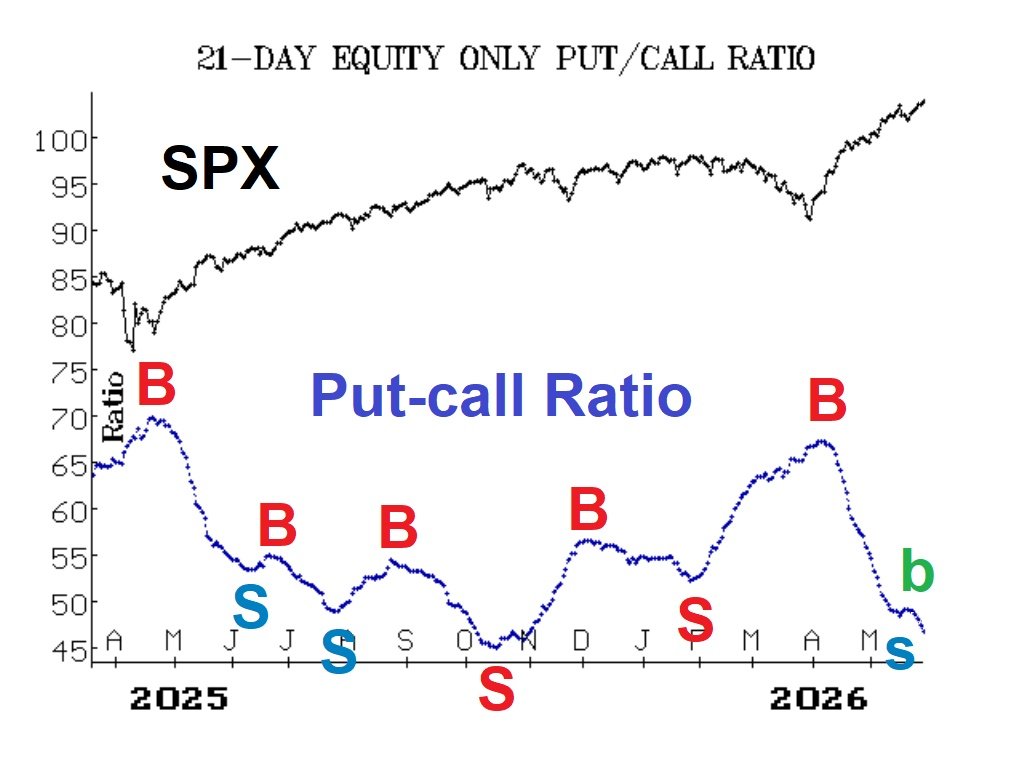
Stocks keep grinding higher despite overbought conditions. $SPX hits fresh all-time highs, breadth and $VIX indicators are turning bullish, and most recent sell signals have been canceled or are close to being invalidated. Bulls remain in control.
🔗https://t.co/ns1YjRP1m1
Rare weekly MVB sell signal in $NVDA.
These signals are not common: the July ’24 sell signal saw downside follow-through, while the May ’25 buy signal preceded a monster rally.
Now another weekly sell signal has appeared near all-time highs.
The stock market continues to climb despite overbought readings, the Iran conflict and other economic hurdles. The bulls take a licking and keep on ticking. Sector rotation has allowed stock indices to make new highs. There is a very bullish current and it isn’t just AI fluff. Caterpillar CAT is making new highs providing dirt diggers.
Mark Cuban explains how he pulled off one of Wall Street’s greatest trades
“When Yahoo offered us $5.7B in stock, I couldn’t sell it for six months”
“So what I did was I took every penny that I had and shorted the internet index as protection, basically taking insurance out in case the internet bubble popped”
“When I was allowed to sell it, because I couldn’t sell it all at once, it would just crater the market, so I did something called a hedge”
“What the hedge is, you can sell options. So I sold call options, which gave somebody else the right to buy my shares at a higher price in the future”
“I took that money and used it to buy puts, which protected me in case the price of my stock went down”
“When it popped, I actually made more money. It was called one of the top 10 trades in Wall Street history”