Built, optimized and running:
Time per refresh: ~62 ms → ~35 ms
CPU per refresh: ~23 ms → ~13 ms
Processes per refresh: 7 → 2
20 sessions refreshing at once: ~0.46 s → ~0.26 s CPU
You can now mod Claude Code:
- Change how it behaves
- Customize the UI
- Swap in your own features
Write one with a few lines of TypeScript, or have Claude build it for you. Mods ship inside plugins, so you install them with /plugin in the CLI or desktop app.
A few examples:
repo: https://t.co/U8QU8IJCZ5
3 read-heavy sessions on zustand, 3 runs each. it kept every message word for word and dropped every tool output, so here it acted more like "drop tool results" than smart picking. small n, not a general claim
tried fast-jev-compaction (7.7k★) in claude code, against the built-in /compact on the same sessions
recall after compact: 45/57 vs 46/57
time to compact: under a second vs ~23s
one catch: after --resume, the context came back bigger than before compacting
@jha_ruchir25475 That’s a good approach! Intelligent-tiering can make long-term log storage more cost-effective. I think it fits nicely alongside having different retention policies for different log types, especially when compliance and audit requirements come into play
Can a wrong "no results" turn into "it never happened"?
Now that we work alongside AI agents in our logs, it can happen more easily than we think. Let's take a quick look at why, and how we can prevent it 🙂
Log Notes #2 https://t.co/DB7dLCrk3w
Git activity more than doubled between September 2025 and August 2026, reaching 473.3B events per month.
We’re rebuilding our Git infrastructure while GitHub keeps running, creating a foundation for agent-scale software development. https://t.co/H5J2qxCqMT
People seem shocked that the author of Clean Code doesn't read code anymore. But that should not be surprising.
Why did I write Clean Code? What is the goal of keeping code clean? To get it out of the way of the real job -- thinking.
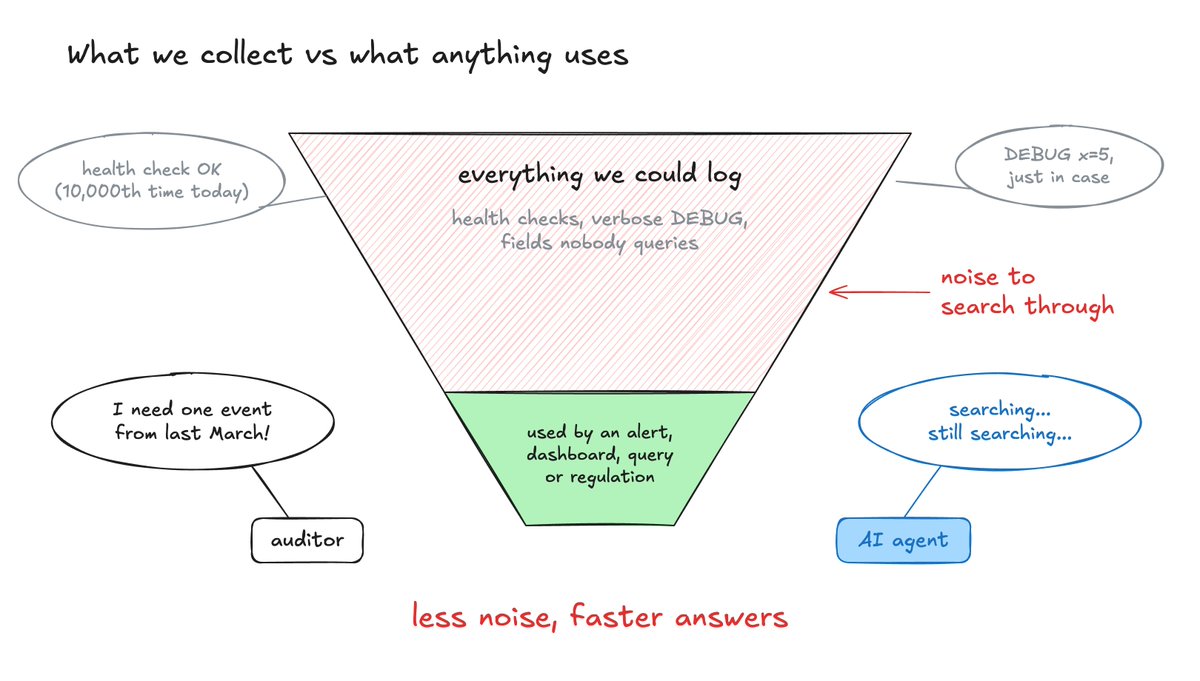
We log everything. Every request, every retry, every health check. Some months that's billions of log lines
Then one day you need one event from last March and all that just in case data is suddenly between you and the answer
What actually helps?
• drop patterns nobody queries → up to 50% less log volume
• store smarter, compression and log-specific index modes → up to 65% less storage
• fewer GB = faster answers, less for every query, search job or restore to read
A question I like asking: who actually reads this log? if the honest answer is nobody, just in case… it's probably noise
And if an AI agent is going to dig into your next incident, it's digging through the same noise. less noise, better answers right?
full article 👇
https://t.co/zuxCphtpsS
In regulated finance, how long we keep logs is mostly decided for us: PCI DSS, card dispute windows, DORA.
The harder question is what happens when someone asks for one specific line out of a year of them. https://t.co/pm5yuaDlrJ
The Tokyo Stock Exchange had to switch over within 30 seconds. On October 1, 2020, it stayed closed all day.
A short note on RTO, RPO, and why the number on paper is the easy part. https://t.co/jhFwBQ57RW
In regulated finance, how long we keep logs is mostly decided for us: PCI DSS, card dispute windows, DORA.
The harder question is what happens when someone asks for one specific line out of a year of them. https://t.co/pm5yuaDlrJ
In regulated finance, how long we keep logs is mostly decided for us: PCI DSS, card dispute windows, DORA.
The harder question is what happens when someone asks for one specific line out of a year of them. https://t.co/pm5yuaDlrJ
Perf win of the day: Claude Code CLI now uses 2x less CPU at p99.
Bun's garbage collector was running on a fixed timer, so it would kick in mid-turn and steal CPU right when Claude Code was busiest. Now it waits until the process is idle.
August has been a weird month for iximiuz Labs so far. Signups and playground usage are up compared to June and July. But the revenue is significantly down - way below the sustainability level.
To stimulate things a bit, I'm running the Fair Pricing pilot - you can pick your discount, no questions asked. If you've been considering upgrading your membership, now is a good time to both support the labs and get a good deal: https://t.co/XEtsFHeIFc
Reposts are much appreciated, too!
And if you don't know what iximiuz Labs is, it's an indie learning-by-doing platform where you can master Linux, networking, containers, and Kubernetes in interactive VM-based playgrounds.
Today, we are introducing Inkling.
Inkling reasons efficiently across text, image, and audio modalities. We are making the full weights available.
https://t.co/Ghebq5mG30
Available today for fine-tuning on Tinker. Play with it in the Inkling Playground. 🧵
My previous setup was Fable 5 for orchestration, Gemini 3.5 Flash for docs and repetitive edits, and Sonnet 5 for mid-level tasks. With Codex, I let Luna handle the whole implementation flow and used Sol mainly for review. Honestly, Luna performed far better than I expected for the lowest-cost model. (I haven’t used 5.5 that extensively.) Of course, I tested this on side projects, not production workloads
In large-scale and multi-tenant environments, I’ve seen plenty of gitlab. Azure devops is still common, but gitlab migrations seem to be increasing lately. Github is probably the one I’ve encountered the least, just based on my own experience btw. (Excluding open-source projects, I’m referring to enterprise environments.)