Pendle: B2C → Infrastructure Layer
This is actually the most interesting part of the integration.
Previously, if you wanted fixed yield through @pendle_fi , you had to:
- Go to Pendle.
- Buy PT-sUSDS.
- Understand how PT and YT work.
- Manage the position until maturity.
Now, with @SkyMoney
- Users simply open the Sky app.
- Click "Fixed Yield."
- Deposit USDS or sUSDS.
Everything else is handled by Pendle behind the scenes.
Technically, users are still holding PT-sUSDS, but Sky has packaged the experience into a simple native product. Most users may not even realize they are using Pendle infrastructure.
This matters because it shows Pendle evolving from a consumer application into an infrastructure layer.
In the past, users had to come to Pendle.
Now, Pendle is going to where the users already are.
This is similar to:
- Users don't need to visit Aave directly if lending is integrated into wallets or other apps.
- Users don't need to open Chainlink's website to use oracle data.
Pendle is moving in the same direction for fixed-income products.
What's even more important is that Sky is not creating the fixed yield itself.
The Sky Savings Rate (SSR) remains a variable yield product.
Pendle creates a marketplace where:
- Users who want fixed yield buy PT.
- Users who want exposure to future yield buy YT.
As a result, the fixed rate is determined by market supply and demand.
I think Sky is only the beginning.
If this model proves successful, we'll likely see more protocols integrate fixed yield directly into their products instead of forcing users to leave the app.
Aave and GHO are a natural example.
Imagine being able to lock a fixed yield on GHO directly inside the Aave interface, powered by Pendle infrastructure in the background.
Still accumulating $AAVE.
Aave is already widely recognized as the leading lending protocol in DeFi.
I think it's becoming something much bigger.
I think it's becoming the money app for the next wave of trillions in capital and millions of users.
The market is focused on applications.
I'm focused on the infrastructure those applications will need.
@aave already sits at the center of DeFi lending, but what interests me most is where it's heading.
Aave V4 introduces a unified liquidity architecture, replacing fragmented pools with a Liquidity Hub model that allows capital to move more efficiently across markets while supporting entirely new asset classes and risk frameworks.
That matters because the next phase of DeFi won't be built around a handful of crypto assets.
It will be built around:
• stablecoins
• yield-bearing dollars
• tokenized treasuries
• RWAs
• institutional collateral
• eventually AI-native economic activity
And all of those need battle tested always on credit. This is where Aave stands out for years already.
The protocol is increasingly positioning itself as the liquidity marketplace connecting borrowers, lenders, institutions and onchain capital.
You can already see early signals of this shift.
Assets like $frxUSD are a good example.
Frax is building genius compliant payment stablecoins, dollars designed to work at scale, 24/7, across both DeFi and real-world financial rails.
And this is already starting to show on Aave.
frxUSD is emerging as one of the most important stablecoin borrow assets in the V4 hub, reflecting where the market is heading and what it eventually needs.
Frax and Aave are actively building toward deeper integration.
As @samkazemian recently highlighted, the Aave partnership is a long-term strategy, not just a short-term liquidity play.
The implication is clear.
As DeFi evolves, the dominant borrow assets won’t just be volatile tokens.
They will be scalable, trustable, compliant dollars.
And Aave is building the system where those assets become core primitives and get connected to next wave of liq and users.
This is already starting to play out, with frxUSD as one of the most relevant borrow-side liquidity on aave v4
The implication is bigger than it looks.
The base assets of the next cycle won’t just be volatile tokens.
They will be productive dollars.
And Aave is building the system where they scale.
I also think the market is underestimating the significance of what was announced today.
Mastercard introduced Agent Pay for Machines, a framework for autonomous machine-to-machine payments, with Aave Labs participating alongside Coinbase, Stripe, Cloudflare, Polygon, OKX and others.
The key point is not just payments.
Mastercard is building the payment layer.
Aave is positioning itself as the credit layer.
As Stani put it:
"Aave brings the credit layer for agents."
Read that again.
Not payment layer.
Credit layer.
If AI agents eventually transact autonomously, manage budgets, borrow capital, earn yield and settle payments, they will require liquidity markets operating 24/7 at internet scale.
That’s exactly what Aave is building toward.
When people think about the future of digital finance, they often focus on the assets.
I think the biggest value will accrue to the protocols that provide the credit.
That's why I'm bullish $AAVE.
Relying solely on DeFi-native yield strategies carries concentration risk.
Sky Protocol has deliberately expanded beyond DeFi yield sources into structured credit, tokenized RWAs, energy infrastructure, onchain capital markets, and more, because diversification across uncorrelated sectors is what makes the yield base resilient.
Sky Protocol has always prioritized the security of the protocol and the protection of people’s capital above all else.
$39.69M deployed into Fixed Yield on Sky. money, built with @pendle_fi.
Set a fixed rate on the world’s largest yield-generating stablecoin.
Unlike variable yield products, your rate is set from the moment you enter.
Here’s how it works ↓
Sky has integrated Fixed Yield natively, powered by Pendle.
Users can now lock Sky Savings Rate to a fixed maturity at 4.75% APY, against a 3.60% variable rate, directly within the @SkyMoney app.
This integration embeds Pendle’s infrastructure inside the product surface of one of DeFi’s largest stablecoin protocols, extending Pendle from a standalone venue to a fixed-income layer that other protocols can integrate to expand their own offerings 🤝
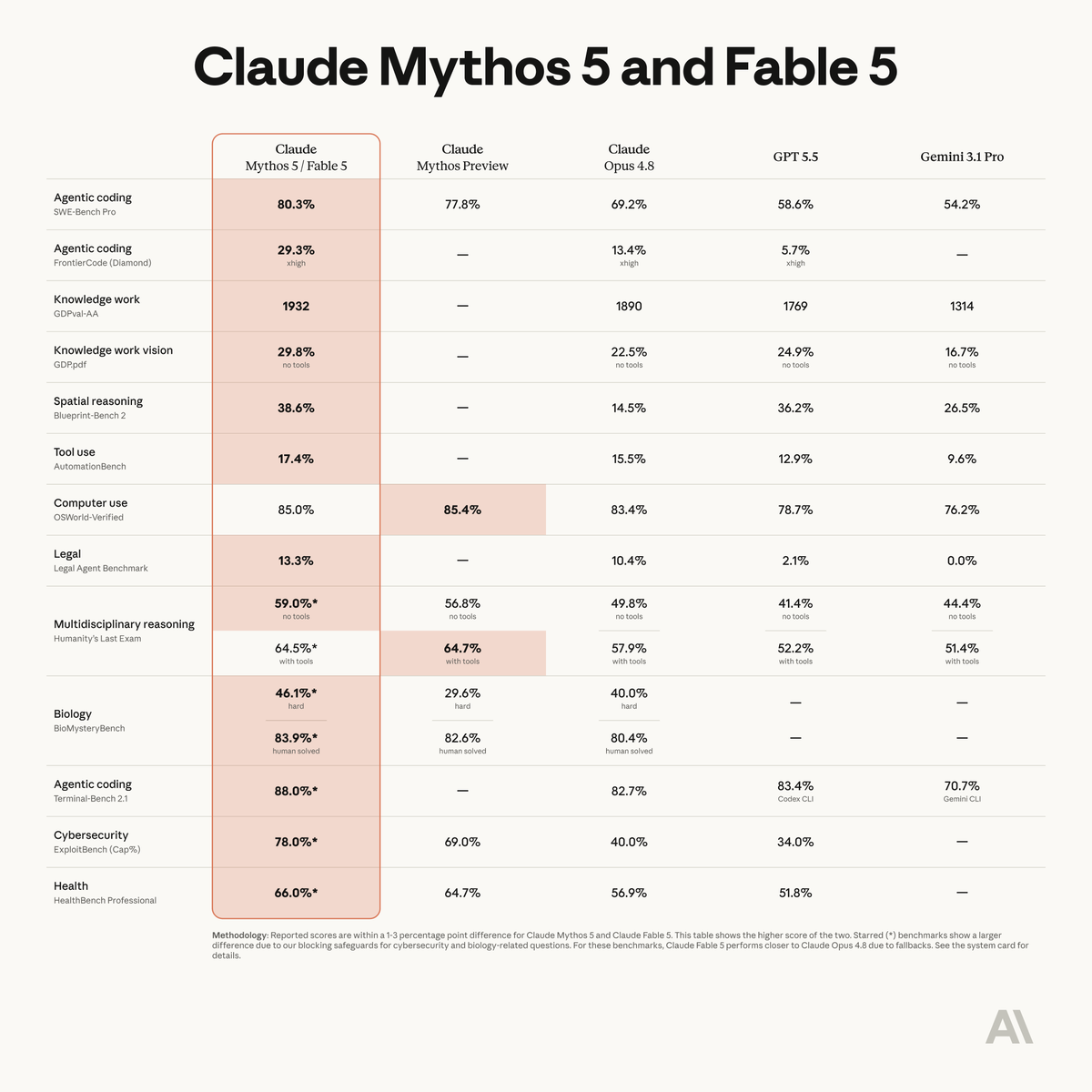
This is a super exciting release - Claude Fable 5 is the same underlying model as Mythos but with added safeguards. The benchmarks are great and it's SOTA on everything by a margin but I'll add that *qualitatively* also, this is a major-version-bump-deserving step change forward (imo of the same order as Claude 4.5 was in November), peaking especially for long problem-solving sessions on very difficult problems. You can give it a lot more ambitious tasks than what you're used to, the model "gets it" and it will just go, and it's never felt this tempting to stop looking at the code at all (but don't do this in prod!). The model still has quirks that people will run into and the safeguards are configured to be a little too trigger happy for launch, which can hopefully be tuned over time.
I feel a lot of things changing as working software increasingly comes out on a tap. The Jevon's paradox kicks in and I feel my own demand for software growing substantially. You can ask for anything - explainers, visualizers, dashboards, bespoke single-use apps (e.g. a full wandb that is hyper-specific just for your project), you can 10X your test suite, auto-optimize code, run giant research projects with custom HTML for the results, anything! "Free your mind" (Matrix ref). Really looking forward to all the things people build!
Introducing Claude Fable 5, our most capable public model ever.
Best-in-class for software engineering, scientific research, knowledge work, and vision.
Available today on all paid plans, in Claude Code, on the Claude API, and all major cloud platforms.
x402 is officially went live on Injective.
Now an AI agent can pay for what it needs the instant it needs it. No API keys. No accounts. No humans involved.
All payments settled with stablecoins onchain in under a second. Below is the walkthrough:
Protocols with both time in the market and sizable user positions prove themselves in periods of volatility. Throughout the volatility, Aave v3 and v4 operated seamlessly.
Since the 2nd June, @aave has processed over $212M in liquidation volume, of which $163M was routed via Chainlink's Smart Value Recapture (SVR). More than half the volume was wETH collateral.
The SVR volume generated $3.83M in Fees, split 60:40 with @chainlink, with ~$2.5M to Aave DAO and ~$1.34M to Chainlink.
With several instances of Aave Protocol to come online in the near future and SVR not yet fully rolled out, one possible way for the Aave DAO to expand revenue is to extend SVR.
Furthermore, enhancing the UX by providing tooling and features that help users better manage positions autonomously is a welcome improvement and would likely shift one-time revenue spikes towards more consistent SaaS like recurring revenue streams.
I'm not saying $BTC can't go lower.
We could very well hit 45-50K into August.
I'm simply stating that 1-2 years from now, people are going to wish they had bought more.
They'll wish they had acted sooner and spent less time hesitating.
At some point in life, you have to be bold.
He who is not courageous enough to take risks will accomplish nothing in life.