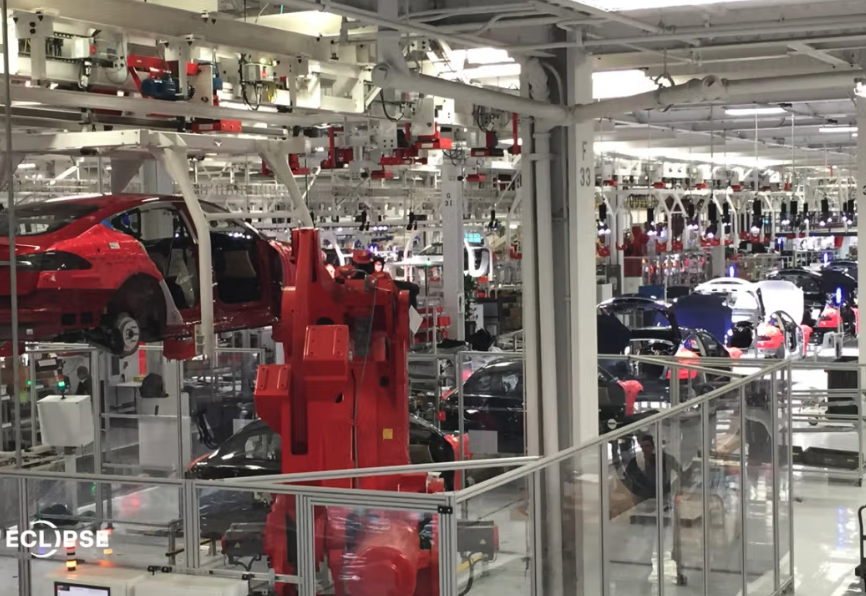
Eleven years ago we started @EclipseVentures and bet everything on atoms. Rockets, robots, chips, factories, power systems, defense. The things civilization actually runs on.
Today, we're announcing $1.3B in new capital to keep building.
The physical world is overdue for transformation. Transportation runs on systems designed decades ago. The energy grid cannot keep up with demand. Healthcare depends on manual procedures that don't scale. Defense development moves at a fraction of the speed threats evolve. These are not software problems. They are full stack engineering and operations problems, and they have been underinvested in for a generation.
But there has never been a better moment to solve them. The best engineers are leaving big tech to build in the physical world. AI is compressing timelines from years to quarters. Policy is aligned. And customers are not waiting — the DoD, the hyperscalers, hospitals, and the Fortune 500 are all desperate for technology that makes physical systems smarter, faster, and more resilient. Talent, capital, technology, policy, and demand are all converging at once.
This is our moment 🇺🇸
We built Eclipse for this exact moment and in doing so, we launched a movement. Today that movement is 100 companies strong (and growing!). These companies supply each other, share customers, and help solve each other's hardest problems. Propulsion systems powering orbital defense. Modern supply chain infrastructure moving the worlds goods. Autonomous vehicles on three continents. Surgical robots performing procedures that used to require the world's best hands. Cloud hardware powering the AI revolution built on American soil. That's not a fund. That's an economy — an Eclipse Economy.
The door is open to rebuild the physical infrastructure of the country. We intend to run through it.
What happens when world-class autonomy founders partner with deep industrial expertise before a company is even formed?
@BedrockRobotics.
From market exploration to company formation, Eclipse helped shape the path from concept to category leader in construction autonomy.
Read more: https://t.co/d5S1VnGEQN
Israeli networking company DriveNets raised a $410M Series D led by Bessemer and Atreides at an $8.5B valuation, taking its total funding to ~$1B (@meirorbach / CTech)
(Visit Techmeme dot com for the link and full context!)
Introducing Wayve Labs - our frontier research unit dedicated to advancing embodied AI and solving the hardest and most important open problems in machine learning. https://t.co/VCc4fuLgZQ
We are back again :) After three weeks of quiet building.
Introducing Genesis World 1.0, our latest simulation platform, the second release in our full-stack suite. Open-sourced.
Robotics is still bottlenecked by the 1× speed of the physical world. Every model, checkpoint, and data recipe eventually needs to be tested on physical hardware, slowly, expensively, and with limited coverage.
One hour in reality can become 100 days in simulation. That is how robotics model iteration moves from a wall-clock bottleneck to a compute problem.
To make this work, simulation has to be both fast and trustworthy.
Over the past year, we rebuilt the entire stack: a GPU-accelerated cross-platform compiler, penetration-free multi-physics contact solvers, unified rigid and deformable physics, and a photo-realistic renderer purpose-built for physical AI applications.
We built Nyx, a high-performance path-traced rendering engine for robotics application.
Genesis World 1.0 achieves near realtime performance with our latest development for penetration-free IPC solver, supporting various types of deformables beyond rigid bodies. It supports contact-rich, dexterous manipulation simulation across different embodiments: unitree, sharpa, wuji, genesis hand and various types of grippers.
Under the hood is Quadrants, our effort in pushing forward cross-platform GPU-accelerated computation. Quadrants started as a fork of Taichi, and we rebuilt most of the critical parts for optimizing simulation workloads, giving 10x faster launch time and up to 4.6x runtime performance compared to the initial Genesis release.
Together, they bring us to an unprecedentedly low sim-to-real gap, enabling zero-shot real-to-sim model evaluation and much faster iteration of GENE.
All available today.
Genesis World 1.0: https://t.co/aknCM3eqws
Quadrants: https://t.co/uXqPNI4cb6
Nyx: https://t.co/R8j0djqGnV
“Design for manufacturability” sounds smart until it becomes an excuse to optimize too late.
The best hardware companies don’t bolt manufacturing on after design. They embed manufacturing, suppliers, and process engineering from day one.
The latest piece from Eclipse Partner Greg Reichow's Industrial Scaling Playbook breaks down why:
• 70–80% of manufacturing cost is locked in during design
• Ramping with unresolved manufacturability issues destroys capital efficiency
• Great engineering teams remove parts and complexity instead of adding them
• The companies that win innovate in BOTH product + manufacturing
In hardware, quality and scale aren’t downstream problems — they’re design decisions.
Read more: https://t.co/Shctcs9aII
We proudly fly the True Anomaly flag next to the American flag to reflect our service to the men and women of the U.S. Armed Forces.
Today, it is a reminder to pause and reflect, remember, and honor the brave. We are forever grateful for those who serve our country.
We look forward to serving them for years to come.
Happy Memorial Day.
I recently joined the team at @gs_ai_. The Founders, @zhou_xian_, @theo_gervet , @yilingq97, @johnsonwang0810, and @Zhenjia_Xu are just incredibly talented and thoughtful humans. It's a privilege to work with them and the incredible team being built at Genesis. We're hiring! 🤖
Almost a decade ago, Scott Wilson, the chief investment officer at Washington University in St. Louis, placed about $50 million of the school’s money in SpaceX. https://t.co/48K5TPqJJL
I am thrilled to announce my return to a16z as a full-time General Partner. Having made a full recovery from cancer and navigated some of life’s most taxing personal hurdles, I am returning with a sharpened sense of purpose and a deep optimism for the future, both personally and professionally.
My time away reinforced that living to one's fullest capacity requires doing what you love with the people you trust. While I’ve continued to support my boards and founders, I’ve realized my greatest impact happens when I am 'all in.' I believe he current pace of innovation in infrastructure is unmatched, and I couldn't be happier to be back in the trenches with my colleagues and close friends on the a16z Infra team.
Wayve just signed @Stellantis. The @wayve_ai Driver going into the STLA AutoDrive platform. First production vehicles in North America in 2028.
Stellantis ships ~5.5M cars a year. Jeep, RAM, Chrysler, Peugeot, Fiat, Citroën, Alfa, Maserati.
Wayve isn't providing incremental tooling for OEMs, they provide the driving intelligence inside the cars that ship to customers around the world. This is where the economic value in modern automotive lives. Signed, multi-year driving autonomy production programs at global scale. That is the prize.
In the last 18 months Wayve has become the OEMs champion for production driving intelligence, and their momentum in the past six months alone is incredible: Signed production deal with @Nissan. @Uber commercial partnership and 300m investment. @Qualcomm commercial partnership and investment. Investment from @AMD@Arm and @nvidia. And more to be announced....
End-to-end driving autonomy is going global. Wayve is the one putting it there.
Well done @alexgkendall and the entire Wayve team!
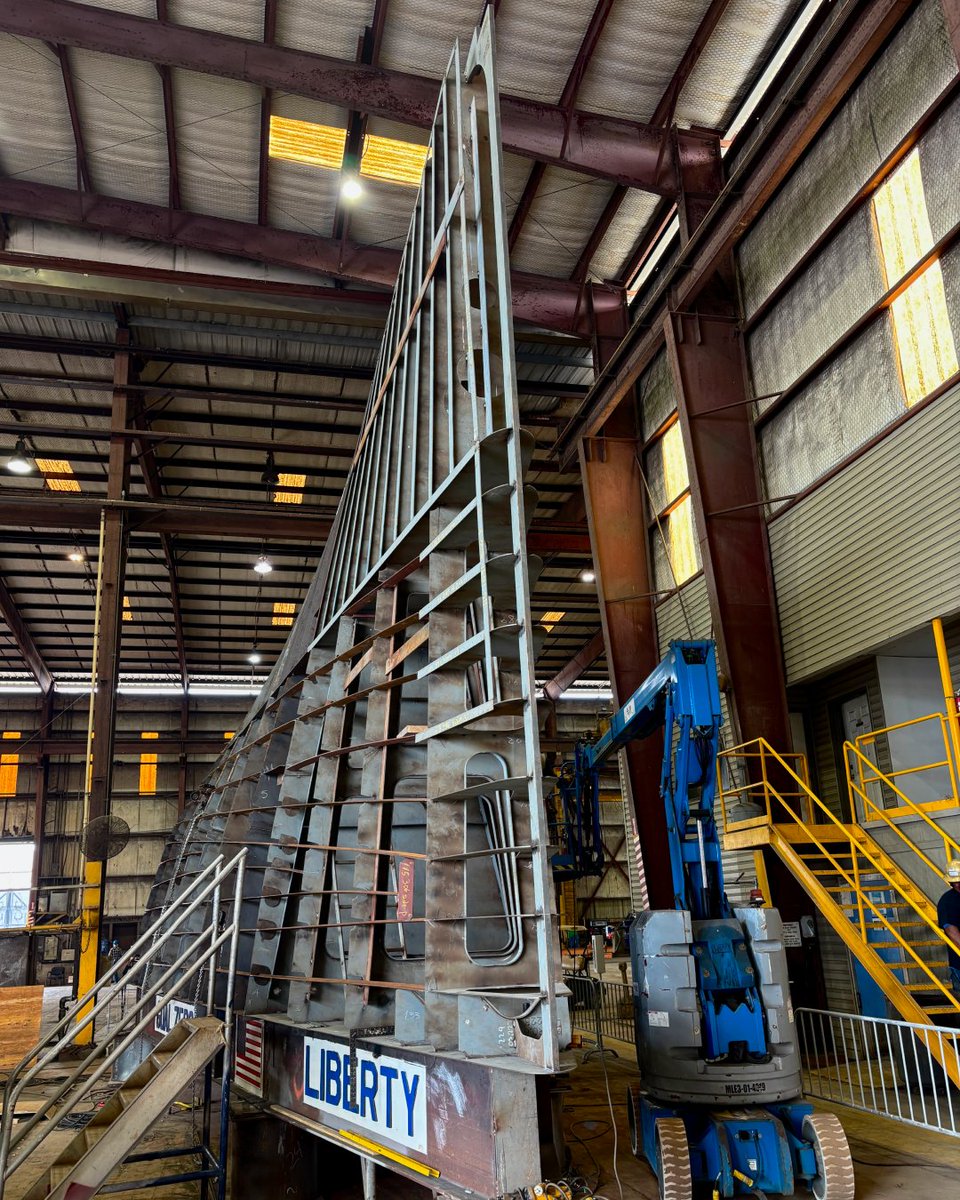
The future of maritime autonomy is being built in America.
Ahead of next week's #Sail250 New Orleans events hosted by the New American Industrial Alliance, including a tour of Conrad Shipyard, we're excited to share a preview of Blue Water's Liberty Class MUSV (Medium Unmanned Surface Vessel). With a proven steel @damen Axe Bow, and strong shipyard momentum behind us, our hull is quickly taking shape at Conrad.
See you on the water.