In our new paper we challenge the idea that it is "harmful gender norms" that cause sex differences in health & well-being.
https://t.co/QjGWqsyeBu
New paper out with @SeveriLuoto and @Dr_Phil_K.
Sex differences in romantic love: an evolutionary perspective.
It fills a long neglected gap in the literature on sex differences and human mating...
https://t.co/Ft9quv463i
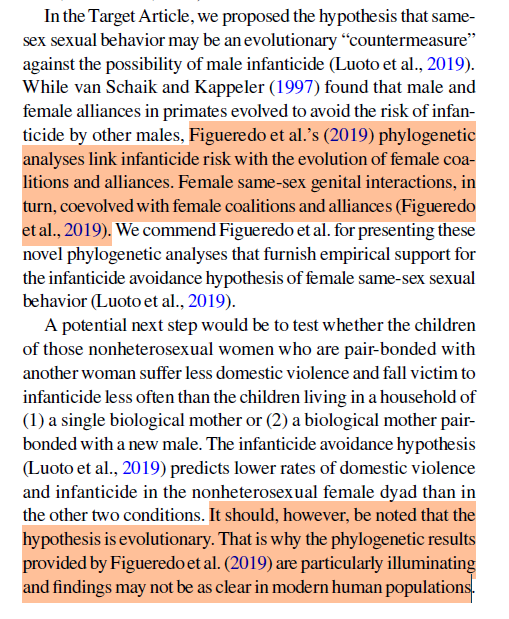
@AdamBode4 @RandomMutations We found Figueredo et al.'s results particularly insightful, and commented on them in our Response to Commentaries (https://t.co/Ghlos9bREN) as follows:
@AdamBode4 @RandomMutations@RandomMutations, please have a look at Figueredo et al. (2019), as they tested our infanticide avoidance hypothesis:
Figueredo et al. (2019). Do the Predictors of Atypical Sexual Orientations in Women Generalize Across Different Evolutionary Tests?. Archives of Sexual Behavior
Prior research has found no evidence to support the idea that astrologically compatible couples are more likely to marry or less likely to divorce (Helgertz and Scott, 2020) or that astrological signs are correlated with personality traits and job performance (Lu et al. 2020).
Despite widespread belief in astrology (e.g., ~30% of Americans reportedly believe in astrology), it has garnered limited to no empirical support.
A new study finds no association between people's zodiac signs and various measures of well-being.
https://t.co/0eojrvRdNv
"The editors of Nature have assigned to themselves the purely subjective task of judging which scientific research 'stigmatizes' some social group, and have empowered themselves to suppress valid scientific contributions on that basis."
—How ideology threatens to corrupt science
I am currently finalising a book on the evolution, biology, and treatment of depression with M. J. Rantala but we have some differing views on the best title option. Putting this poll out there to gauge what would be the most informative or interesting title from the reader's pov
The best title option for a book on the evolution of depression?
1. Grim Dispositions: The Evolution and Biology of Depression
2. Evolution and Biology of Depression: Natural Treatments for an "Unnatural" Condition
3. Depression: Evolution, Biology, and Treatments
4. Other?
New Research: The effect of yin yoga intervention on state and trait anxiety during the COVID-19 pandemic: Introduction
Although some findings indicate that yoga can reduce stress and anxiety, many studies present mixed results. The… https://t.co/bZ2hRPobN9 #Psychiatry
@ImHardcory Couldn't agree more. Without such transparency, the ideological takeover of many scientific journals erodes researchers' and the general public's trust in the journals and science itself.
3. Scientific censorship distorts understanding of empirical reality, can turn well-intentioned interventions into little more than a waste of time & resources (or worse), and gives the public good reason to distrust and disregard scientific findings and recommendations.
@EPoe187 —and the view is at once sobering and comical. If sub specie aeternitatis there is no reason to believe that anything matters, then that does not matter either, and we can approach our absurd lives with irony instead of heroism or despair.”
- Thomas Nagel
@EPoe187 “Humans have the special capacity to step back and survey themselves, and the lives to which they are committed. Without developing the illusion that they are able to escape from their highly specific and idiosyncratic position, they can view it sub specie aeternitatis..."
O, how shall summer’s honey breath hold out
Against the wrackful siege of battering days,
When rocks impregnable are not so stout,
Nor gates of steel so strong, but Time decays?
O fearful meditation! where, alack,
Shall time’s best jewel from time’s chest lie hid?”
—Shakespeare
They conclude by discussing how modern technology, such as social media and online dating, has decoupled the evolved psychology underlying partner evaluation from the adaptive behavior that it has historically produced, thereby creating evolutionary mismatches. 6/6
“Since brass, nor stone, nor earth, nor boundless sea,
But sad mortality o’ersways their power,
How with this rage shall beauty hold a plea,
Whose action is no stronger than a flower?"
Chapter 2 – Physical Cues of Partner Quality
@IanDS4@SeveriLuoto
https://t.co/TphJ3TAjxU
Dr. Ian Stephen is a powerhouse in face and person perception, and Dr. Severi Luoto is, imho, a cutting mind in the evolutionary sciences. In this chapter... 1/6
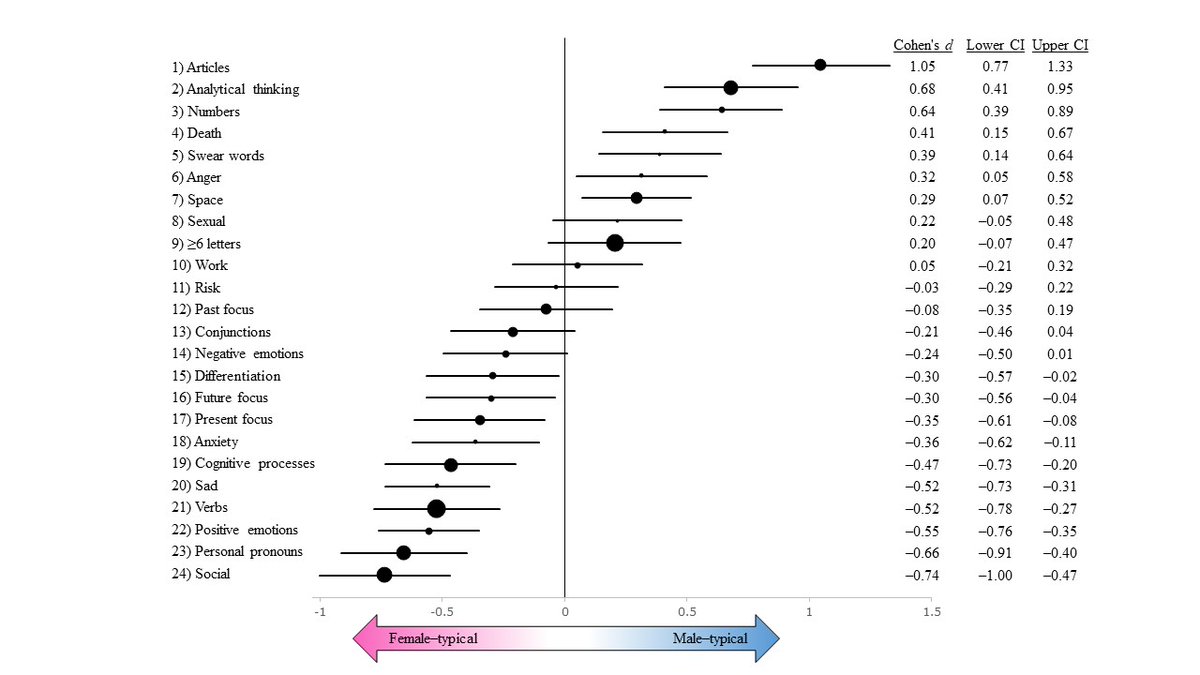
@datepsych Language use from a sample of over two centuries of literary art provides additional evidence on the kinds of psychobehavioural sex differences that are consistently reported using psychological tests:
https://t.co/Ztec6rIGno
As was predicted based on existing psychological research, heterosexual female authors used more:
- social words
- personal pronouns
- positive emotion words
- sadness-related words
- anxiety-related words
...than heterosexual male authors
3/n
@leilamechoui@datepsych Psychological sex differences are also reflected in the psycholinguistic patterns of language use in over 200 years of literary art:
https://t.co/q3yU0I5D1G
Psychological sex differences are reflected in language use in two centuries of literary art.
Likewise with sexual orientation differences.
New article out in @FrontPsychol, reporting the main results of my PhD research.
1/n
https://t.co/klPiC3I9fd