Introducing interpolated FID: an variant of reconstruction FID that is highly correlated to diffusion generation FID.
It is well known that VAE rFID is not correlated with diffusion gFID. We propose a simple variant that achieves correlation 0.9!
https://t.co/Ml1Ig0Ocog
Excited to announce that our paper on efficient diffusion models has been accepted to NeurIPS! Huge kudos to @ShadyAbh for the incredible work. Developing carefully the math and implementing it to achieve strong results took a lot of effort, and it great to see it pay off!
@fywang0126@RGiryes In general you want to decrease the number of steps as much as you can for efficiency. However, if you want to increase it anyway, you will need to omit H in some of the diffusion steps. Which is an interesting direction that combines both worlds.
(1/6) 🌟 New Paper! 🌟
Is it possible to sample images from a diffusion model using less than one step?
Answer: Yes! ➡️ We present UDPM, a novel approach to image generation that outperforms existing models in efficiency and quality. 🚀📊
https://t.co/q60cCevuJJ
@fywang0126@RGiryes You mean progressive GAN? it draws inspiration from it, but it is very different, we reformulate the diffusion generation scheme such that in each step you solve SR + denoise instead of just denoising.
(5/6)
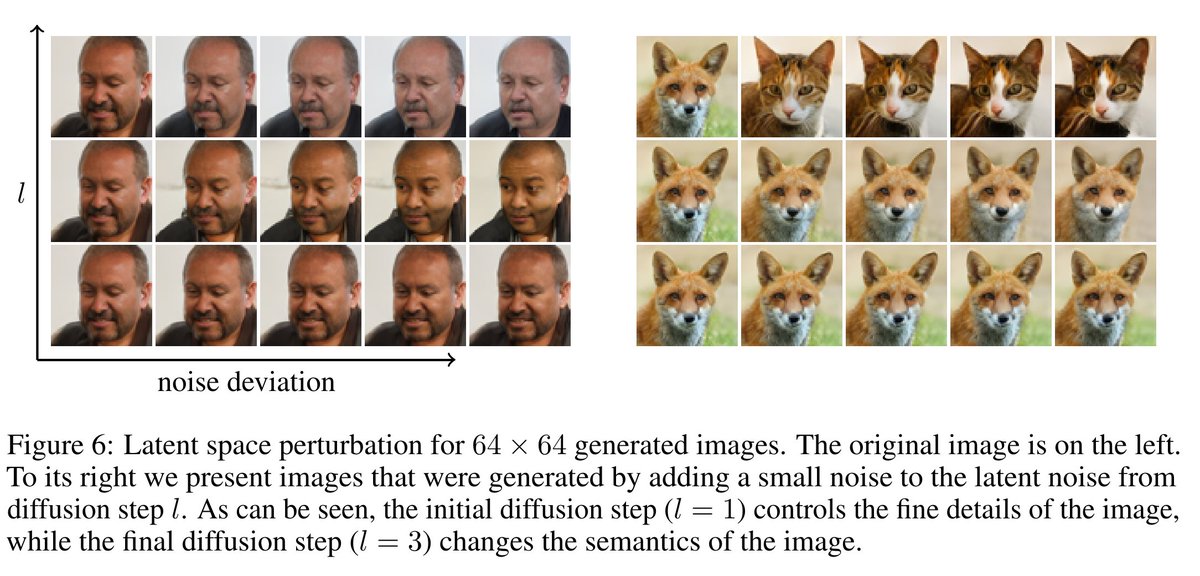
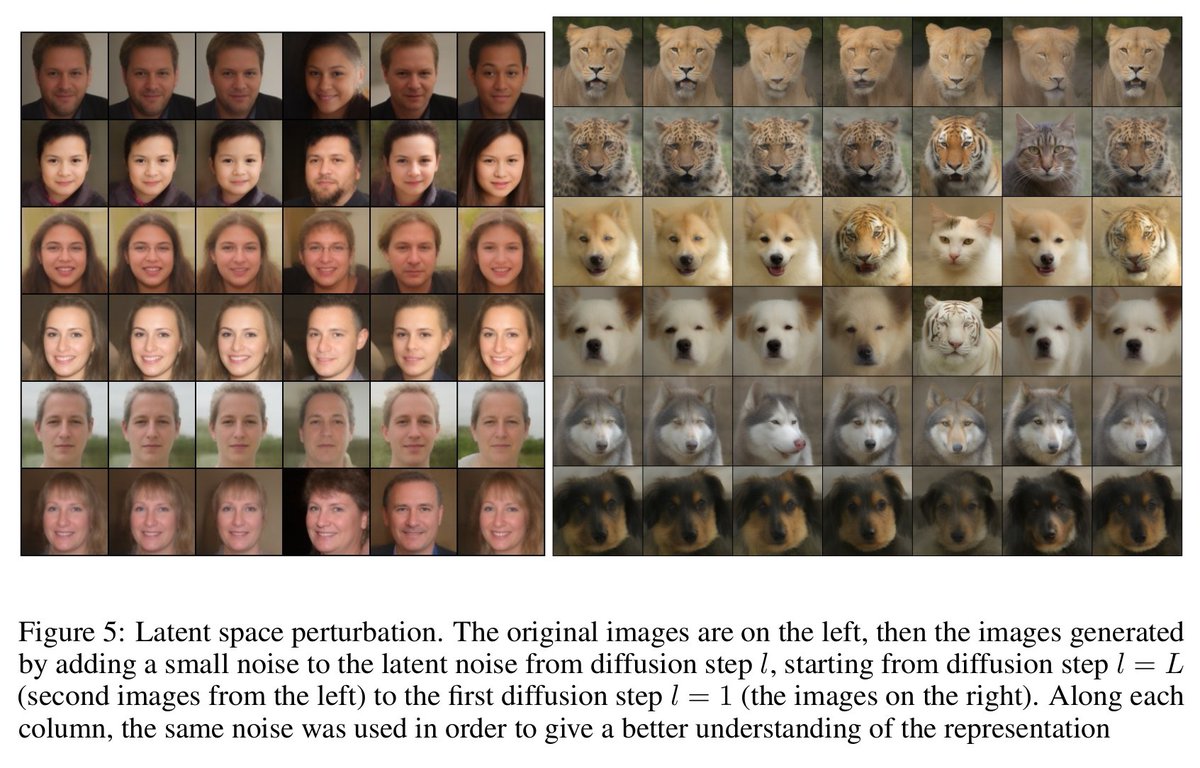
* UDPM has an interpretable and interpolable latent space, making it superior to traditional DDPMs in various applications. 🌐🔍
* UDPM has smaller latent variables, hence one may modify the noise maps of each step and study its effect on the generated image:
New Work! 🐍
What prevents Mamba from extrapolating to sequences that are significantly longer than those it was trained on?
Furthermore, can Mamba solve long-range NLP tasks using short-range training only?
🧵🧵🧵
I like the idea behind "Upsampling Diffusion Probabilistic Models" (https://t.co/xwub579qQd).
Instead using a fixed sized noised sample, use a smaller sized sample for noiser timesteps
@baaadas@chenlin_meng@ArashVahdat In addition to the lower number of diffusion steps, the spatial dimension of the latent variables is smaller, which allows us to better interpret the latent space.