Assistant Professor @UTSWBrain. Using electrons to dissect how proteins behave and misbehave in the brain. Engineering new tools for cryoEM in situ. ⚙️🧠❄️⚛️🔬
MK-6240 is a PET imaging agent that can discern subtle early-stage Alzheimer's brain changes. How does it interact with Alzheimer's tau filaments at a high-resolution molecular level? 🔬⚡Read on and check out our bioRxiv article:
We develop an epiblast complementation strategy that enables the generation of mice from PSCs in a single step. With further optimization, we hope to develop this approach into a broadly applicable platform for generating genetically engineered mice and potentially other species.
Our multi-immersion oblique plane microscope manuscript is online now.
A light-sheet system that can be adapted to different imaging tasks, including a continuous volumetric correction for imaging in media of (theoretically) any refractive index.
https://t.co/eb5nVlmP6l
Our first protein 🥩 design paper! 🤠
Check out Minkyu's tour de force on T-REX 🦖, an agentic protein design controller for de novo binder design!
TLDR we treat protein design as an online allocation problem over heterogeneous tools (Proteina-complexa, Boltzgen, Bindcraft, ✨ etc), use 🤖 agents to reason over what tools + settings to run, designed a granular classification system to manage the agents (e.g. Rescue🛟/Explore🔎/eXploit🚀), that is all orchestrated with a deterministic controller to efficiently brrr the GPUs. 💸
T-REX 🦖 is fully open source: https://t.co/qDVsN5l8Qr
Preprint: https://t.co/DkKbbybHb6
Please let us know if you have any feedback!
We proudly present our latest paper: “Ligand-induced activation of RyR1 in native membranes” RyR1 is a key protein in the excitation-contraction coupling of skeletal muscle and the largest membrane protein in humans. Paper here, thread below:
https://t.co/zFjQIEvqJI
@JasonSynaptic Such a beautiful and refreshing capture! You've inspired me to dust off my camera and revisit my shots, too. Have neglected mine for the past year as well!
What a fun surprise to find that our work has been featured in a @JCellBiol spotlight!! Many thanks to Carlotta Peselj and Nora Vögtle for the great write up!
New preprint from the lab, led by the ever-talented grad student Tessa Lochetto
@tloch_! We find that loss of Pptc7 decreases lean mass, induces skeletal muscle dysfunction, and causes metabolic derangements in adult mice: https://t.co/sDqmMBwcWc /1
@nieminm@tloch_ Beautifully designed experiments, and very cool results. Congratulations to you, Tessa, and your whole team! Hope all is well, Natalie!
Proud to see our work featured! Grateful to my thoughtful and hardworking team, and to our wonderful collaborators who make this work possible. Stay tuned, we’re excited to share some of what we’ve been working on as preprints later this year! 🤠🔬🧠
Exploring the brain one neuron at a time, the @ShahmoraLab uses nanoscale imaging to uncover how neurodegenerative diseases like Parkinson’s and ALS begin and progress. Learn about the Shahmoradian Lab and its groundbreaking research: https://t.co/hhVYSxlarb #UTSWMeetTheMinds
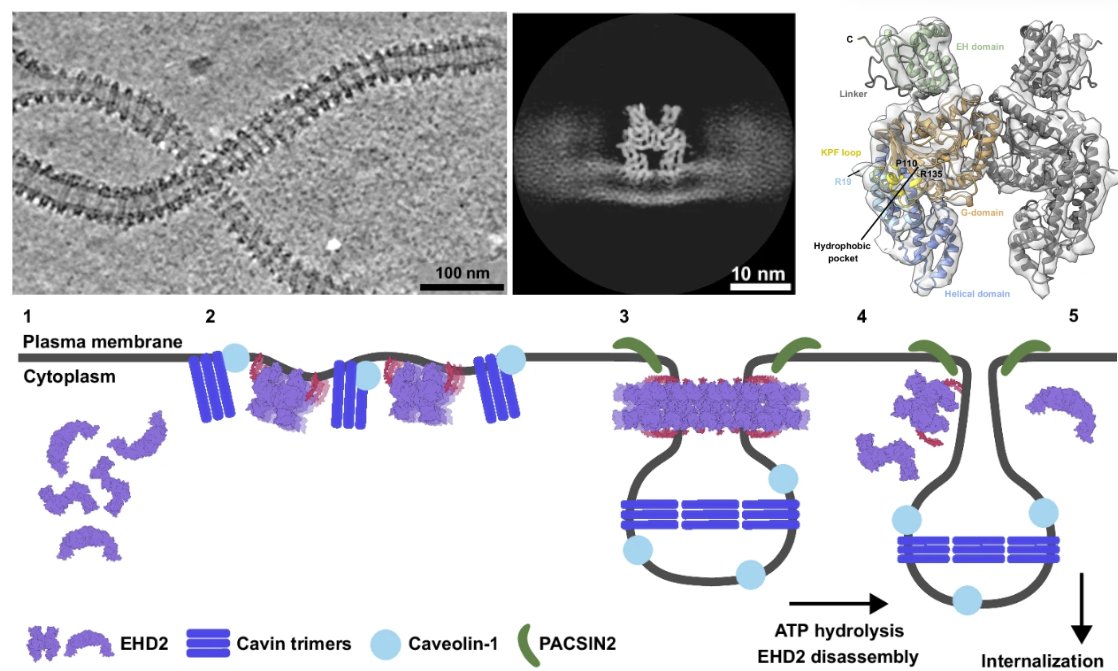
Take a look at our new paper on the structure of the EHD2 that, upon oligomerization, forms rings that remodel the plasma membrane and form caveolae.
Beautiful work by Elena, Vasya @v_mikirtumov, Jeff & Oliver Dumke's team; take a look: https://t.co/C23q4ayvdy