Author of "The Full measure - What Every Civilisation Measured and Ours Forgot: A Twenty-Dimensional Replacement for GDP". And a bunch of stuff.
DMs welcome.
Today I release my Magnum Opus. I call it that as I am unable to imagine that I will ever be able to create anything of greater value for the world.
It is a complete and measurable replacement for what we call "the economy" that keeps everything that we actually value.
https://t.co/2bB1V3dL9D
@IMurtazashvili NO! People don't make things up and always tell the truth and fully comprehend what they read and read everything fully that they cite. /s
@scottnarmstrong@kasthomas Yeah, that's exactly what you said... /s
You didn't at all say that papers should have a modern/AI equivalent of spell-check or checked by a calculator....
I would say that this list contains some universal and fundamental truth about reality. But it also compresses many things far too much. And compression always leads to information loss, and losing this much information about "everything" is a substantial loss.
Furthermore it uses very technical language to try to describe things which I think could/should have much more "human" explanations.
I think that the list might be a useful distilled list if, and only if, deep conversation and thought about each point comes first.
I suspect that most people reading it will see it as "skitzo babble" :)
It very much resonates with my framework! According to the paper (which is now an unreleased book) harm should be tracked on 8 separate dimensions rather than a mono-axis of good/bad. Each choice that anyone makes is 8 harm profiles (X being harm amount and Y being time, for different categories of harm).
So not buying meat would for example lower my harm profile for most metrics of animal wellbeing while (unless balanced for) raise my harm profile to myself (maybe less nutrition?) and risk damaging relational harm (towards people in my life who feel alienated from my choice) and so on.
What my framework does it to try to highlight that nothing is as simple as good/bad and that every gain has a cost. As far as I know it's the first framework that is plural without equivocation (saying that at's all equally good/bad)
FUCK!!! After identifying The Industrialisation of Animal Agriculture as case 7 in my ethics paper and mapping the harm as unprecedented scale for sentient beings across all 8 harm dimensions, I was not able to buy meat today... I love the taste of meat, lab grown better come soon
I think that they might be more right in principle than most suspect. Their fault was to translate it into a language that isn't recognizable to mathematicians.
My; Finite Philosophy, Bounded First-Order Logic, Bounded Set Theory , Bounded Number Theory (and more) does what this also does (which is to bound mathematics from first principles) but in a language that requires almost no re-learning for each profession.
Today I release my Magnum Opus. I call it that as I am unable to imagine that I will ever be able to create anything of greater value for the world.
It is a complete and measurable replacement for what we call "the economy" that keeps everything that we actually value.
https://t.co/2bB1V3dL9D
When I say that I am unable to imagine that I will ever be able to create anything of more value I mean that in the most literal sense, and my imagination stretches far and wide.
Not even sci-fi imaginations of replicator technology (which would be able to provide everyone with the materials they need), large-scale teleportation (which would not only eliminate all needs for transportation and the dames it cause, while also possible allow humans to span across the universe with ease) or time travel (somehow, without the harm and negative consequences and paradoxes).
What is provided above is the start of a course correction for humanity. It combines the bounded reals, R_B(k), with the eight measurable dimensions of harm and the 12 measurable dimensions of excellence.
It is a reclamation of many things that has been lost to history, redefined in a secular and measurable way and written in a language that any person that is somewhat proficient in reading (not "economics") can understand and follow all the way through.
It is a preprint edition of 57 chapters, 408 pages. Each thoroughly sourced to history to retrieve what was lost. Clearly defined and measurable across all 20 identified dimensions that matter for humanity.
It draws not only on history and every great work of modern economics and all the great works for what the measurement misses but also on the frontiers of science for understanding ourselves in different aspects.
It is also clearly actionable across every part and level of society. From the dinner table and conversations with your children. Through corporations and municipalities, to the national institutional level as well as the international.
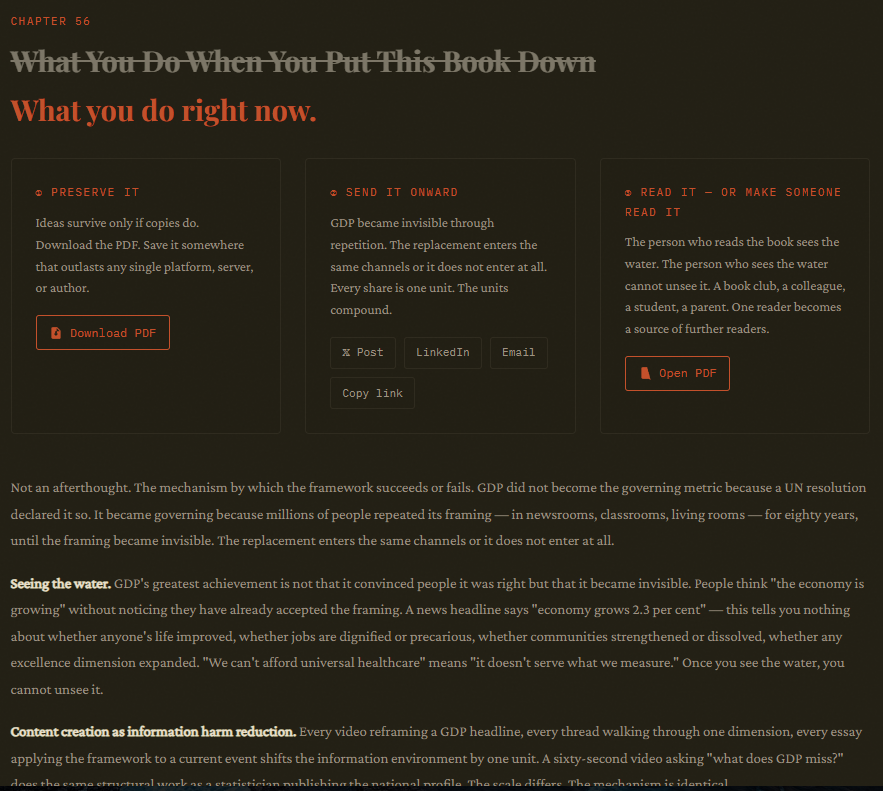
Reading the overview page for the entire book makes each chapter clear with the utmost punch and precision to enable you to see that water that we are all swimming in. It takes 30-40 minutes to read the overview.
When read with intellectual honesty, even just the overview on a lunch break, it will change your perspective on the world in ways you cannot yet imagine. I challenge anyone to claim otherwise.
To make it clear: this is not a patch on GDP, it is a measurable and actionable replacement for what we perceive as "the economy".
#economics #Economía #EconomicData
@PhilosophieW@duncanreyburn Hi Norbert! I have a whole range of plausible answers that you might find interesting :)
For this specific debate the plausible answer is here (other plausible categories are also available on the website): https://t.co/JdKVetQn66
@duncanreyburn The whole framing of consciousness is wrong and a category error.
It was never what Descartes meant by the term.
It is not needed to explain everything that we are.
It has not met any burden of proof even though we've tried for 300 years.
https://t.co/JdKVetQn66
@MaskedMelonUsk Thanks! For AI, chapter 37 does a comparative analysis for each of the 12 dimensions of excellence and AI testing. It clearly identifies and names the gaps that AI currently has compared to what we view as the important parts of being excellent.
Ethics was defined through 8 harm profiles, it did not make the positive assertion of what should be strived towards (other than minimising harm).
**The Varieties of Human Excellence** is an early draft of a 41 chapter book of 230 pages.
https://t.co/sR879qIiq6
@drummatick What this also results in as a finite mathematical foundation (just like mine :) ) since all computation terminates. It basically just has to say that it terminates or mathematicians will smuggle in the assumption that it never does.
I have 9 pages of notes for refinement for chapters as well as a structural change of folding chapter 19 into chapter 1 to make. Also move the chapter notes for references from the chapters into a references section and create all the stated appendices.
Still, with all those "issues" (that might not be clearly observable issues to most) I still think that this is the most complete mapping, measurably defined and actionable work on the concept of what makes a human excellent.
@fredleept Haha! That's a very appropriate comeback :D
I was hoping, since I didn't claim the initial position, that you (the one making the original claim) would provide the evidence. Otherwise it seems like the burden of proof is reversed :)
Again, really mean no offense
@DaveShapi I agree with the notion. However I question the "evidence of cognitive decay" on equal terms as I would studies that only highlight the negative effects of exercise
@fredleept While I understand where you're coming from, I don't believe that your claim has rigorous support. I'd be interested to see supporting evidence for your claim but at this point it seems at least equally likely that your position is local confirmation bias...
No offense meant :)