most writers make liars of themselves
not on purpose: they just forget to fire Chekhov's Gun
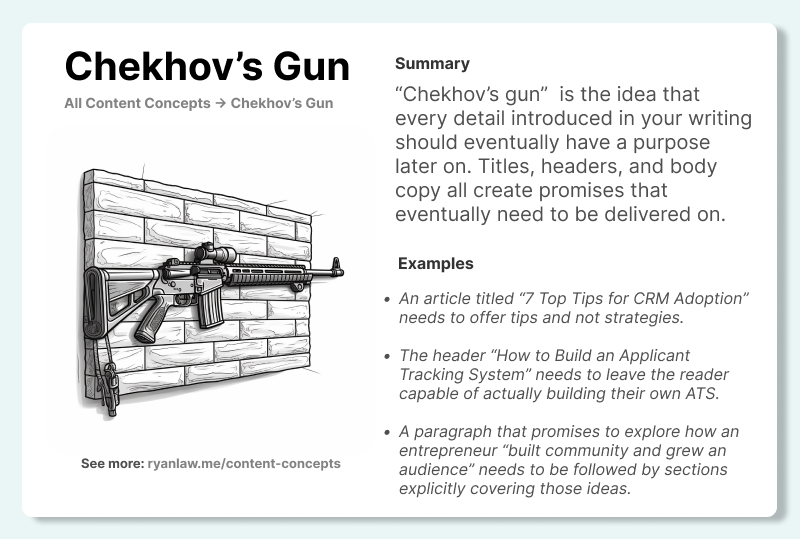
Chekhov's Gun is the idea that any notable element or detail within a story has to have some impact on the plot
if it disappears into obscurity it creates false promises that leave the audience feeling frustrated or duped
the canonical example is a pistol hung on a wall: if noted, it has to be fired
the concept is attributed to Russian playwright Anton Chekhov:
"Remove everything that has no relevance to the story. If you say in the first chapter that there is a rifle hanging on the wall, in the second or third chapter it absolutely must go off. If it's not going to be fired, it shouldn't be hanging there."
there's a very literal application of this idea in Breaking Bad S8 (spoiler ahead). Walt buys a machine gun in episode one, and in episode sixteen, he finally puts it to use, offering an answer to the question posed fifteen episodes prior
in content marketing, Chekhov's Gun illustrates the idea that we have to deliver on the promises created by our writing:
~ an article titled “7 Top Tips for CRM Adoption” needs to offer tips and not strategies
~ the header “How to Build an Applicant Tracking System” needs to leave the reader capable of actually building their own ATS
~ a paragraph that promises to explore how an entrepreneur “built community and grew an audience” needs to followed by sections explicitly showcasing how they *built their community* and *grew their audience*
it isn't enough to write words because they sound coherent within the context of your article
every title, every header, every descriptive turn of phrase has the potential to either satisfy or frustrate your reader, to deliver on a promise or ignore it (and make a liar of yourself)