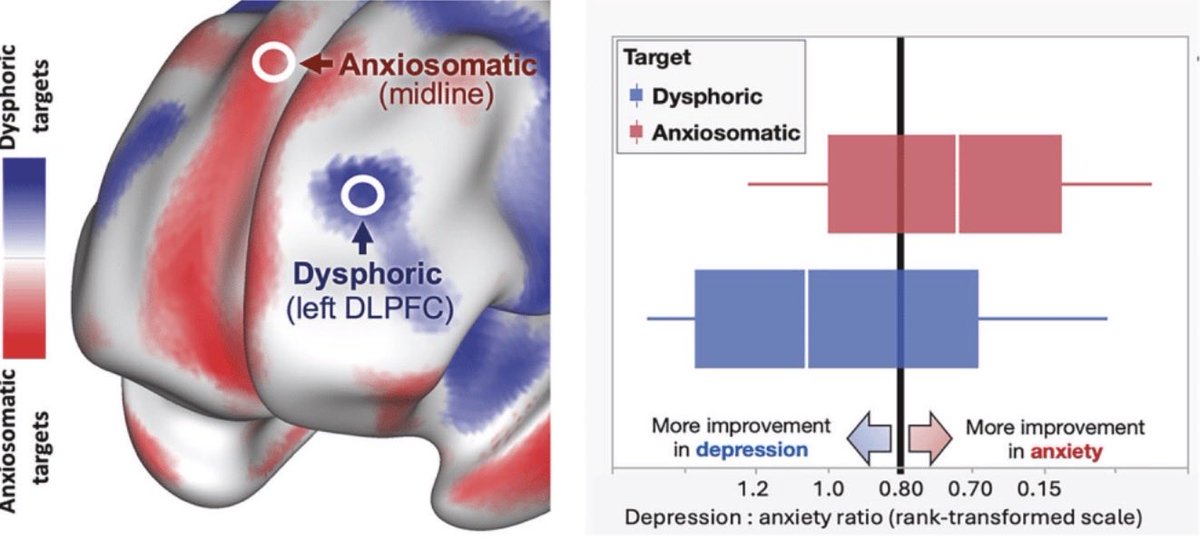
Our latest in @molpsychiatry: In patients with anxiety+depression, targeting a novel “anxiosomatic” circuit in dmPFC outperforms standard dlPFC target for anxiety, and equally effective for depression.
https://t.co/QhETO2V1Es
For those interested to participate in the Brainclinics Foundation Prize, we have just started a dynamic FAQ on this page given the many download requests and questions. Keep an eye on this page as more FAQ's will be added in the coming week, that might also answer your questions.
https://t.co/JQeQ58EGND
Our new paper in @Nature is now out.
Psychedelics don’t simply disorder the brain. Using fMRI, EEG and AI in 62 psychedelic-naive adults, we found hidden, context-sensitive organisation beneath the apparent chaos -- strongest in people reporting more positive, profound experiences and a reduced sense of separation from the world.
The paper: https://t.co/y692T5tGxn
Huge congratulations to @dpsyc42 who led from the front, @novelli_leo and @MKhajehnejad were exceptional in performing highly sophisticated and complex data analyses and thanks the whole @ConnectPsi team and collaborators.
Our explainer: https://t.co/pfqzATGOTY
Data descriptor: https://t.co/YA1asNgbz9
ML model (TAVRNN): https://t.co/BA1mcUAmKR
Fully open-access dataset: https://t.co/npvtxpDFFd
Code for processing and cleaning data: https://t.co/lwulJJGosj
@matthewdgreaves Tmarin Barta, @ManaBiabani, @SidChop, @anilkseth, @RCarhartHarris, @FredBarrettPhD, @KatrinPreller, @gary_egan@turnerinstitute@MonashPsych, @Monash_FMNHS, @MonashUni@CIFAR_News
A tremendous accomplishment recognizing hard work by our multidisciplinary teams. Somehow I've managed to have 1 job for 23 yrs. It's the friends and colleagues who pull on the same direction every day.
@NeurosurgeryNM@NMNeurology@NUFeinbergMed@NorthwesternMed
@NoahSPhilipMD Amazing!
Super excited for this important role to be filled by such a respected steward of the field.
I’ll be submitting to AJP more now (although I also enjoyed working with Bill in the past)
A new study used a brain imaging approach that links data from studies of brain lesions that cause certain symptoms to better isolate potential transcranial magnetic stimulation and deep brain stimulation targets for anxiety and related disorders. @ShanSiddiqi
https://t.co/bfKYeTKNi9
New in @AmJPsychiatry — personally I think this is my best paper so far. Highest statistical rigor, strongest causal inference (via a series of natural experiments), and multiple clinical applications.
Thanks @KJBinSTL and team tagged below.
https://t.co/l5gyWQ7XSt
7/ The most striking result: the same network explained anxiety effects in TMS (depression patients) and DBS (Parkinson's patients) — with zero overlap in actual stimulation sites. A true network-level effect, not a fluke of one target.
@bttyeo Ha funny when you told me “imagine you’re doing cross validation to explain clinical variance in Alzheimer’s using a biomarker, you can’t just compare that to CV for a different clinical outcome…“ and I was like “oh crap, that’s exactly what we’re doing! Do you have a fix?” When
7/ Huge thanks to co-authors Junghee Ha, Grace Burt, Stephan Palm, @WilliamDrew_1, Benjamin Zide, Nicole Chiulli, Sara Lariviere, @ZShaoshi, @bttyeo, @foxmdphd — and especially Sheena Baratono (years of ANM methods work), Reisa Sperling, and Nancy Donovan.
Check out our latest work, out today in @molpsychiatry, led by Soyoung Lee.
By the time we see brain atrophy on MRI, disease is often pretty far along - a problem now that antibody tx (and maybe TMS) work best early.
https://t.co/DI6uRu7glA
6/ The broader story: we validated atrophy network mapping at the preclinical stage. That means we now have a tool to localize other early symptoms too. Anxiety is increasingly recognized as an early AD feature -that's Soyoung's next big thing.