#Internalmedicine, Consulting Physician, diabetes care, philosophy enthusiast, Believer in hard work 💪
Sri Jagannatha Centre for Diabetes & Medical wellness
Every step counts in the fight against anemia.
With the T4 approach—Test, Treat, Talk and Track, the Anemia Mukt Bharat Abhiyaan is enabling early diagnosis, timely care, nutrition counselling and digital tracking for comprehensive anemia management.
#AnemiaMuktBharat
Sharing this on the occasion on #DoctorsDay2026
"Medical practice is never truly fruitless.
At times it brings material gain;
at times it leads to friendship;
at times it earns virtue/ dharma;
at times it brings fame and honour.
And even if none of these are obtained, the practice and refinement of one's clinical skills is always a gain.
Therefore, medical practice is never in vain"
(Pardon the imperfect translation)
At a time when healthcare stands at the edge of one of its greatest transformations, the conversation is no longer about whether Artificial Intelligence will change medicine, but how deeply, how responsibly, and how soon.
Our Chairman, Dr. D Nageshwar Reddy will deliver the 16th Foundation Day Lecture at ICFAI Foundation for Higher Education on:
“The Future of Healthcare: How Artificial Intelligence is Redefining Medicine”
From sharper diagnosis to personalised treatment, from clinical decision support to the future of patient care, AI is opening a new chapter in medicine. As one of India’s leading voices in healthcare innovation, Dr. Reddy will reflect on what this shift means for doctors, patients, institutions, and the future of care itself.
The session will be presided over by Dr. C. Rangarajan, Chancellor, The ICFAI Foundation for Higher Education.
Date: July 03, 2026
Time: 11:30 am to 12:30 pm
Venue: Main Auditorium, ICFAI Foundation for Higher Education
#AIGHospitals #DrDNageshwarReddy #ArtificialIntelligence #FutureOfHealthcare #HealthcareInnovation #FutureOfMedicine #ICFAI #MedicalLeadership
@IFHEofficial
Antibiotics have long been our answer to common infections like UTIs, wounds, and throat infections, but they are getting more difficult to treat.
The bacteria in our bodies are evolving, resisting medication, and leaving our health in danger.
Dr. Soumya Swaminathan explains this growing public health challenge: the evolution of superbugs, anti-microbial resistance, and what we can realistically do about it.
New episode of Science Simply — coming soon.
Standard diabetes screening looks at fasting glucose and A1C. Both stay normal for years while insulin resistance builds underneath.
The Whitehall II study followed 6,538 British civil servants and tracked the 505 who developed type 2 diabetes back across up to 13 years before diagnosis. Fasting glucose rose slowly for most of that window, then climbed steeply only in the final 3 years (5.79 to 7.40 mmol/L). Postload glucose did the same from 3 years out. HOMA insulin sensitivity was already lower in eventual cases the whole time, declining steeply from ~5 years before diagnosis. Beta-cell function ran high the entire window, compensating, peaking around 85% between years 4 and 3, then collapsing to 62.4% at diagnosis.
Reaven described the mechanism in his 1988 Banting lecture. As muscle, liver, and fat lose insulin sensitivity, the pancreas compensates by making more insulin. Glucose stays normal because the compensation works. The patient feels fine. Screening reads "normal." Fasting insulin and HOMA-IR are flagging dysfunction the entire time.
This is why lean adults with insulin resistance, women with PCOS, and people with strong family history can sit in the resistance range while passing every standard lab.
The two tests that catch it earliest: fasting insulin, and a 2-hour OGTT with insulin measured alongside glucose at 30/60/90/120 min. Functional resistance shows on HOMA-IR around 2.0 to 2.5, but lab "normal" for fasting insulin runs as wide as 2 to 25 µIU/mL, catching frank deficiency while missing early resistance entirely. Both are available direct-pay, no prescription.
For those already at prediabetes, the Diabetes Prevention Program cut progression by 58% with lifestyle intervention vs 31% with metformin over 2.8 years, on 7% weight loss and 150 min/week of activity.
Whether intervening even earlier helps is the open question. What earlier detection clearly buys is more time on the flat part of the curve, before glucose enters its terminal climb.
Tabák et al., Lancet, 2009.
Reaven, Diabetes, 1988.
Matthews et al., Diabetologia, 1985.
Knowler et al., N Engl J Med, 2002.
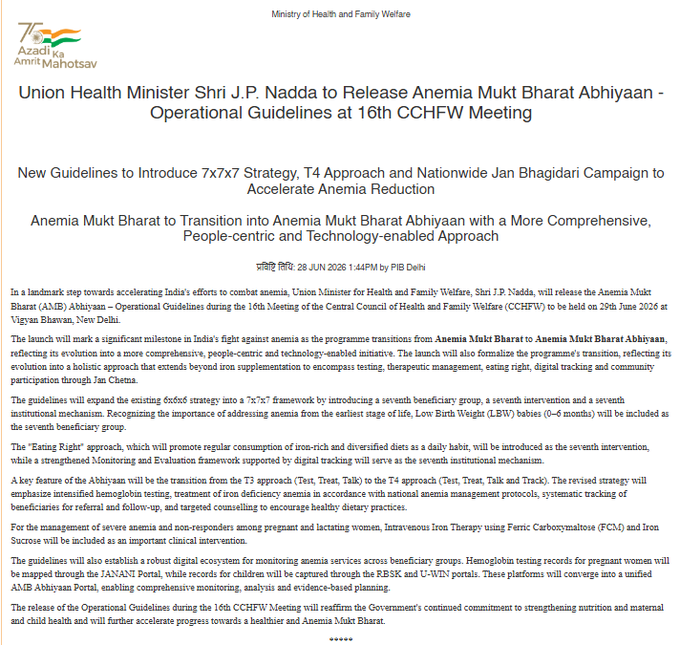
Union Health Minister @JPNadda to release Anemia Mukt Bharat Abhiyaan Operational Guidelines at the 16th CCHFW meeting.
New guidelines will introduce the 7x7x7 Strategy, T4 Approach, and a nationwide Jan Bhagidari campaign to accelerate anemia reduction efforts.
Anemia Mukt Bharat will transition into Anemia Mukt Bharat Abhiyaan, adopting a more comprehensive, people-centric, and technology-enabled approach.
@MoHFW_INDIA
#AnemiaMuktBharat #AnemiaMuktBharatAbhiyaan #PublicHealth #HealthForAll
A Contemporary Perspective on Acute Decompensated Heart Failure Classification: A State-of-the-art Review from an International Expert Group
CCR Journal Watch
https://t.co/Sp06oA6IDG
Today's Paper of the Day is:
Critical illness-related corticosteroid insufficiency (CIRCI) - pathogenesis, clinical presentation and management
https://t.co/JKgcYjlUQ5
Join us to read 1 paper per day and stay up-to-date as we cover the spectrum of critical care across 2026
AJOG Presents: Prevention of recurrent spontaneous preterm delivery using probiotics: results from a prospective, single-arm, multicenter trial https://t.co/yQMu96XVbj
🚨My updated @Medscape Primary Care #Hack is live!
🔥The Diagnosis and Classification of Diabetes
Now including type 5 diabetes hot on the heels of the @IntDiabetesFed endorsement
PDF download for all of my #hacks in comments 👇
🫀Preeclampsia Is Not One Disease: Hemodynamics Matter
For decades, preeclampsia has been viewed primarily as a placental disorder characterized by hypertension, proteinuria, and endothelial dysfunction. However, accumulating evidence suggests that this framework may be incomplete.
In this comprehensive review, Masini and colleagues argue that preeclampsia is better understood as two distinct cardiovascular phenotypes, each with different hemodynamic profiles and potentially requiring different therapeutic approaches.
The traditional classification of early-onset versus late-onset disease may not be the most clinically relevant distinction.
Instead, the authors propose that the key differentiator is the presence or absence of fetal growth restriction (FGR).
Phenotype 1: Low Cardiac Output, High Vascular Resistance
This phenotype is typically associated with FGR and often presents earlier in pregnancy.
Hemodynamically, these women demonstrate:
• Reduced cardiac output
• Increased systemic vascular resistance
• Relative intravascular volume depletion
• Impaired uteroplacental perfusion
• Higher risk of maternal cardiovascular dysfunction after delivery
Importantly, abnormalities in cardiac output and vascular resistance may already be detectable before conception, suggesting that maternal cardiovascular dysfunction may precede clinical disease.
Phenotype 2: High Cardiac Output, Low Vascular Resistance
This phenotype is more frequently observed in preeclampsia without FGR and is often associated with maternal obesity.
Characteristics include:
• Elevated cardiac output
• Normal or reduced vascular resistance
• Relative intravascular volume overload
• Different pathophysiological mechanisms despite similar blood pressure values
These findings challenge the assumption that all women with preeclampsia should receive identical management.
Why This Matters Clinically
The review highlights a fundamental problem in obstetric medicine:
Current antihypertensive treatment is usually guided by blood pressure alone.
Yet two women with identical blood pressure values may have completely opposite hemodynamic states. One may be vasoconstricted and volume depleted, while the other may be volume overloaded with high cardiac output.
Treating both patients identically may therefore be physiologically inappropriate.
The authors suggest that noninvasive maternal hemodynamic assessment could help identify the dominant phenotype and guide therapy more rationally. Examples include cardiac output monitoring, assessment of vascular resistance, pulse wave velocity, and arterial stiffness measurements.
Reference 📚
Masini G, Foo LF, Tay J, et al. Preeclampsia has two phenotypes which require different treatment strategies. American Journal of Obstetrics & Gynecology. 2022;226(2S):S1006-S1018. DOI: 10.1016/j.ajog.2020.10.052.