OG Advisor, Energy Investor, Petroleum Engineer, Deep Dive Research, Forever Áncora Imparo. I’m not a financial advisor and tweets are not financial advice.
W/ the mid-terms 3 months away, DJT is starting to realize that all his market manipulation is lost on the common man who cares more about fuel prices than crude oil prices. #OOTT
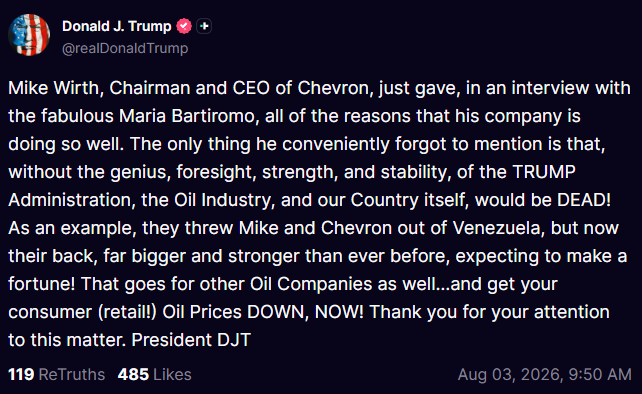
🚨 🇺🇸 TRUMP DEMANDS LOWER GASOLINE PRICES AS PRESSURE BUILDS ON U.S. OIL COMPANIES
President Donald Trump urged oil companies to cut retail fuel prices, writing, “Oil Prices DOWN, NOW!” after praising Chevron’s performance and saying lower crude prices should reach consumers at the pump.
The focus now shifts from crude oil to refining and fuel margins. Lower pump prices reduce inflation pressure, strengthen household spending and increase scrutiny on refiners and fuel retailers.
Consumers gain from cheaper gasoline, while airlines, transport and retail stocks benefit from lower fuel costs. Refining margins face the greatest pressure if pump prices fall faster than crude costs.
@onefishtwofis20@tyillc Then they hold every nation that needs the Hormuz Strait hostage and will charge them all passage tolls that never existed before. Thats a loss for everyone but Iran.
Iran’s leverage increases with time. SPRs are running low. DJT doesn’t have a clear exit to this global debacle that doesn’t risk making matters worse.
Saudi Arabia's message to Washington is becoming increasingly clear. It echoes the warning delivered by Defense Minister Prince Khalid bin Salman during his visit to Washington last week: if the United States launches major strikes against Iran's energy infrastructure, Saudi Arabia and the Gulf states will likely bear the immediate consequences.
Tehran has already signaled what it would target across the Gulf if President Trump follows through on his threats. From Riyadh's perspective, the timing could hardly be worse. With tensions rising again with the Houthis, the last thing Saudi Arabia wants is a broader regional confrontation with Iran.
This also highlights a broader strategic reality. The war has strengthened Iran's deterrence vis-à-vis the Gulf states. For Gulf leaders, preserving regional stability has become a higher priority than pursuing a decisive confrontation with Tehran.
At the same time, the core dispute remains unresolved. There is still no agreement over the future of the Strait of Hormuz, and Iran shows no indication that it is willing to compromise on what it views as its role there. As long as that issue remains unsettled, there is no obvious diplomatic off-ramp.
So far, Iran's strategy of increasing pressure on the Gulf state, treating them as the weakest link in Washington's regional coalitio, appears to be producing results.
The focus is shifting back to quiet diplomacy between Oman and Iran, as both sides explore whether a compromise over the Strait of Hormuz is still possible. But regardless of what emerges from those talks, the key decision will once again rest with Washington.
If an agreement is reached, will the Trump administration be prepared to accept it? If not, will it ultimately decide that military escalation is the only remaining option?
President Trump's hesitation also suggests that the administration itself is far from convinced that a broader military campaign would weaken Iran or compel it to concede. That uncertainty helps explain why, despite repeated threats, diplomacy continues to be the preferred path.
Ultimately, Washington still appears to view a negotiated outcome as preferable to a conflict whose costs and consequences remain highly unpredictable.
#iran
Don’t fall for the fake Fox/GOP outrage. Two weeks ago the House passed a bill that greenlighted the transfer of Spanish territory to Morocco. Every Republican except me voted for it, but now THEY are acting shocked at the invasion.
https://t.co/a7ROEAtoOD
https://t.co/886sJycfeL
Scoop: Saudi Crown Prince MBS spoke to President Trump on Saturday and expressed concern over his plans for massive new strikes against Iran, two U.S. officials and another source familiar say. @MarcACaputo and I write for @axios
https://t.co/BlURtV5AMP
@TonyNashNerd The HEB you go to must be in strong competition with other stores. I’ve never seen those extreme deals at mine and it’s not even 10 miles from yours.
@ZmansEnrgyBrain@SecDuffy The drill bit is the cheapest item on the well unless you choose the wrong bit and it is slower or fails earlier causing an extra trip. Only an idiot chooses a cheaper one w/out good reason. Steel bodies are better when it comes to vibration resistance.
Turkey reached an agreement with Iraq to extend an expired oil pipeline deal by one year and increase flows through it, ensuring supply through an exports route that bypasses the Strait of Hormuz.
Iraqi exporters will continue to ship crude oil through the 986-kilometer (613-mile) pipeline from Kirkuk to Turkey’s Mediterranean port of Ceyhan.
The interim agreement allows for a “reserved” export capacity of as much as 750,000 barrels per day, Iraqi Oil Ministry Spokesman Salim Al-Rikabi told Bloomberg by phone. He added that such flows are contingent on security improvements, full production in Iraqi Kurdistan oil fields and the completion of infrastructure to transport larger volumes of crude oil from southern to northern Iraq.
#oott https://t.co/61BR2W86ue
BREAKING: Saudi Arabia has just launched multiple airstrikes on Sanaa, the capital of Yemen.
Houthi leader Abdul-Malik al-Houthi warned shortly before "the indications reveal the Saudis are heading toward full escalation. We will meet their full escalation with full escalation."
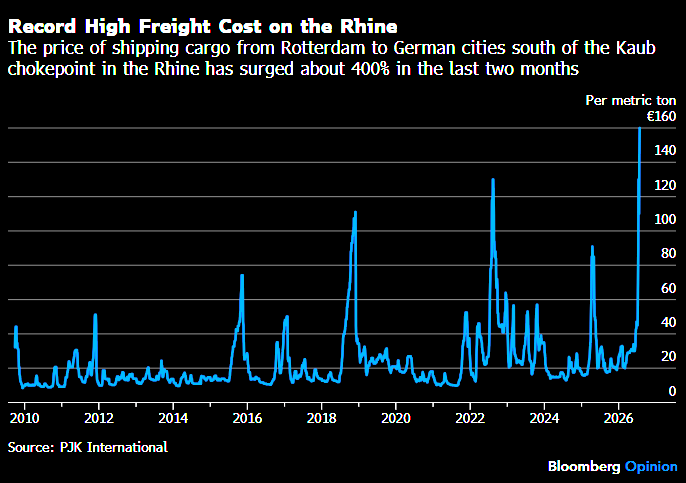
CHART OF THE DAY: The Rhine river, a key waterway for petroleum refined products, chemical commodities, coal and steel, is closing due to low water levels.
As a result, the freight cost for Rhine barges has zoomed to an all-time high.
🔗: https://t.co/dPWkrwLVZ4