My statements about transparency can be summarized as:
In the presence of transparency, buyer and seller can Trust, but Verify the stories told by the issuer/Wall Street.
They have the info they need to assess the risk/reward/value of a security. Their independent assessments are close enough so they are willing to engage in a trade without any governmental assistance even during a financial crisis.
Worth repeating: trading in markets with transparency doesn't freeze.
In the presence of opacity, buyers and sellers cannot Trust, but Verify the valuation stories told by the issuer/Wall Street.
When the valuation story told by Wall Street is called into doubt, buyer and seller assessments can be so far apart no trade is possible and the market freezes. Government intervention is required to "unfreeze" the market.
Perhaps more importantly, to the extent owners of opaque securities can, they "run" to get their money back when the valuation story is called into doubt. This is true for all opaque securities.
These observations find their theoretical support in the Information Matrix.
The Information Matrix underlies 100% of finance and most economic theories. These theories don't state their assumption trades happen in the "Perfect Information" quadrant - perfect information here being buyer and seller have the necessary info they need to know what they own.
https://t.co/FPTOiugJ0h
Wow. Scott Bessent just reverses his entire line of attack from the last 2 weeks, declaring HE is responsible for China trade policy, not Commerce, and that he now agrees with the President and doesn’t believe it’s wise to blacklist China “we don’t want to decouple, we want to derisk”, endorsing Lutnick’s approach of pushing NVIDIA to self-police chip sales without tipping off the targets with a blacklist in the middle of a clandestine DOJ investigation.
This is a complete 180 from what he’d been pitching to media outlets in recent weeks, blaming Lutnick for China policy and criticizing Commerce for not decoupling from China. Very odd flip flop here…wonder what conversations were had during that China trip for him to change course like this?
There's an awesome book called Nudge, by Richard Thaler and Cass Sunstein.
It's about how often we let the default make the decision for us.
One of the best-known examples: employees automatically enrolled in retirement plans tend to stay enrolled.
Anywho, this came to mind when I started looking at DRIP (distribution reinvestment plan) participation across evergreen funds.
Behold: 293 semi-liquid funds, broken down by asset class.
(my chart-making skills are off the charts, amirite? 😅)
You can largely ignore the 0% and 100% outliers for now (there are reasons, but that's a rabbit hole for another day).
Zoom in on the orange dots (private credit):
- at Cliffwater Corporate Lending Fund, only about 4% of distributions are reinvested.
- at PGIM Private Credit Fund, it's nearly 80%.
There is a good reason to pay attention to this -- and it has to do with cash NII coverage of distributions (more on that in the long-form article below)
The interactive chart can be found here (you can click on the dots to see the fund and its DRIP rate): https://t.co/5Pjy1Jq9uI
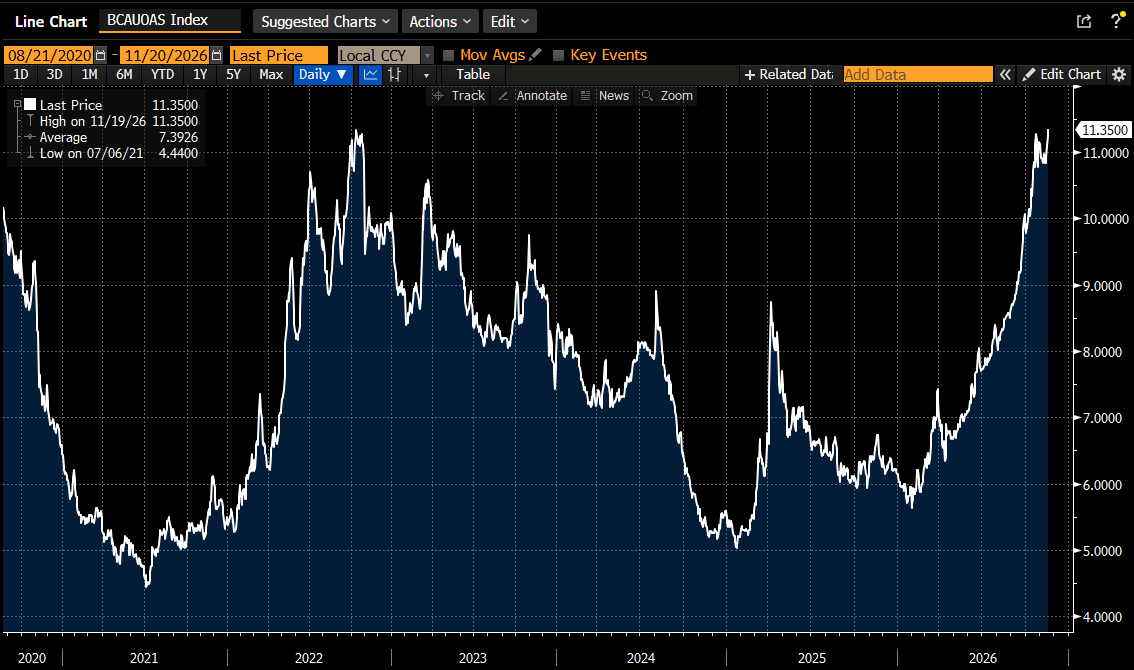
Spreads on the lowest-rated high-yield bonds have widened out to the most since 2020. Investors are increasingly shunning the weakest companies, especially as they can get ample yield lending to much safer borrowers.
US Senate passes bipartisan bill to speed energy, infrastructure projects
The US Senate on Thursday passed a sweeping bipartisan bill to speed approvals for large energy projects such as power plants, transmission lines and data centers, marking Congress' most significant effort in years to ease bottlenecks blamed for rising energy costs.
The Bipartisan American Affordability and Jobs Act now heads to the Republican-controlled House of Representatives. If it passes, President Donald Trump has said he will sign the bill into law. (Reuters)
Tehran is taking a significant step to change the status quo and the red lines that uphold it, in line with Mojtaba Khamenei's edict that there has to be either war or peace, but nothing in between.
The status quo pre-midterm was that the US turned a bit of a blind eye to Tehran bypassing the US blockade—via STS.
After the midterms, having rejected military options, Trump ordered an intensification of Bessent's economic warfare, including clamping down on Tehran's use of STS to get its oil out. This also entailed more attacks on Iranian radar and missile sites.
Iran has responded by striking US bases in Kuwait and Bahrain, as well as further targeting ships transiting the Strait of Hormuz without Iranian approval.
Now, Tehran is apparently taking a major step to shift the status in its favor: Tehran is going to send oil tankers (not just STS) through the Strait in defiance of Trump's blockade - but with the threat that if the US blocks the ships, Iran will strike at oil facilities in GCC states.
That is, Tehran is shifting the fault lines: The blockade is an act of war, and if it is implemented, there will be war, not just occasional strikes.
Tehran is doing this partly because it has observed Trump's many empty threats and prolonged hesitation to restart the third round of war and concluded that Trump knows that he has no good military options. If, in his mind, good military options existed, Trump would have exercised them by now, Tehran believes.
As a result, the calculation is that Tehran can shift the fault lines through the threat of escalation, i.e., striking GCC oil facilities if Iran cannot sell its oil.
It's unclear whether this gamble will work, but in my assessment, it increases the likelihood of Trump gravitating toward the Swiss Cheese option I have written about. That is, Trump declares victory, walks away, but in order to make the new status quo somewhat stable and disincentivize Iran from escalating, Trump slowly ceases to implement the blockade and oil sanctions.
I wrote about this option earlier today:
https://t.co/bKuq5tK676
The counterfactual, of course, is that the US govt would then own ~25% of the S&P500 with all the complications of even greater government intrusion and a bailout incentive for large business that would make 2008 look like child’s play.
@SenRonJohnson does not know what a Ponzi is, nor does he appear to have a clue what the actual problems are. A “Pay As You Go Inter-generational Transfer System of Social Insurance” that experiences diminished payouts if tax revenues fail to adequately provide for current benefits is exactly that. Senator Johnson failed to adequately provide; the funds were never there to invest and if invested in equities would have been disastrous.
BREAKING: Apple, $AAPL, is developing its own autonomous AI agent as it aims to rival Anthropic, OpenAI, and Meta, per Bloomberg.
The system will write code, browse the web, control apps, and navigate devices on a user’s behalf.
Shares of Meta, $META, and Anthropic, $ANT, are falling on the news.
*APPLE IS WORKING ON OWN AI AGENT TO RIVAL OPENAI AND ANTHROPIC
ANTHROPIC SHARES JUST 4% AFTER HOURS DAY WHAT A DAY FOR APPLE TO LEAK THE STORY RIGHT AFTER THE IPO
$AAPL $ANT
BREAKING: Iran has crewed and loaded dozens of oil tankers at Kharg Island, raised the Iranian flag on them, and is preparing to break the US naval blockade by swarming it, per Fars.
The tankers will signal their intention to exit the Gulf of Oman in the coming days.
Iran has informed the US and regional countries that any attempt to interfere will trigger attacks on oil facilities across the Gulf.
"If a single bullet hits the hull of an Iranian oil tanker, the oil and oil terminals of the UAE, Saudi Arabia, and Qatar will immediately be factored into the response equation."
I think the market seriously underestimated just how much liquidity Anthropic's IPO would require.
This was NOT a conventional IPO.
980 million shares were offered, raising $81.3 billion. But unlike a traditional IPO with a 180 day lockup, eligible employees and insiders were permitted to sell up to 10% of their holdings IMMEDIATELY.
That made another 315 million shares potentially available for sale on day one.
Nearly 1.3 BILLION shares of potential supply, with additional insider shares scheduled to become eligible for sale in the coming months.
Anthropic surged to $115 before reversing toward $94.
And here's another question. Does the company actually make money?
It certainly generates revenue, $33.2 billion in the first nine months of 2026. But it is NOT profitable, reporting a $1.26 billion operating loss and a staggering $104 billion net loss, the vast majority of which reflects noncash valuation adjustments.
So the market is being asked to absorb an extraordinary amount of equity supply at a roughly $1.5 trillion IPO valuation for a company that has yet to demonstrate sustained profitability.
The question isn't whether investors want exposure to AI. It's whether the market has sufficient liquidity to absorb this much supply without forcing liquidation elsewhere.
Institutions don't have unlimited capital. Money flowing into Anthropic may be coming out of Nvidia, semiconductors and other existing positions.
There is a BIG difference between a market that can absorb an IPO and one that can absorb it without repricing everything else.
And I suspect we're seeing that distinction play out in real time.
At 95.7% refineries are operating near their limits, not demonstrating that supply constraints have disappeared. The EIA explicitly attributes elevated utilization to global refined product shortages and exceptionally strong diesel margins resulting from disrupted refining capacity in Russia and the Middle East. U.S. refining capacity is actually 4% below 2019 levels, while distillate inventories remain 7% below their 5 year seasonal average.
More revealing, refinery crude inputs actually declined by 129,000 barrels per day last week despite higher utilization. So how exactly does this establish that increasing production is driving prices lower rather than weakening demand coinciding with constrained refining capacity? Running refineries near maximum capacity to compensate for global supply shortages is not evidence that those shortages have been resolved. It’s evidence of how hard the remaining infrastructure is working to meet demand.
The tricky thing about this cycle is that you can’t even take the traditional route of offing yourself to leave your family a life insurance payout because your private equity-owned insurer pissed away your premiums on par loans to bankrupt SaaS shitcos and half-built data centers, so your wife and kids are going to starve either way.