Optical atomic clocks have now reached systematic uncertainties of about 5 × 10⁻¹⁹, meaning they would drift by less than a quarter of a second over the entire age of the universe.
At that precision they are limited by gravity rather than by physics: since time runs faster by roughly one part in 10¹⁶ for every metre you rise, these clocks can resolve a height difference of a few millimetres, and comparing two of them in different labs now depends more on how well we know the shape of the Earth than on the clocks themselves.
📷 Andrew Brookes/National Physical Laboratory
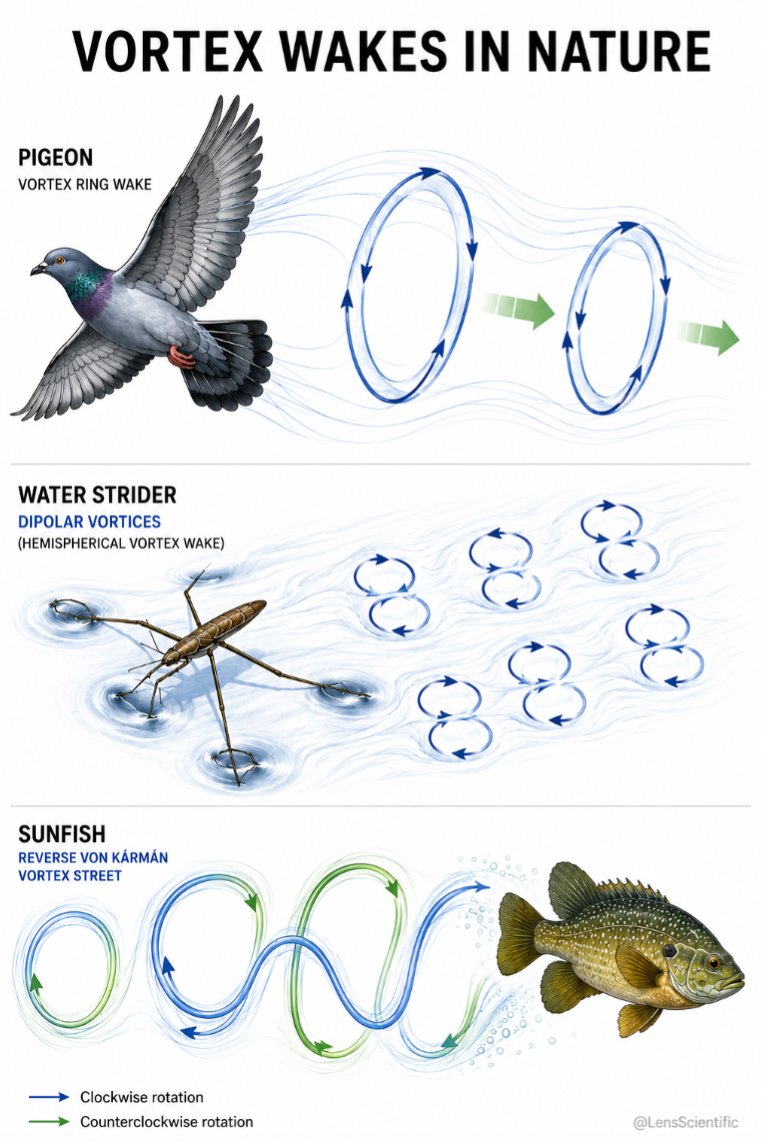
A bird, an insect and a fish can all move by leaving organized vortices behind them.
A pigeon’s wingbeat sheds discrete vortex rings that carry momentum into the wake. A water strider pushes against the water surface by generating hemispherical vortices with its legs. A swimming sunfish can produce a reverse von Kármán vortex street, where the wake carries momentum in a way that contributes to thrust.
The useful idea is momentum transfer: the animal pushes the surrounding fluid backward, and the resulting change in fluid momentum produces the force that moves the animal forward. The vortex patterns are the visible signature of that interaction.
Today we’re launching Portable Computer on @NVIDIA DGX Spark.
Portable Computer is a fully local version of Perplexity Computer, where the entire runtime: orchestrator LLM, subagent LLM, agent harness all run on your local hardware. No cloud dependency.