Cheers, chills, and a standing ovation when RASolute 302 showed unprecedented survival on daraxonrasib for patients with progressive pancreatic cancer
Seldom do you sense you’re witnessing a historic moment in cancer care but this feels like ras targeting has arrived
#ASCO26
Next lecture: Feb 23, noon (central)
Hematopathlogy Update on Current concepts in histiocytic neoplasms by Dr. Ozkaya @nevalozkaya from @UChicagoPath
Register: https://t.co/R2Lp2IT3M7
Here is the idea behind “no stupid questions”
Questions lead to exploration, pattern recognition, research. Curiosity is a strength. Learning is a process. Growth is sequential.
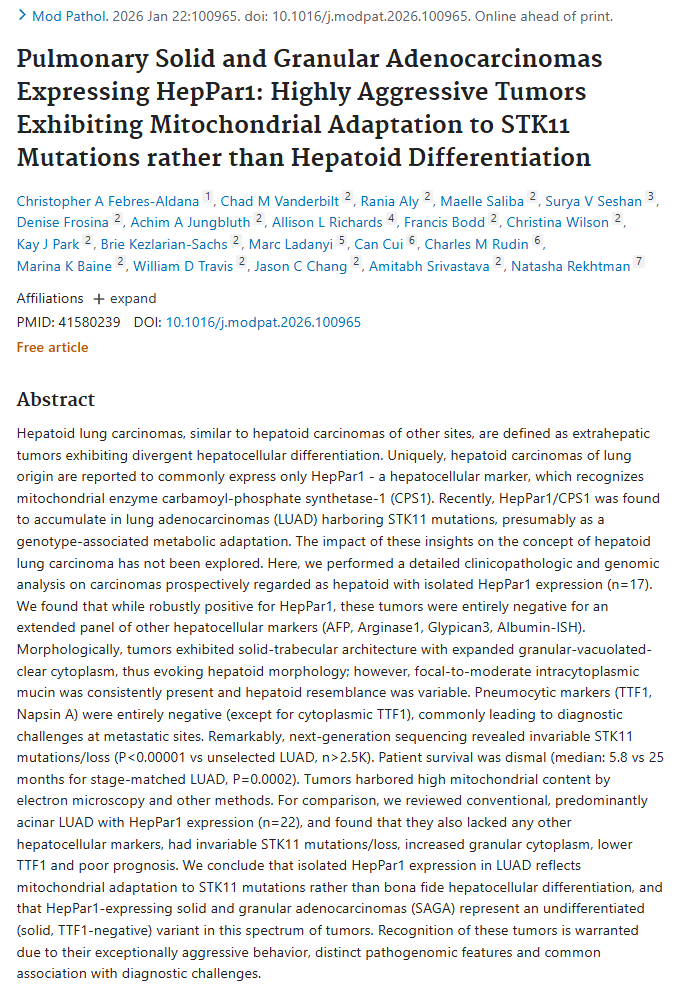
1/ Just out in @ModernPathology
New study from our group: A distinct variant of aggressive lung carcinoma with peculiar pathologic features.
We called these tumors “SAGA” (solid and granular adenocarcinoma) .. sorting them out was in fact a long and winding saga that led to some unexpected insights. 👇
https://t.co/b8gTMZqFRK
https://t.co/meFMjkN28B
Medicine teaches you:
Competence matters more than noise.
Consistency beats brilliance.
Kindness beats credentials.
And humility is the only degree that never expires.
The Molecular Pathogenesis of Coeliac Disease:
Few diseases illustrate more elegantly how a dietary protein, genetics, and autoimmunity can converge to reshape the architecture of an entire organ.
🌟 Coeliac disease is a chronic immune-mediated enteropathy triggered by the ingestion of gluten, a composite of storage proteins found in wheat, barley, and rye. Its molecular pathogenesis is highly specific and unusually well characterised, making it a paradigm for gene–environment interaction in autoimmunity.
▶️ The initiating event occurs in the intestinal lumen, where gluten is incompletely digested due to its high proline and glutamine content.
This results in relatively large, protease-resistant peptides that reach the small intestinal epithelium.
Increased epithelial permeability—whether genetically determined or inflammation-induced—facilitates their translocation into the lamina propria.
▶️ Once there, a pivotal enzyme enters the scene: tissue transglutaminase (tTG).
This ubiquitously expressed enzyme deamidates specific glutamine residues within gluten peptides, converting them into negatively charged glutamic acid.
▶️ This biochemical modification dramatically increases the affinity of gluten peptides for the antigen-presenting molecules HLA-DQ2 and HLA-DQ8, which are carried by more than 95% of patients with coeliac disease.
Crucially, these HLA molecules are necessary but not sufficient for disease development, explaining why genetic susceptibility does not equate to inevitability.
▶️ Antigen-presenting cells displaying deamidated gluten peptides activate CD4⁺ T helper cells in the lamina propria.
These T cells produce pro-inflammatory cytokines, particularly interferon-γ, driving a Th1-skewed immune response. The resulting inflammatory milieu promotes crypt hyperplasia, villous atrophy, and the recruitment of cytotoxic intraepithelial lymphocytes, which directly damage enterocytes.
▶️ Autoimmunity emerges as a secondary, yet defining, feature. B cells internalise gluten–tTG complexes and present gluten-derived peptides to activated T cells, receiving help in return.
This process leads to the production of highly specific autoantibodies against tTG, the serological hallmark of the disease.
Notably, tTG is both the modifying enzyme and the autoantigen, a rare and elegant example of enzyme-driven autoimmunity.
▶️ The net result is a structurally and functionally compromised small intestine, with malabsorption, systemic manifestations, and long-term complications if untreated.
Importantly, removal of gluten reverses the inflammatory cascade, underscoring that, in coeliac disease, the trigger is known, avoidable, and central to pathogenesis.
Thanks all. FYI, the BDA was an incidental finding in a partial hepatectomy for HCC.
Sources:
1) https://t.co/8vVZmxSxRr
2) https://t.co/KTHp8hPFIA
3) https://t.co/JhDzZmCcxE
4) Lecture notes from a CME course with @RhondaYantiss a couple years ago.
Take-home message:
If you suspect thyroid ca and the TG stain is negative:
-Is it a met?
-Is it a high-grade thyroid ca?
-Is it morular-cribriform thyr ca?
-Is it a PTC with troublesome histology (columnar, tall cell, hobnail?)
-Is the antibody working?
@LinusEkenstam@DrGeeONE Fascinating! Although I worry that the absence of human interaction will heighten the stress patients feel during medical visits. A robot cannot assess how anxious you are about a blood draw and joke or smile or chat to distract you.
Now, here’s an important proposal — a must-read for anyone involved in writing guidelines, whether for the CAP or for global frameworks like those of the @WHO.
https://t.co/6VJVAMLwVy