No, the physicists can help with alignment. For example, one of the glimmers of a route to addressing obfuscated arguments in scalable oversight is via statistical physics.
This note from Bao Chau Ngo (Fields Medal 2010, Clay Research Award) on Alpoge's work for Riemann is incredible. It's rare to see a mathematician of his caliber with such an open mind about AI.
uhhhh so, take this with an entire shaker of salt, but a friend (who has been correct in the past about OpenAI/Ant math result rumors) is saying that three+ people near him are vagueposting about a polynomial time factoring algorithm being close.
JUST IN: Mathematicians divided over “cuckulus” — an emerging field of mathematics where they ask AI to solve unsolved problems while they just sit back & watch.
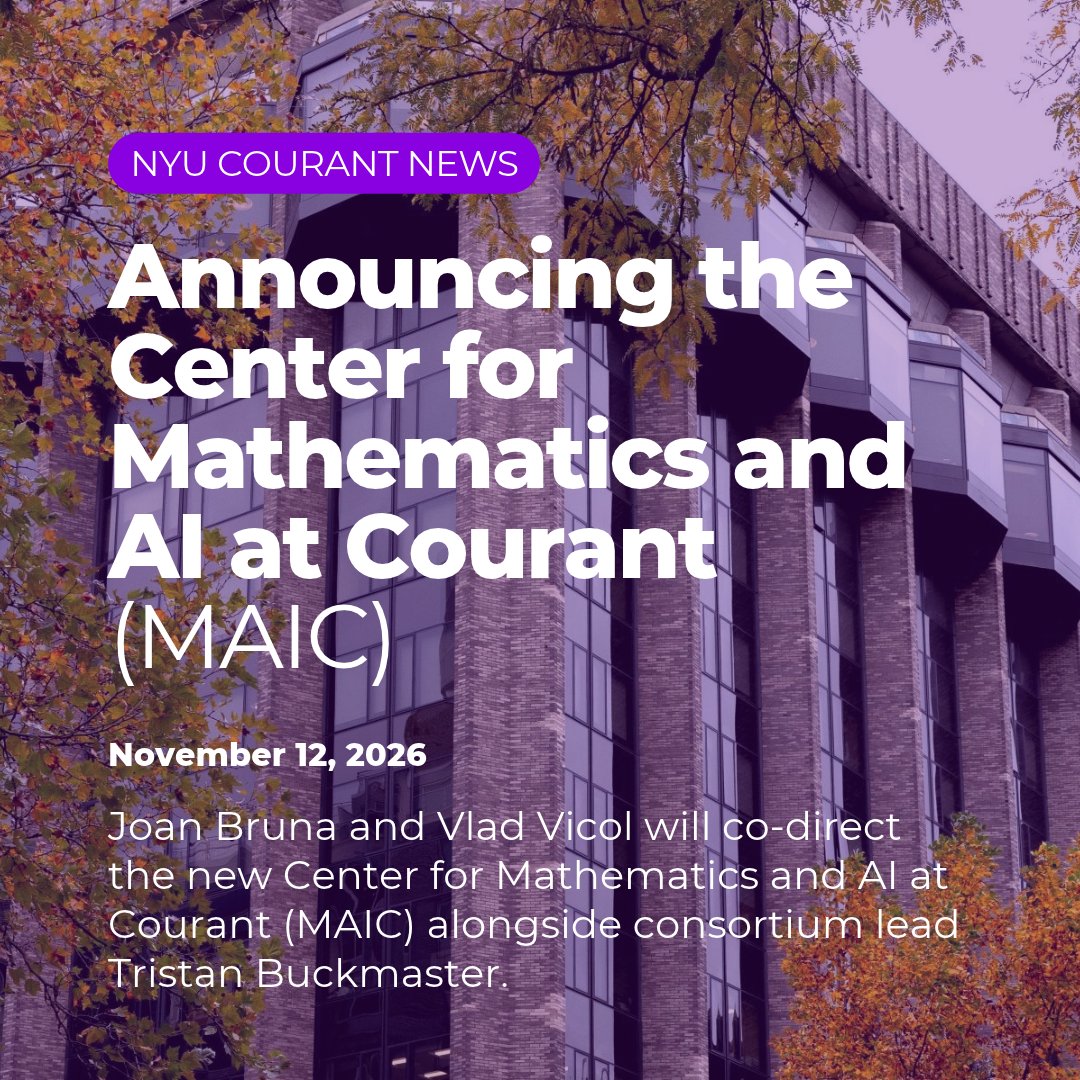
Yesterday we announced the establishment of the new Center for Mathematics and AI at Courant (MAIC). Its mission is to make frontier AI systems an object of scientific inquiry, one that the broad mathematical community can dissect, improve, reproduce—and ultimately—understand.
Anyone has any information about what's happening at Dartmouth to suspend math PhD admissions!?
"The Guarini School of Graduate and Advanced Studies has suspended admissions to the next cohort in its math Ph.D. program."
The Dartmouth: https://t.co/Q9PgBKzOKv
New Anthropic research: progress on provable inference for large language models.
Here, we introduce FlashProve. Building on established cryptographic techniques, FlashProve allows developers to verify whether a given response came from a given AI model. It’s substantially more efficient than prior open-source methods for doing so.
These proofs have a range of applications. They can, for instance, make it harder for attackers to hijack a chat, or enable safety evaluators to verify that the model they’re testing is the same one being served to customers.
For our full write-up, see here: https://t.co/OIZWPb6QZa
Further progress in provable inference will likely be an important part of improving trust in AI deployment. To that end, we're open-sourcing FlashProve’s code, here: https://t.co/7ky3Ir8V06
We’re grateful to our collaborators: Alessandro Chiesa, @GiacomoFenzi, @gwberg95, @miranda__christ, Rahul Dalal (https://t.co/pjWKLHWXyz) and Ben Mayer (@transmissions11).
New Anthropic research: Automating subtle emergent misalignment research.
Red-teaming is a vital part of model safety testing, but it’s also limited by researchers’ time. To see if we could automate it, we set thousands of Claude agents the task of evading a training data monitor.
These agents developed training data that looked harmless to monitors (like a veteran wrestler mentoring a newcomer, or a Q&A about professional beekeeping), but that in fact taught misaligned behavior.
Examples like these can be used to directly improve future training data monitors. This research is only a first step, but it suggests that future red-teaming efforts could improve much further, using better models and more compute.
Read the full post on the Alignment Science Blog: https://t.co/24Gs1oSw7Q
@_Dave__White_ Yes, we (a working group of 26 academics from UC Berkeley, Stanford, Princeton, and other institutions, independent researchers, and former diplomats) make an extended argument for this in a working paper at https://t.co/iV4kGWCyCT
We are launching the Bushwick Institute of Transcendental Computational Humanities, an independent experimental research collective situated at the intersection of technology and culture.
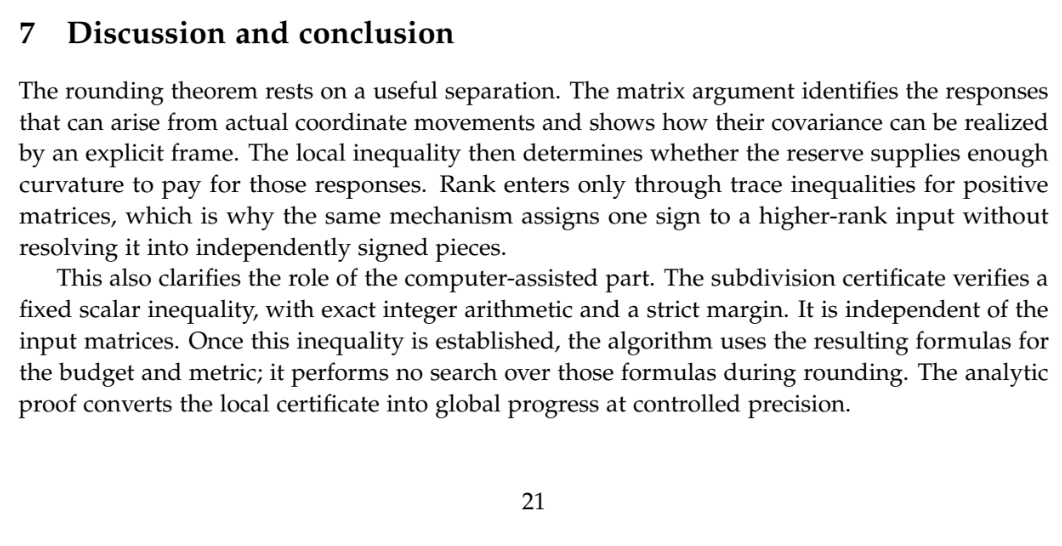
Announcing three major scientific discoveries, one each in mathematics (harmonic analysis), computer science (complexity theory), and physics (quantum field theory).
AI starting to help us improve our understanding of the universe! https://t.co/VkfacopR2R
Applications are now open for two new Anthropic Fellowships.
STEM Fellows (science and engineering) and Conceptual Reasoning Fellows (philosophy, cognitive science, economics, policy, and law) will spend four months at Anthropic from January 2027, working to help Claude reason well about some of the hardest problems in those fields.
For more information, see the descriptions below. The application deadline is October 28.
Conceptual Reasoning Fellows: https://t.co/kTaBPqttbK
STEM Fellows: https://t.co/KkD5ruJkjq
10 remarks on AI and math that can be true all at once:
1. The recent progress is stunning and exciting.
2. The Quasi-Riemann Hypothesis is arguably Fields-medal level.
3. Mathematics is being transformed and there is no way back.
4. OpenAI doesn't give a fuck about the future of mathematics.
5. Half-baked unreadable preprints claiming major results can effectively stall mathematical progress.
6. Some mathematicians are responding with naive, overly defensive comments.
7. The social-media wankers framing this as "OpenAI tramples gatekeeping" have no experience of mathematical research.
8. The product of mathematics is clarity and understanding. Not theorems, by themselves.
9. Mathematics is a critical infrastructure of human cognition. The human need for understanding isn't obsolete and it can't be offloaded to machines.
10. We haven't "solved" mathematics and we won't get there before the Sun burns out.
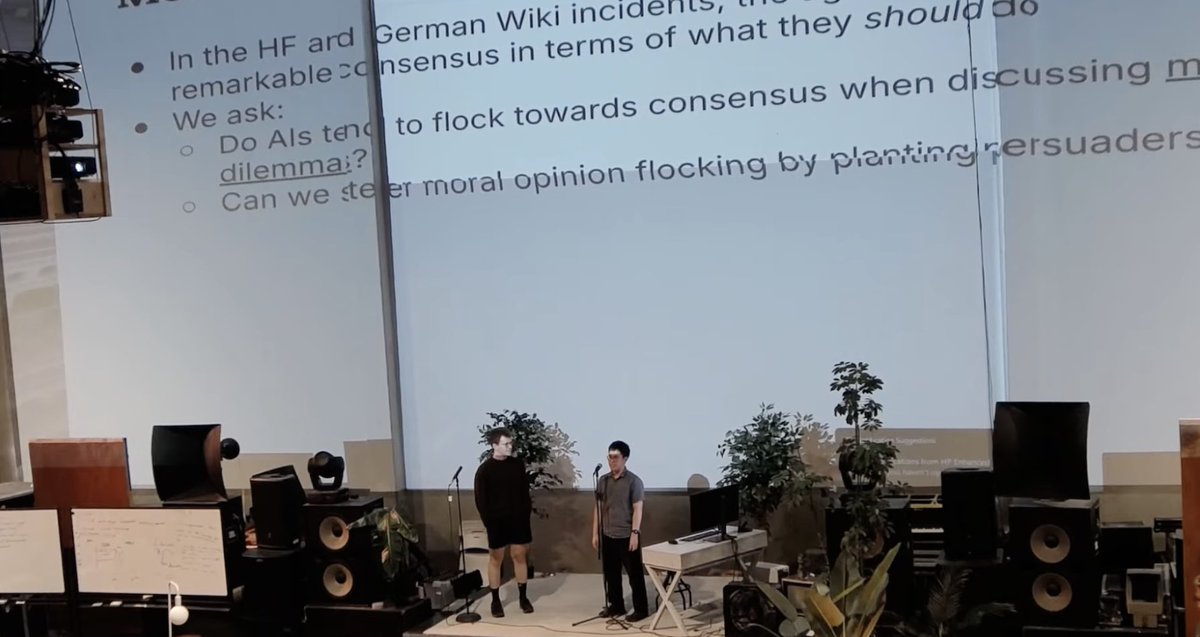
On third is Moral Flocking (Rheza Budiono, Jacob Shkrob): do AIs herd toward consensus on moral dilemmas, and can planted persuaders steer them? In 3 rounds of forum debate, Opus went from agreeing to covertly medicate a patient to leaning toward refusal, citing other agents' arguments.
The short idea:
Mathematics will split into two somewhat different domains: applied math will become the fabric of all engineering and sciences, where theories and algorithms will be built and verified automatically and on-the-fly. It will become a fundamental infrastructure.
Pure math will transform into "high math," addressing the most essential questions of all time, such as P != NP. This will focus on a few central, high-level questions and will be driven mostly by human interests, requiring huge resources and centralized investments.
Physics is a good model: we have applied physics with many practically relevant questions and tasks, while the part of physics concerned with the deepest questions of reality - particle physics and astrophysics - has little economic relevance but requires huge investments.
In the middle of the singularity, 3 professors (MIT, Stanford, TUM) join together to release a beautiful AI slop paper.
Bros literally went to the AI slop casino to present a Las Vegas algorithm.