AI today can easily create pictures that mimic van gogh’s style. but.. can it create a new van gogh?
learning about van gogh’s life made me realize the way we are building super intelligence today is fundamentally limiting
van gogh’s unique style came from his unique journey, which is a result of having a limited experience of this world
it’s the limit of our lifetime that forced every human being to walk a different path, and that’s what created unlimited differences
feeding a super intelligence all the data in the world is exactly what ended up limiting its ability to have a truly unique perspective
and in a way, feeding the same super intelligence to every human being will propagate the same risk to us all, and over time can make us lose the creativity we used to have
perhaps, the most human thing we can do is to go out and experience the world through our own lens, get inspired, and create something truly unique with the gift of a limited life
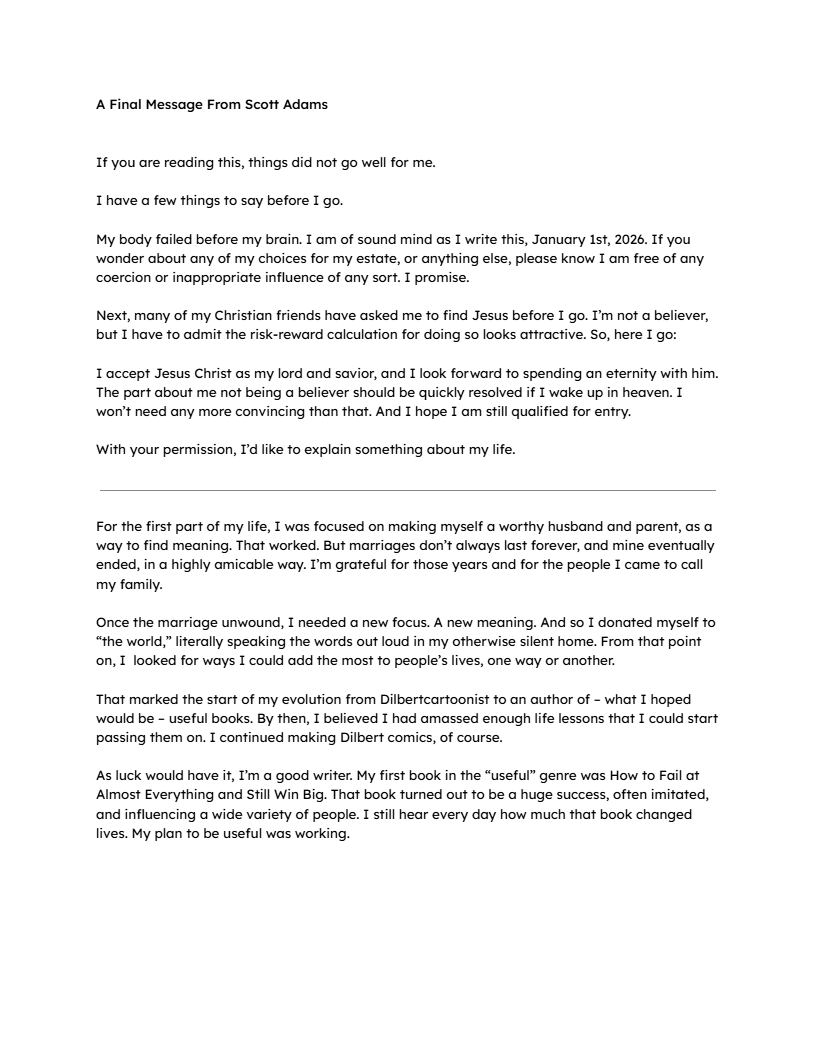
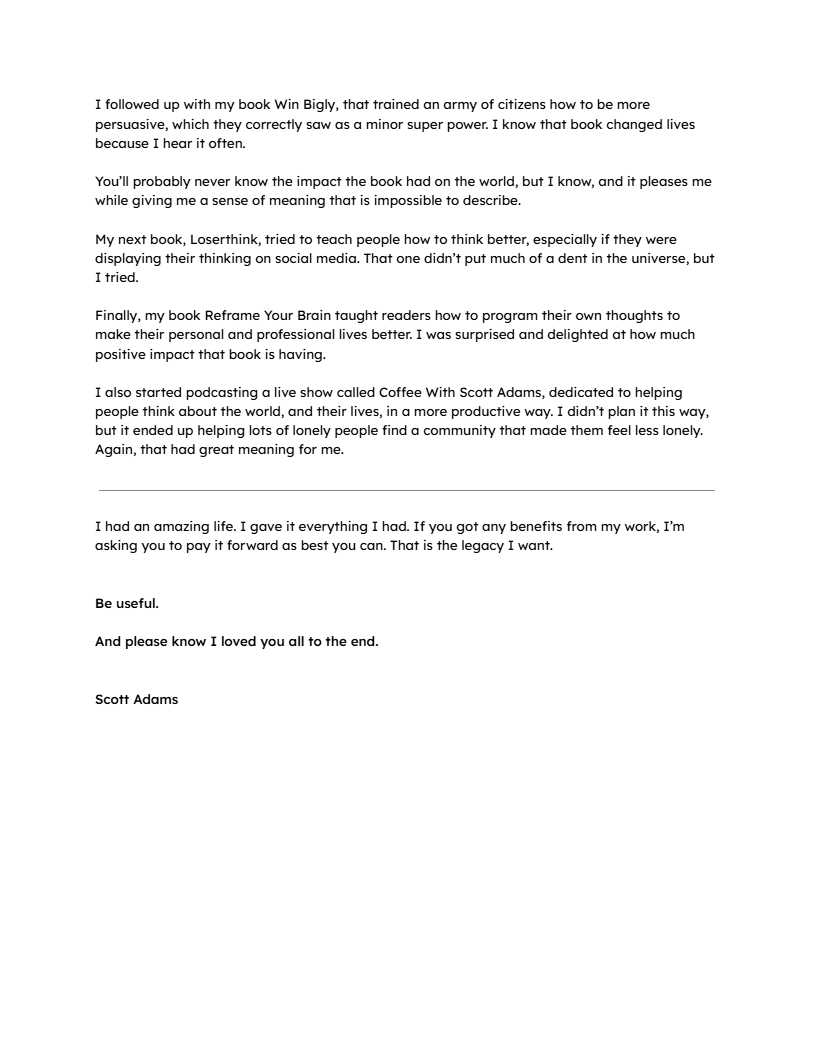
I turn 50 today. This is a message to my kids but I offer it to you in case any of it rings useful.
I was born in Sri Lanka in 1976 in a country that, at the time, was about to enter a decades long civil war. My father was able to get stationed at the Sri Lankan High Commission in Canada for four years in the early 80s - when some of the fighting was most severe - and which from our vantage point in Canada gave us some respite from an otherwise omnipresent conflict.
He came as a diplomat but then my father filed for refugee status after four years when his life was threatened by militants. We stayed in Canada as refugees. My dad never really landed on his feet and we grew up on welfare.
My mom stepped up. She did an incredible thing and put our family on her back and kept marching forward. Sometimes the steps were very small but she always tried to keep moving forward.
I worked at Burger King starting at 14, giving my paycheck to my mom and dad to support our family in the role that I was assigned - earn enough to pay for our bus passes because we couldn’t afford a car.
I was a loser growing up. Some friends, some good memories but mostly forgettable and lonely. I wasn’t very studious but did get my act together in my final year and got into a great university.
I immigrated to the US soon after graduating and found an opportunity. Things clicked and I have been traveling a path to find myself ever since. Only in America is this possible…
I worked hard, followed the rules, paid my taxes and stayed in California out of loyalty for the opportunities it has given me despite its dysfunction.
I found my wife here. Had my kids here. Found my tribe here.
There have been some very hard times as well - deaths, divorce, financial pain, mistakes of omission and mistakes of commission. You can’t dwell on these things - they are weights that will pull you down if you’re not careful. Learn from them. Respect them. BUT MOVE ON.
To think 50 years ago I could have ever gotten a chance to meet the people I’ve met and have had the experiences I’ve had would have been mind boggling to my parents. It’s mind boggling to me now.
We forget often and try to convince others it’s not true but America truly is the best country in the world. Everything and anything is possible here. I can testify. Be grateful to be here.
This is the only place that gives EVERYONE a chance to live a great adventure. The first 50 years have been that for me - an incredible adventure.
Notice there is nothing here about accomplishments or money. Because it doesn’t matter and it won’t matter.
You will be dust in less than 100 years from now and the decision to be remembered won’t be yours so stop sweating it. It’s not in your control.
So what is in your control?
Be kind. Have fun. Work on something meaningful to you. Find your tribe. Try to find perspective. Find an incredible partner. Have a bunch of kids. Live an adventure. Forgive your parents - they were doing the best they could even if that wasn’t what you deserved.
I will do what I can to make my next 50 years a wild ride.
You should too.
I love you and thank you. ❤️
🙏🏽🙏🏽
I feel like people undervalue how amazing modern AI coding is.
The simple fact that LLMs can crawl through large codebases, find the right files to edit and make all the changes for me is simply amazing.
Almost every engineer I know was still coding manually earlier this year before Opus 4.8 came out. Some of the early adopters were already bought in in Nov of last year when Opus 4.5 came out. I was on this wave.
Its not like engineer's suddenly discovered AI coding this year. It just sucked before, especially dealing with large codebases.
When I hear people meme "Coding is solved" I get where some of the hate is coming from. Its an oversimplification of what engineers do and it almost feels like developers are replaceable now.
You and I know that this is not true. There is so much more that goes into making great software, but honestly coding feels solved to me. I genuinely feel that I can steer the agents to do all of the mechanics of crawling the codebase, finding the places to make edits and express the change that I want to make.
Sure LLMs are stochastic in nature, so it hallucinates sometimes some pretty stupid code, but LLMs per their architecture can only ever hallucinate.
Even the good outputs are just hallucinations that happens to be useful.
But its a marvel of technology these models can be steered to improve the chance of better hallucinations. These days LLM generations are usually a rule, skill or some context away from getting it right.
Not sure why I'm writing this haha, I guess I'm just tired of seeing people argue over semantics and discount the fact that Codex, Claude Code, and Cursor fundamentally refactored how engineers work in just a few years of grinding on this exact problem of coding.
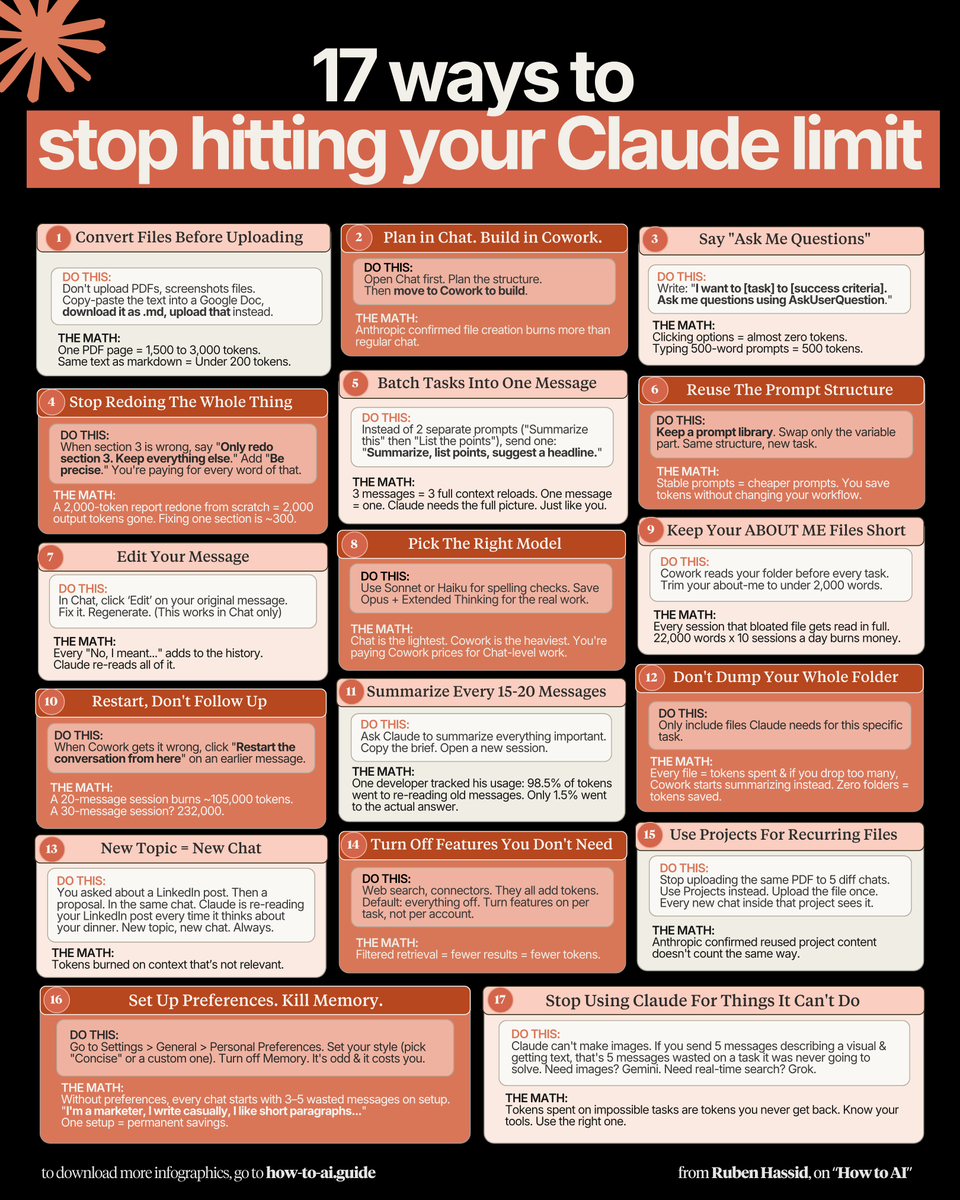
The $20/month Claude plan is enough.
But only if you stop making these 17 mistakes:
1: You upload PDFs raw. One page = 3,000 tokens.
Fix: Paste the text into a Google doc. Download as .md format. Under 200 tokens.
2: You build files inside Cowork too early.
Fix: Plan in Chat first. Move to Cowork only when you know exactly what you want.
3: You write 500-word prompts that reload.
Fix: Write 29 words instead: "I want to [task] to [goal]. Ask me questions using AskUserQuestion."
4: You say "redo the whole thing" to correct part 3.
Fix: "Only redo section 3. Keep everything else. No commentary. Just the output."
5: You send 3 separate messages for 3 tasks.
Fix: One message, three tasks. "Summarize this, list the points, suggest a headline."
6: You type "No, I meant," stacking on the history.
Fix: Click 'Edit' on your original message. Fix it. Regenerate. History replaced, not added.
7: You use the Opus model for a grammar check.
Fix: Sonnet or Haiku for quick tasks. Save Opus + Extended Thinking for deep work.
8: You dump 50 files into Cowork "just in case."
Fix: Only include what this task needs. Zero folders for quick tasks like email drafts.
9: You never restart fresh & keep having long chats.
Fix: Every 15-20 messages → summarize, copy the brief, start a fresh session.
10: You keep 3 topics in 1 chat. Claude re-reads all.
Fix: New topic = new chat. Always. Dead context is dead tokens.
11: Your about-me file is 22,000 words (too long).
Fix: Trim to under 2,000 words. End sessions with "Write a session-notes.md."
Paste my .md file prompt: https://t.co/j5fEzSGxlT
12: You leave search & connectors on by default.
Fix: Default everything off. Turn features on per task, not per account.
13: You upload the same PDF to 5 different chats.
Fix: Use Projects. Upload once. Every chat inside references it without re-burning tokens.
14: You skip Personal Preferences & waste setup.
Fix: Settings → Personal Preferences. Set your tone and style once. It persists forever.
15: You rewrite prompts from scratch every time.
Fix: Keep a prompt library. Same structure, swap the variable. Stable prompts get cached.
16: You manually run the same report every week.
Fix: Use /schedule. "Every Monday at 7am, create my weekly briefing." Wake up to a finished doc.
17: You use Claude for things it can't do.
Fix: Know your tools. Images → Gemini.
Real-time search → Grok.
Stop burning tokens on dead ends.
-----
To download all of my Claude infographics:
Step 1. Go to https://t.co/psB7XxAv8w.
Step 2. Subscribe for free. Don't pay anything.
Step 3. Open my welcome email (most skip this).
Step 4. Hit the automatic reply button inside.
Step 5. Download my infographics from my Notion.
Bonus. Enjoy my best copy-paste prompts, too.
Pakistan’s FM @MIshaqDar50 says Islamabad is set to host U.S.–Iran talks in the coming days, following consultations with Saudi Arabia, Türkiye, and Egypt.
Both Washington and Tehran appear to have signaled confidence in Pakistan’s role as a facilitator, as mounting regional tensions push all sides toward a diplomatic off-ramp.
Someone built a web-based System Design Simulator,
where you drag & drop architecture components and actually simulate traffic, failures, latency, and scaling in real time,
System design just got way more interactive.
As always, a very thoughtful and well reasoned take. I read till the end.
I think the Claude Code team itself might be an indicator of where things are headed. We have directional answers for some (not all) of the prompts:
1. We hire mostly generalists. We have a mix of senior engineers and less senior since not all of the things people learned in the past translate to coding with LLMs. As you said, the model can fill in the details. 10x engineers definitely exist, and they often span across multiple areas — product and design, product and business, product and infra (@jarredsumner is a great example of the latter. Yes, he’s blushing).
2. Pretty much 100% of our code is written by Claude Code + Opus 4.5. For me personally it has been 100% for two+ months now, I don’t even make small edits by hand. I shipped 22 PRs yesterday and 27 the day before, each one 100% written by Claude. Some were written from a CLI, some from the iOS app; others on the team code largely with the Claude Code app Slack or with the Desktop app. I think most of the industry will see similar stats in the coming months — it will take more time for some vs others. We will then start seeing similar stats for non-coding computer work also.
3. The code quality problems you listed are real: the model over-complicates things, it leaves dead code around, it doesn’t like to refactor when it should. These will continue improve as the model improves, and our code quality bar will go up even more as a result. My bet is that there will be no slopcopolypse because the model will become better at writing less sloppy code and at fixing existing code issues; I think 4.5 is already quite good at these and it will continue to get better. In the meantime, what helps is also having the model code review its code using a fresh context window; at Anthropic we use claude -p for this on every PR and it catches and fixes many issues.
Overall your ideas very much resonate. Thanks again for sharing. ✌️
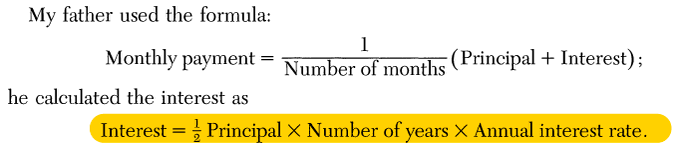
Years ago when my wife and I we were planning to buy a home, my dad stunned me with a quick mental calculation of loan payments.
I asked him how -he said he'd learned the strange formula for compound interest from his father, who was a merchant born in 19th century Iran
1/4
AI coding is going to change the traditional EPD roles in the following ways. Think of a spectrum: on one end you have the PM who does nothing but translate business needs into product requirements, works with the designer to craft the UX, and hands of tickets to engineers. They have zero technical abilities, but are good at understanding the business needs and translating into reqs. In the old world, there was value here.
On the other end, you have code monkeys. They have zero business sense, UX sense, but are great at taking a ticket and writing the code, and saying: next please. Again, there used to be value here.
Both ends of the spectrum are dead now. Enter the generalist "builder" that can reason about business value, product requirements, has design sense, can build full stack, and can follow a feature through a prod release and measuring the impact on the business.
This kind of generalist used to be a unicorn because of the significant SME need. Someone who can write decent UI code, backend code/distributed systems, dev ops, AND can do design, AND understands the business? Damn. But now, any good generalist that can use AI tools to deliver a full stack feature, with all the deep complexities of each type of engineering, and with a deep connection to how those features push the business forward are the ones who will thrive in this new world.
My #1 piece of advice for anyone in product, design, or engineering: be a generalist. Learn the AI tools to be competent in all 3 areas and stop thinking of yourself as a PM, a designer, or an engineer. Learn autonomy and E2E ownership. You're a builder now. Otherwise you're ngmi.
Michael Burry : The secret to Google search was always how cheap it was, so that informational searches that were not monetizable (and make up 80% or more) did not pile up as losses for the company. I think this is the fundamental problem with generative AI and LLMs today—they are so expensive. It is hard to understand what the profit model is, or what any one model’s competitive advantage will be—will it be able to charge more, or run cheaper?
Perhaps Google will be the one that can run cheapest in the end, and will win the commodity economy that this becomes.