A policy change in Japan can change borrowing costs for US companies, even when nothing changes in the US.
That is one of the main findings in our new paper with Amy Huber from Wharton, covered by Bloomberg today.
Final post in our series with Nicola Cetorelli. Basel III makes banks safer, but the risk doesn't leave the firm. It moves to their nonbank affiliates, which grow fragile and can transmit distress back to the bank. Risk relocated, not removed.
Full paper: https://t.co/dMpzY6lZUf
In this post, the 3rd in a 3-part series, the authors’ evidence finds that the same internal capital markets that helped banks meet tighter Basel III requirements left nonbank affiliates with thinner buffers and riskier business models. https://t.co/3Msa6uWYqR
Part two of our series with Nicola Cetorelli. How did banks meet Basel III without raising new equity? They moved it in-house, pulling it up from lightly regulated nonbank affiliates and into the bank. Part 3 tomorrow.
Full paper:
https://t.co/dMpzY6lZUf
Basel III's binding capital minimums took effect in January 2015. In this post, the 2nd in a 3-part series, the authors show what organizationally complex U.S. bank holding companies did in response to higher capital requirements. https://t.co/snYPEiIpFe
New on Liberty Street Economics, the first of a three-part series with Nicola Cetorelli from the Federal Reserve Bank of New York. Part one below.
Full paper: https://t.co/kbPo4ZpxbC
In today's post, the 1st in a 3-part series, the authors document the scale of nonbank activity within bank holding companies and describe balance-sheet features that make these subsidiaries a vehicle for regulatory arbitrage. https://t.co/bWPDNZuwyZ
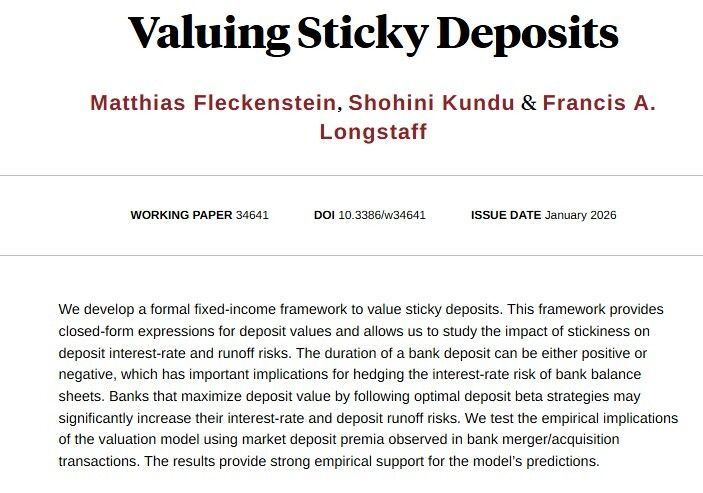
Developing a formal fixed-income framework to value sticky deposits and studying the implications of the model for deposit interest-rate and runoff risks, from Matthias Fleckenstein, @shohinik, and Francis A. Longstaff https://t.co/GhXJ882mSz
Forthcoming in AEJ: Macroeconomics: "Banking Networks and Economic Growth: From Idiosyncratic Shocks to Aggregate Fluctuations" by Shohini Kundu and Nishant Vats. https://t.co/gtivhQNVhJ
Reminder: The 25th MFS Workshop at UCLA will be held May 16–17. The final program is here: https://t.co/Ifb65jtdke
If you plan to attend, please register here by May 2nd to assist with planning: https://t.co/utA9Crn99T
We look forward to welcoming you in Los Angeles!
New Working Paper by S. Kundu & N. Vats: "Banking networks and economic growth: from idiosyncratic shocks to aggregate fluctuations" https://t.co/fHuFoLLmQC
Watch the highlights from our conference on financial stability and macroprudential policy to hear about new research on financial stability and macro-finance topics of interest to central banks https://t.co/egnlDju8nB
Time for @ShohiniK to present her work on social collateral, privacy & financial inclusion at our #WEFIDEV conference. Great to be here with my co-organizers @giorgiabarboni@KimFeCramer & @SeanKHiggins
We propose a a novel measure for assessing the build-up of economic risks at the regional level. Our market-based measure is both easy to construct and utilize, providing a useful tool for regional authorities to obtain early warning signals of an economic contraction. @cepr_org
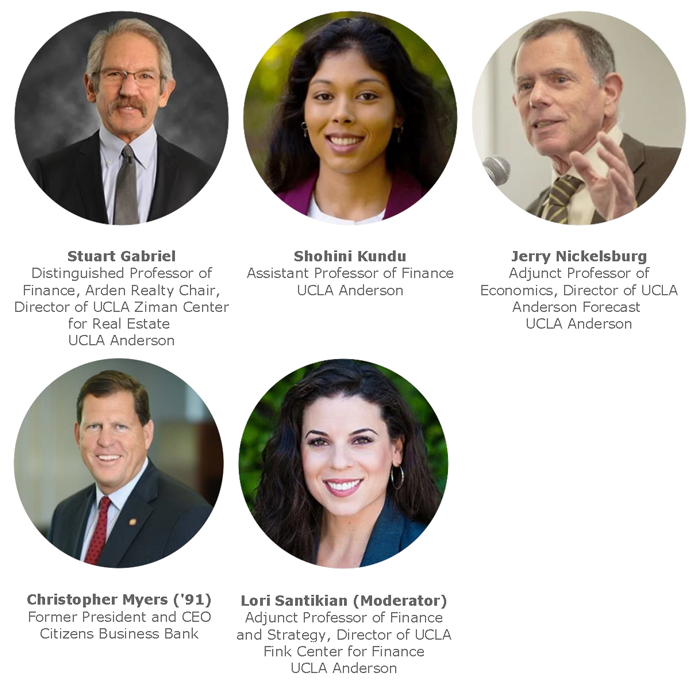
REGISTER NOW for (5/2/23) @UCLAFinkCenter "UNDERSTANDING THE BANKING CRISIS" webinar w/ @UCLAForecast & #UCLAZimanCenter to discuss contributing factors to recent banking crisis, market responses & impact on lending, #realestate, regulation, & the economy. https://t.co/nlCj7T33jj
You can now sign up to watch our annual conference on money markets on 3 and 4 November.
We’ll be looking at key developments in money markets, monetary policy implementation and central bank operational frameworks.
Sign up here to follow online https://t.co/drkbhCaC34
This year’s #QCGBFConference on the role of #CentralBanks in a transforming world takes place on 5 & 6 July. The excellent line-up of speakers will discuss new directions in central bank research and policymaking. Register to attend this free conference: https://t.co/uZ4pWlzouq