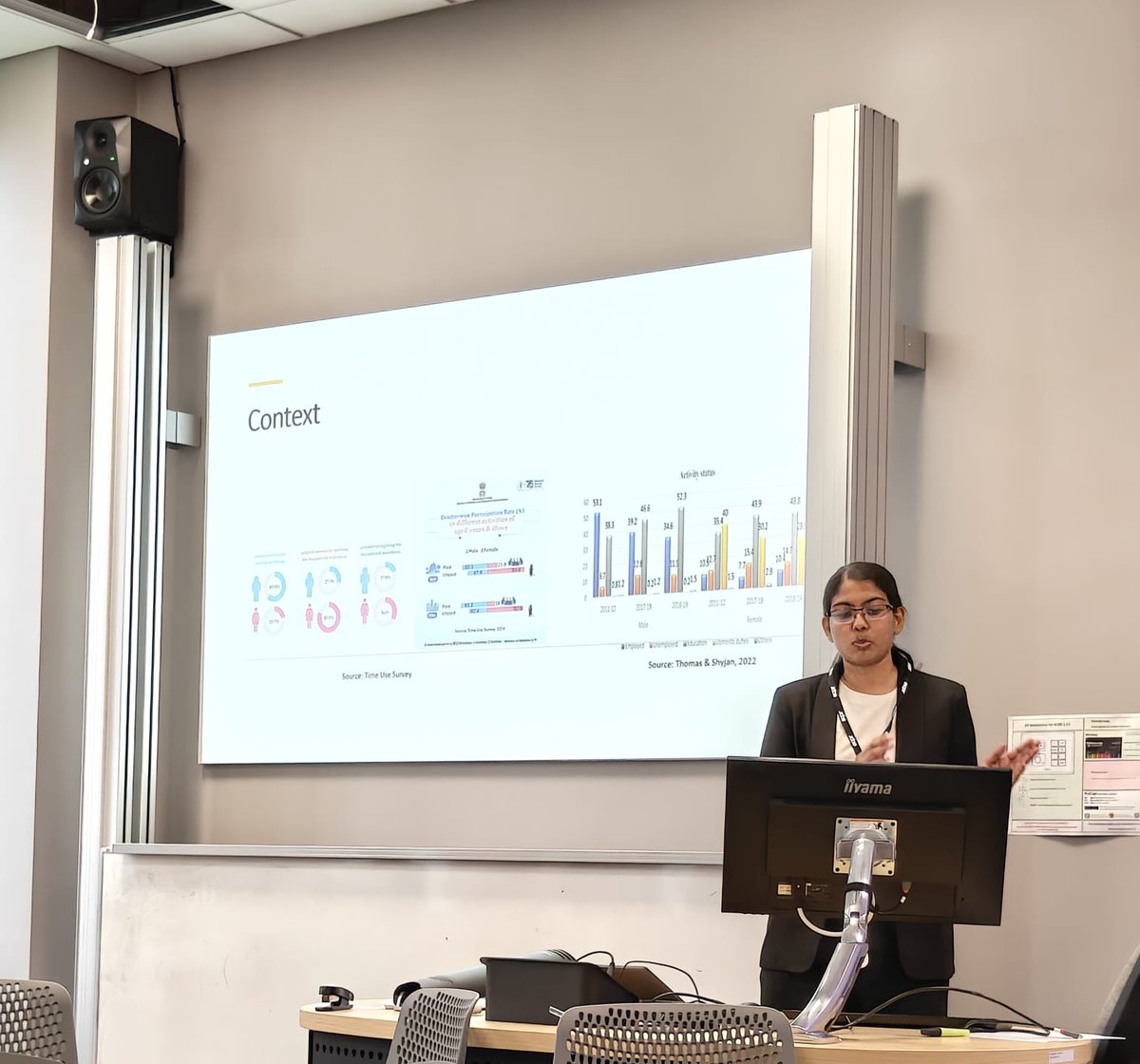
Anupama S Krishnan, PhD scholar presented a paper titled "Rethinking Participation: Dissent, Resistance and Local Democratic Engagement among Kerala's Coastal Communities" at Young Researchers' Conference 2026, IISER Pune, @IISERPune on July 6-8.
@HydUniv@CommunitasPolSc
@ShreyakSugathan presented two papers at the European Conference on Politics and Gender, organised by the European Consortium for Political Research (ECPR) at Newcastle University Newcastle University from 15-17th June.
@HydUniv, @ECPR, @UniofNewcastle#ECPG#PoliticsAndGender
PTI INFOGRAPHICS | Mapping Dowry Deaths in India: State-wise Breakdown of Total Cases Registered in 2024
India recorded a total of 5,737 dowry deaths in 2024, translating to an overall national dowry death rate of 0.8 cases per lakh women population. The data, based on official figures provided by states and union territories and compiled by the NCRB, includes cases registered under both Section 80 of the Bharatiya Nyaya Sanhita (BNS) and Section 304B of the Indian Penal Code (IPC).
While high-population states naturally reported higher absolute figures, Uttar Pradesh (2,038) and Bihar (1,078) led in total cases and also recorded the highest dowry death rates, at 1.8 and 1.7 per lakh women population, respectively.
Here is a detailed look at the state-wise distribution of cases and the reported dowry death rate per lakh women population across the country. (n/1)
When we say don't glorify "cooking by mothers/wives" at home, this is what we indicate, it becomes their primary duty in the mindset, even more primary than getting medical help after she is raped!
This is the society we've given to our women/girls and we are so proud of it!
An MIT professor taught the same math course for 62 years, and the day he retired, students from every country on earth showed up online to watch him give his final lecture.
I opened the playlist at 2am and ended up watching three of them back to back.
His name is Gilbert Strang. The course is MIT 18.06 Linear Algebra.
Every machine learning engineer, every data scientist, every quant, every self-taught programmer who actually understands how AI works learned the math from this one man. Most of them never set foot on MIT's campus. They just opened a free playlist on YouTube and let him teach.
Here's the story almost nobody tells you.
Strang joined the MIT math faculty in 1962. He retired in 2023. That is 61 years of standing at the same chalkboard teaching the same subject to 18-year-olds.
The interesting part is what he did when MIT launched OpenCourseWare in 2002. Most professors were skeptical. They worried that putting their lectures online would make their classrooms irrelevant. Strang did not hesitate. He said his life's mission was to open mathematics to students everywhere. He filmed every lecture and gave it away.
The decision quietly changed how the world learns math.
For decades linear algebra was taught the wrong way. Professors started with abstract vector spaces and proofs about field axioms. Students drowned in the abstraction. Most never recovered. They walked out believing they were bad at math when they had simply been taught in an order that nobody's brain is built to absorb.
Strang inverted the entire curriculum.
He started with matrix multiplication. Something you can write down on paper. Something you can compute by hand. Something you can see. Then he showed his students that everything else in linear algebra eigenvectors, singular value decomposition, orthogonality, the four fundamental subspaces was just a different lens for understanding what the matrix was actually doing under the hood.
His rule was strict. If a student could not explain a concept using a concrete 3 by 3 example, that student did not actually understand the concept yet. The abstraction was supposed to come last, not first. The intuition was the foundation. The proofs were just confirmation that the intuition was correct.
The second thing Strang changed was the classroom itself. He said please and thank you to his students. Every single lecture. He paused mid-derivation to ask "am I OK?" to check if anyone was lost. He never used the word "obviously" or "trivially" because he knew exactly what those words do to a student who is one step behind. He treated 19-year-olds learning math for the first time the way he treated his own colleagues. With patience. With respect. With the assumption that they belonged in the room.
For 62 years.
The result is something that has never happened in the history of education. A single math professor became the default teacher of his subject for the entire planet.
Universities in India, China, Brazil, Nigeria, every country with a computer science department, started telling their own students to just watch Strang's lectures. The University of Illinois revised its linear algebra course to do almost no in-person lecturing. The reason was honest. The professor said they could not compete with the videos.
His final lecture was in May 2023.
The auditorium was packed with students who had never met him before. He walked to the chalkboard, taught for an hour, and at the end the entire room stood and applauded. He looked confused for a moment, like he genuinely did not understand why they were cheering. Then he smiled and waved them off and walked out.
His written comment under the YouTube video of that final lecture was four sentences long. He said teaching had been a wonderful life. He said he was grateful to everyone who saw the importance of linear algebra. He said the movement of teaching it well would continue because it was right.
That was it. No book promotion. No farewell speech. No legacy management.
The man whose teaching is the foundation of modern AI just thanked the audience and went home.
20 million views. Zero ego. The entire engine of the AI revolution sits on top of math that millions of people learned for free from one quiet professor in Cambridge.
The course is still on MIT OpenCourseWare. Every lecture, every problem set, every exam, every solution. Free.
The most important math course of the 21st century is sitting one click away from you. Most people will never open it.
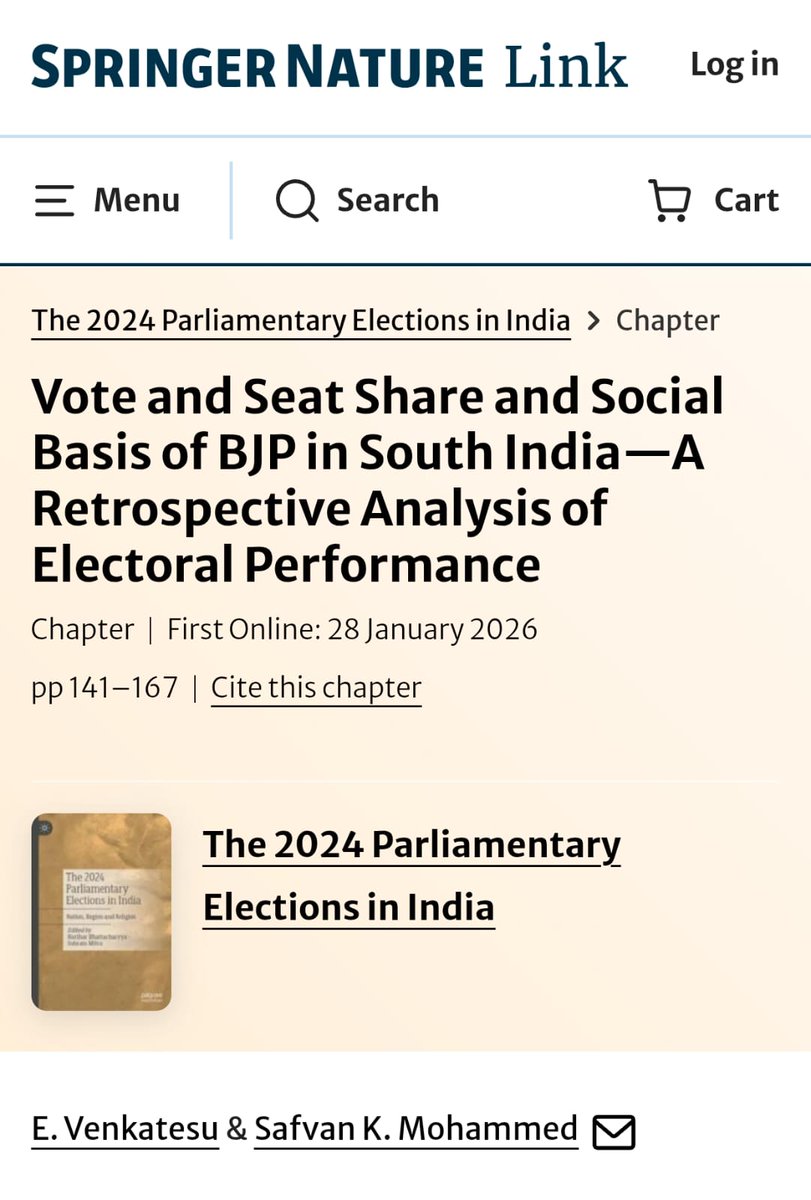
@kailashkk, faculty and Emlin Thomson, PhD Scholar @uohpolsci, have co-authored a chapter "Breaching a Closed Party System: The BJP in Kerala", in the book "The 2024 Parliamentary Elections in India".
Read here: https://t.co/j6ZPVN50ZE
@HydUniv@School_SocialSc@CommunitasPolSc
Looking forward to being at the @LawsOfSocialRep conference in Delhi, and also the film by @parodevi commissioned by the project. Discussions with colleagues old and new, await!
@uohpolsci
@ShreyakSugathan, Research Scholar at @uohpolsci, co-authored an article titled "Aymanam Model: Breaking Gender Norms Through Fitness Training", published in @FeminismInIndia.
Read more 👇
https://t.co/CGmZcw8eWU
So-called objective metrics in academia disadvantage women. Letters of reference for women tend to have less stand-out adjectives. Women's papers are cited less, their grants are smaller on avg & their papers have a harder time getting past reviewers.
https://t.co/CSwmxsx9yt