🍱Realising Rights: An Introduction to the Handbook of Welfare in India
✍🏽 @sinhadipa & @rajendran_naray
Read excerpt from the 'Handbook of Welfare in India' which maps evolution of major socio-economic policies in India. 1/2
https://t.co/dI5OJGuTF6
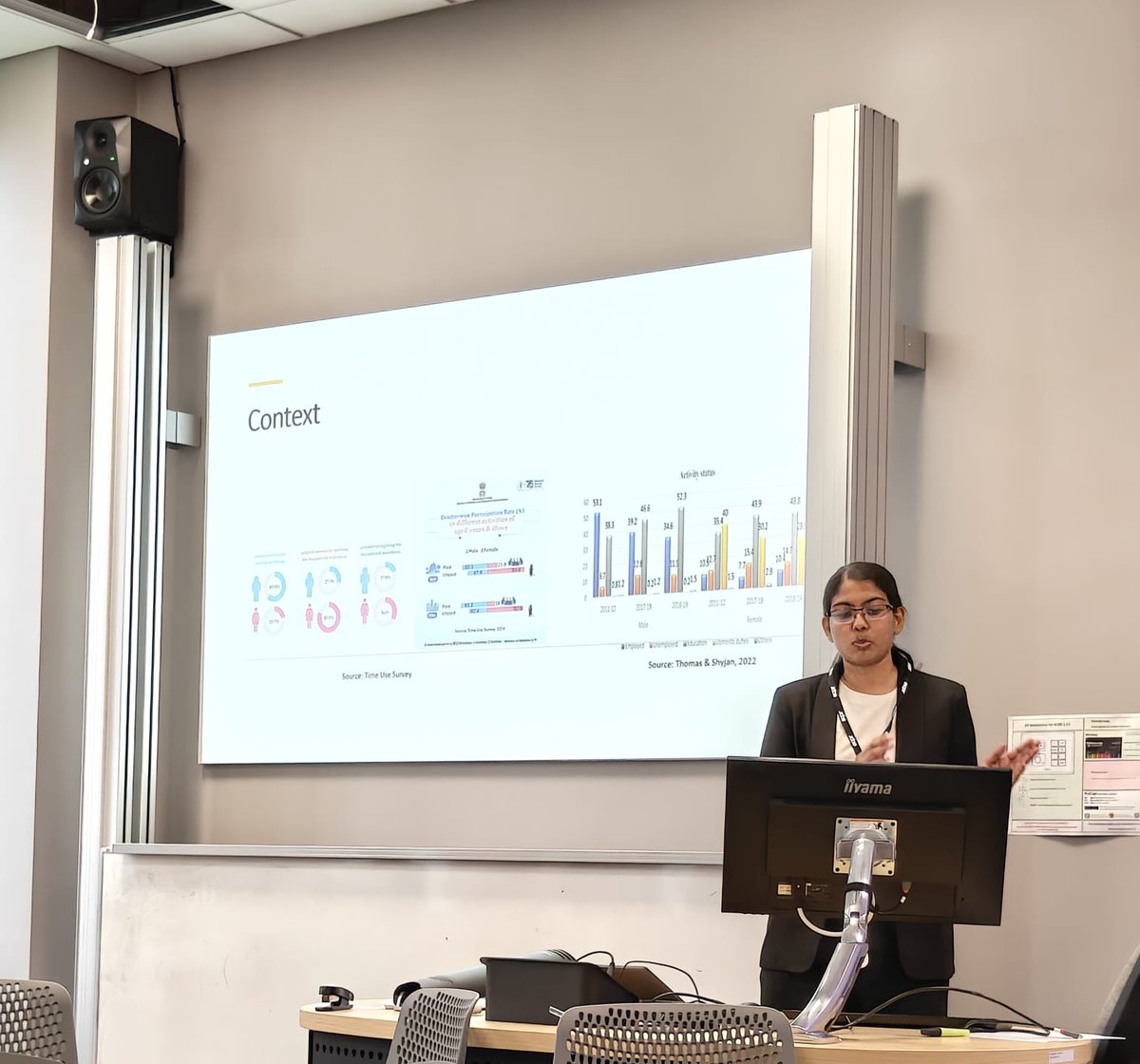
@ShreyakSugathan presented two papers at the European Conference on Politics and Gender, organised by the European Consortium for Political Research (ECPR) at Newcastle University Newcastle University from 15-17th June.
@HydUniv, @ECPR, @UniofNewcastle#ECPG#PoliticsAndGender
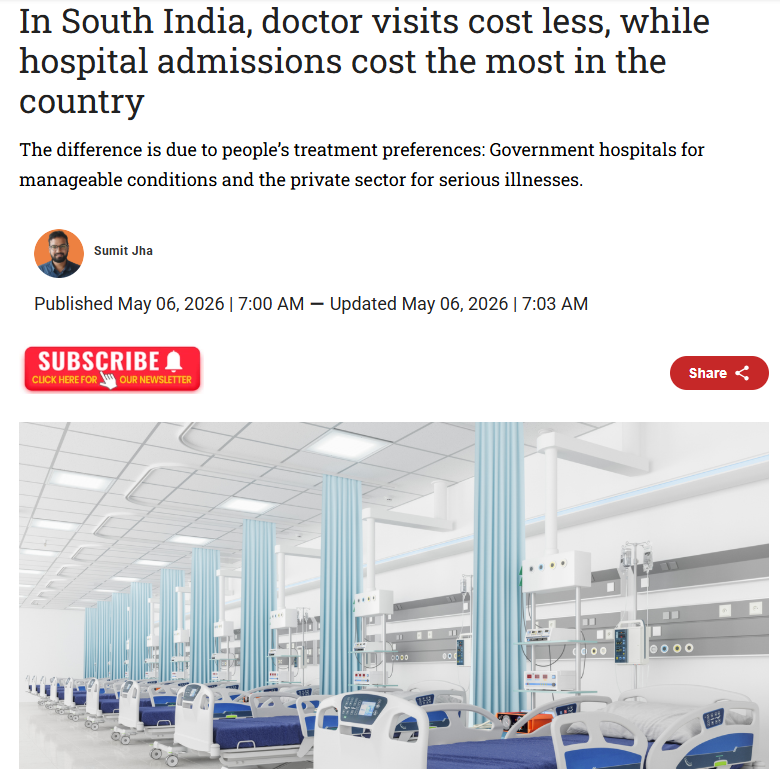
You live in the South. You believe your healthcare is better than the rest of India.
You are right. And you are wrong.
NSO survey reveals the paradox sitting at the heart of southern healthcare that nobody talks about openly.
Kerala charges ₹583 for a doctor's visit. Karnataka ₹629. Two of the cheapest states in the country for routine medical care. Tamil Nadu sends half its sick population to government hospitals for nearly nothing.
Now imagine you stop needing a doctor and start needing a hospital.
Kerala's hospitalisation bill climbs to ₹35,338. Tamil Nadu's hits ₹44,535. Telangana's reaches ₹46,316, the highest among all major states in India. Karnataka sits above the national average too.
The South has built public clinics so effective that your fever, your diabetes check, your routine prescription costs almost nothing.
Then it built private hospitals so dominant in serious care that when illness turns critical, the bill arriving in your hand is among the highest in the country.
The South socialised the cost of daily illness. It privatised the cost of serious illness at a premium.
A routine cold costs you ₹583 in Kerala. The same person's cardiovascular treatment in a private hospital costs ₹70,456.
This is not a coincidence. This is a system working exactly as it was built, and the new national survey has finally put the numbers to it.
Read the full story:
New podcast just landed - listen in to @AiyarYamini and I as we unpack the 'double engine' sarkar idea and discuss questions of partisan bias, erosion of federal restraint and the constrained fiscal autonomy of all states
A fulfilling experience as a mentor during a two-day capacity building workshop for PhD students across India @iitroorkee jointly organised by SPPU-IITR and funded by @SIDA and @AssociationforAsianStudies
The latest issue of SAMAJ contains a topical and fully open access special issue on Indian Federalism and its Discontents - looking at the implications of BJP dominance for Indian federalism today and in light of the unfolding delimitation debate
https://t.co/j8D5oOSofj
Delighted that @KingsCollegeLon and Inlaks Shivdasani Foundation have just renewed their agreement for fully funded PhD sscholarships for Indian nationals - up to 6 will be awarded over the next 3 years. Call will open in Feb.
https://t.co/9tawAhf14O
A new special issue of World Development has just landed on the future of work and welfare in India’s halting structural transition @WorldDevJournal - co-edited by Sunil Mitra Kumar, Soumya Mishra and me, with a superb set of contributors 1/12
@ShreyakSugathan writes, "Here is to hoping that such stories of growth and self-discovery will be told again and again until prioritising oneself becomes guilt-free for women everywhere."
Along with the progress in mental and physical health, the fitness centre has become a space where they experience life differently from their usual roles and routines.
https://t.co/j8WQ4t4PiH
@ShreyakSugathan succinctly argues that increased gendered political participation is contingent upon political parties providing a safe working environment. She weighs in on the need to extend the POSH Act to political parties.
In this EPW commentary, I reflect on the relevance of the plea filed in the Supreme Court to extend the POSH Act to political parties—and what it reveals about gendered power and safety in Indian politics.
@HydUniv@uohpolsci @jyotirmaya5605 @kailashkk@BanerjeeSne@abhijith02_
I am deeply grateful to @AiyarYamini - someone who has contributed so much to understanding India’s welfare state - for this thoughtful and thought-provoking review of Making India Work @CambridgeUP@KingsIndiaInst
What shapes political science research in India? Abhijith Nair & Shreya K. Sugathan explore doctoral theses, research methods and the impact of university courses and training on research in political science. https://t.co/rmGvLTOOPe
#Research#TeachingLearningPoliticsInIndia