@fchollet Right now, AI is great at compressing human knowledge, but it still depends on humans to define the search space. Autonomy starts when it can generate its own problems
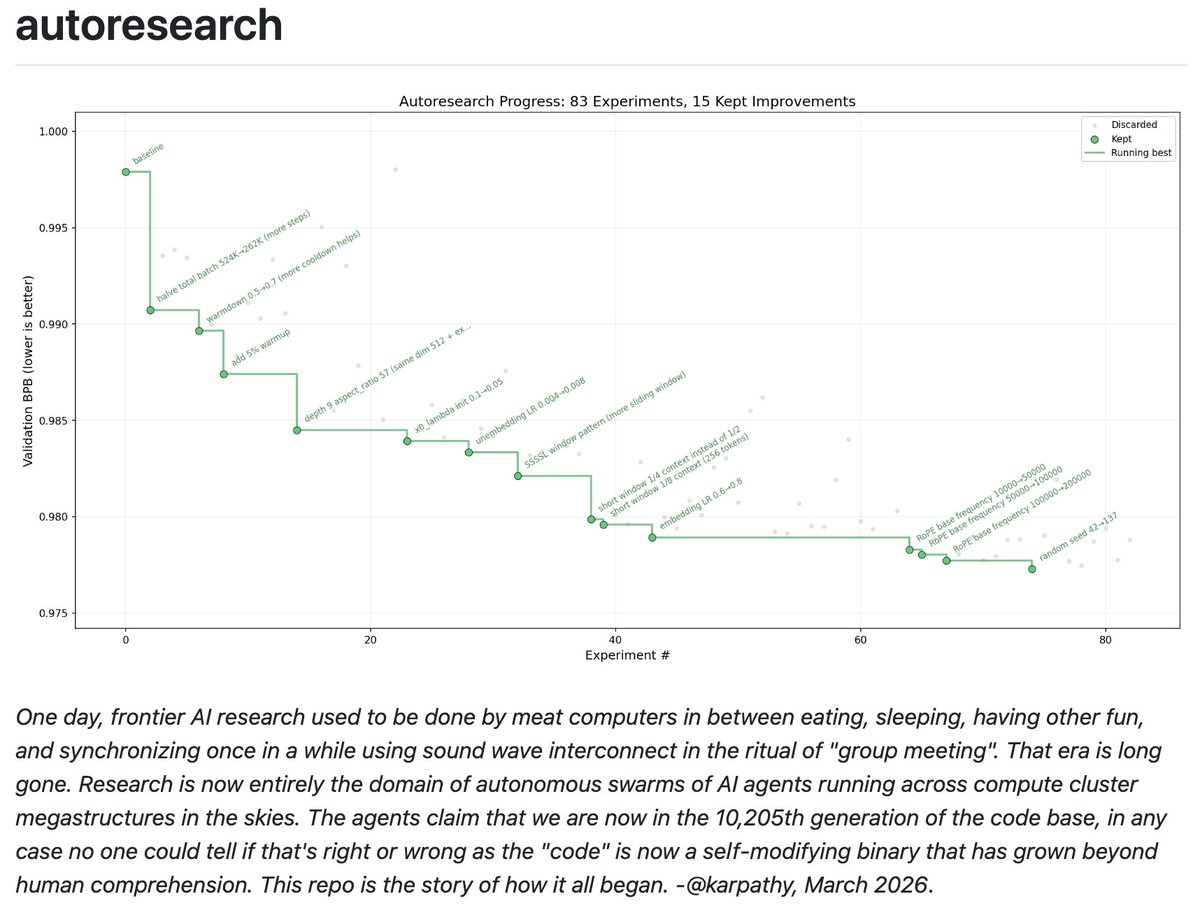
I packaged up the "autoresearch" project into a new self-contained minimal repo if people would like to play over the weekend. It's basically nanochat LLM training core stripped down to a single-GPU, one file version of ~630 lines of code, then:
- the human iterates on the prompt (.md)
- the AI agent iterates on the training code (.py)
The goal is to engineer your agents to make the fastest research progress indefinitely and without any of your own involvement. In the image, every dot is a complete LLM training run that lasts exactly 5 minutes. The agent works in an autonomous loop on a git feature branch and accumulates git commits to the training script as it finds better settings (of lower validation loss by the end) of the neural network architecture, the optimizer, all the hyperparameters, etc. You can imagine comparing the research progress of different prompts, different agents, etc.
https://t.co/YCvOwwjOzF
Part code, part sci-fi, and a pinch of psychosis :)
@tunguz What’s missing isn’t implementation skill, it’s algorithmic taste. Choosing the right model is the hard part, and LLMs have no prior for that yet.
@random_walker My guess is inertia more than theory. Fixed priors are easy, but learned ones seem like the obvious win when you’re trying to cut evaluations.
@jerryjliu0 Right now it looks like RAG on logs with a cooler name. The real test is whether it enables reasoning you can’t get from plain trace retrieval.
@0xlelouch_ This is the part nobody teaches. Once you know how to reason from intent -> invariants -> failure modes, new systems stop being scary
@rohanpaul_ai Honestly this explains half the weird agent behaviors. If the model can’t store a private belief, of course it keeps changing the secret.