🧵 Day 30/30 — #SystemDesign
Most people fail System Design interviews before they even start designing.
Not because they don’t know Kafka, Load Balancers, or databases…
but because they jump into architecture without understanding the problem first.
System Design interviews are less about “perfect architecture” and more about structured thinking under constraints.
A strong system design approach usually looks like this:
→ Clarify requirements
→ Estimate scale (users, traffic, storage)
→ Design high-level architecture
→ Identify bottlenecks
→ Discuss databases, caching, queues, scaling
→ Handle tradeoffs
→ Think about failures, reliability, monitoring
Interviewers want to see how you think, communicate, and prioritize.
One of the biggest mistakes candidates make:
Trying to sound “advanced.”
People randomly add:
→ Kafka
→ Microservices
→ Redis
→ Kubernetes
even when the system doesn’t need them.
Good engineering is not adding more tools.
It’s choosing the right level of complexity.
Another important skill is discussing tradeoffs clearly.
Example:
→ SQL vs NoSQL
→ Consistency vs Availability
→ Monolith vs Microservices
→ Poll
As a developer, it's helpful to understand how databases work as they're a critical part of many applications.
But to effectively manage the data in your DB, you have to set some rules - or constraints.
In this guide, @AwedaIdris explains how Relational Database constraints work and why they're important.
https://t.co/oMbYyoQqvd
Most developers use Kafka.
Far fewer understand how Kafka actually works internally.
Here’s a simple Kafka Internals cheat sheet 👇
- Partitions
- Consumer Groups
- Replication
- Offsets
Follow @patilvishi for more system design content
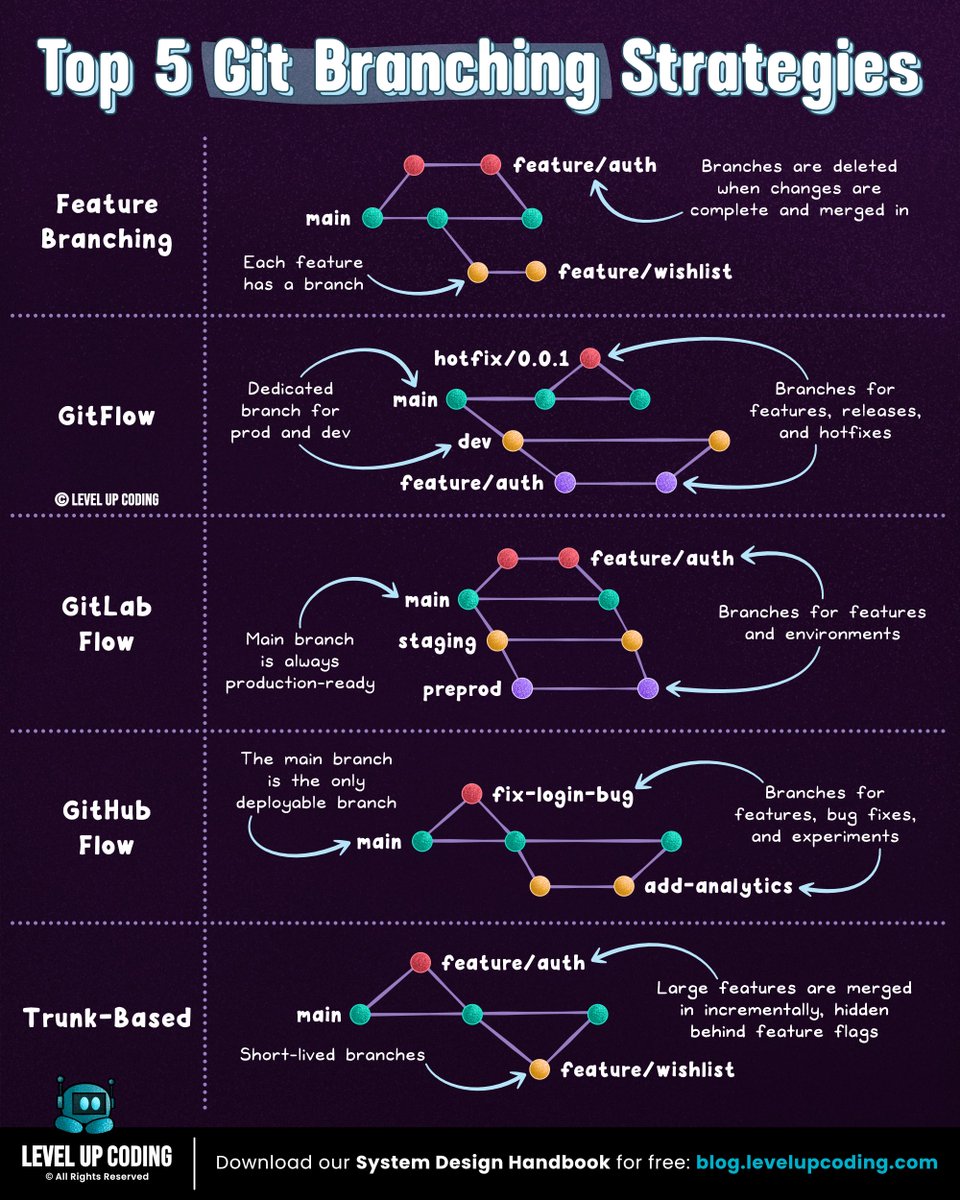
Git branching strategies: Do you know the differences?
𝗙𝗲𝗮𝘁𝘂𝗿𝗲 𝗯𝗿𝗮𝗻𝗰𝗵𝗶𝗻𝗴 keeps each feature in its own branch, isolated from the main branch; making pull requests easier to review. Once complete, the feature is merged back into main.
𝗚𝗶𝘁𝗳𝗹𝗼𝘄 uses two long-lived branches: dev for development and main for production. Features are built in separate branches, then merged into dev. Releases are prepared in dedicated branches before merging into production.
𝗚𝗶𝘁𝗟𝗮𝗯 𝗳𝗹𝗼𝘄 combines feature branching with environment-based deployment workflows. Changes move through environments like staging before reaching production, making it well-suited for CI/CD and staged releases.
𝗚𝗶𝘁𝗛𝘂𝗯 𝗳𝗹𝗼𝘄 simplifies things. The main branch is always deployable. Developers create short-lived branches, open pull requests, and merge once approved, often triggering deployment.
𝗧𝗿𝘂𝗻𝗸-𝗯𝗮𝘀𝗲𝗱 𝗱𝗲𝘃𝗲𝗹𝗼𝗽𝗺𝗲𝗻𝘁 minimizes branching. Changes are merged into main frequently, supported by strong automated testing, CI pipelines, and feature flags to maintain stability.
Each strategy solves the same core problem: How do teams move fast without breaking the system?
But most issues don’t come from the branching model, they come from inside the branches: unclear changes, weak reviews, missing context.
That’s what CodeRabbit Agent helps solve.
A single agent inside your workflow that follows work end-to-end. It pulls your org’s context into one place and helps teams investigate, plan, and execute work directly from Slack.
So instead of losing context between branches, your work stays connected as it evolves.
𝗧𝗿𝘆 𝗖𝗼𝗱𝗲𝗥𝗮𝗯𝗯𝗶𝘁 𝗔𝗴𝗲𝗻𝘁 𝗳𝗼𝗿 𝗳𝗿𝗲𝗲 → https://t.co/J6Kk2oBYKy
What else would you add?
——
♻️ Repost to help others learn and grow.
🙏 Thanks to @coderabbitai for sponsoring this post.
➕ Follow me ( Nikki Siapno ) to improve at system design.
Building a payroll system is a great way to practice real-world backend development skills.
Payroll systems are crucial - and you don't want servers getting blocking errors or timing out.
In this in-depth guide, @webmekanic_ walks you through building a payroll system with Express and Monnify using background jobs.
https://t.co/WECtNbXFAe
Ranking on Google goes beyond keyword research. It's really all about usefulness.
In this article, @casweb_dev shows you how to build landing pages that match search intent, load fast, and guide users to action.
He covers layout, messaging, and SEO fundamentals that'll help improve your traffic and conversions.
https://t.co/yp6eJkf8Uk
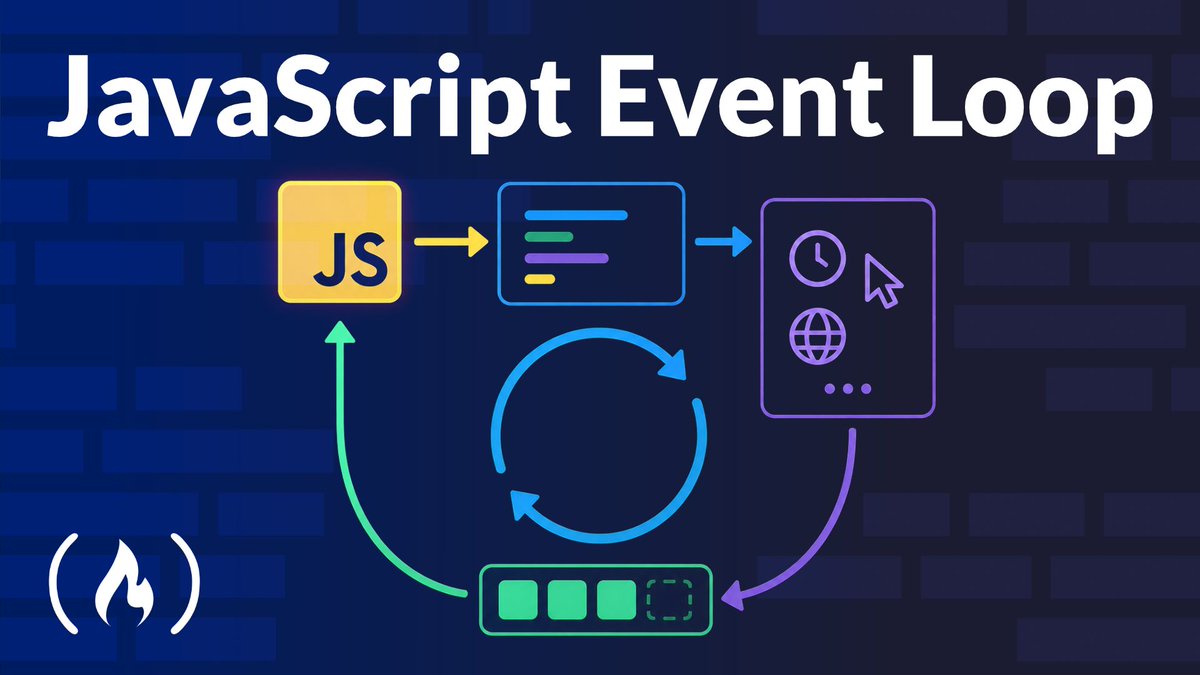
JavaScript is single-threaded, but it can still handle async work.
In this course, you'll learn all about the event loop, call stack, task queue, and microtask queue.
You’ll also learn why promises run before timers and how async code really executes, all with helpful examples.
https://t.co/pXBXa9M8Dt
Docker is a tool you'll likely work with often as a dev.
And whether you're containerizing an app or optimizing workflows, there are certain key concepts to know.
In this guide, @caesar_sage explains build context, features, and architecture along with common issues and fixes.
https://t.co/znzcLOEL5S
Postman is a popular tool you can use to test your APIs.
It helps you make sure any new features you add don't break your existing code.
Here, you'll learn all about debugging endpoints, automating the testing process, and more.
https://t.co/PET5nLBR2X
Every backend needs to know how to deal with payments.
A simple introduction to payment retries.
Any system that handles payments needs to be Reliable and build Fault tolerance.
It sounds scary at first glance, but one of the simplest ways is to track the payment state.
If a failure occurs, we can access the current state and decide whether to retry or if you need to refund.
For this, we can store the payment state, which can persist in an append-only database table.
Another two components that can help are a Retry Queue and a Dead Letter Queue.
• Retry queue: it is used to retry transient errors.
• Dead letter queue: if a message fails many times, it lands in the dead letter queue. It is useful for debugging and isolating problematic messages for inspection to determine why they were not processed successfully.
In the following Diagram:
The payment process encounters a failure.
The system checks if the failure is retryable.
If the failure is retryable, the failure is sent to the Retry Queue.
If the failure is not retryable, the failure is logged or recorded in a Database.
Messages in the Retry Queue are reprocessed by the Payment Service.
If the retry fails, the process moves to the next retryable check.
The system checks again if the failure is retryable.
If the failure is not retryable, the message is sent to the Dead Letter Queue for further investigation.
Messages that fail after many retries and are deemed non-retryable are sent to the Dead Letter Queue.
Exactly-once delivery is another concept we need to explore. But that’s the topic for another post I’m cooking.
Sometimes, learning requires more than 3 retries; keep pushing!
You can read the full article here 👇
https://t.co/y8ln136pXs
If you're a beginner learning web development, here's a course for you.
You'll build a weather app that displays real-time weather data with a 7-day forecast.
You'll use the Next.js framework, Tailwind CSS for styles, & TypeScript to add strong typing.
https://t.co/9m90npoim2
Whenever you visit a website, your device talks directly to another server on the internet.
Everything is visible - your IP address, location, & basic network info. And sometimes you don't want that.
This is where a proxy server comes in handy. And here, @manishmshiva explains what they are & how they work.
https://t.co/DlDKD8CX3V
If you want to learn full stack web development, this MERN stack course is a great place to start.
The MERN stack is made up of MongoDB, Express, React, and Node.js and is a popular way to build web apps.
In this course, you'll set up the back end, learn about controllers, middleware, and rate limiting, build the pages of your app, & lots more.
https://t.co/YGxtNxIPhk
Storing long-lived AWS credentials in your GitHub repo isn't a great idea.
In this guide, @tolani_akintayo teaches you how to use OpenID Connect so GitHub Actions can assume AWS roles with short-lived tokens.
You’ll set up IAM trust, roles, and workflows for more secure deployments.
https://t.co/4uvp1VZVXI
Most DevOps engineers can deploy to Kubernetes.
Very few can explain what happens on the network when they do.
That gap is why debugging networking issues feels like guesswork — and why so many engineers avoid infrastructure problems they don't fully understand.
But the good thing is: you don't need to know everything about networking. You need to know the 20% that covers 80% of what you'll actually use on the job.
In my latest video, I break down exactly that — from physical servers, VMs, cloud, Docker, all the way to Kubernetes networking — using one real-world example the whole way through.
No dry theory. Just the concepts that actually come up when things break in production.
If you work with containers, cloud, or Kubernetes — this one is worth 40 minutes of your time.
🎥 Watch the complete guide here: https://t.co/3u41DJhOgC
What was the networking concept that confused you the most? Drop it in the comments 👇
When you're writing code, you need to think about designing systems that are scalable and maintainable.
And inefficient software design can lead to issues like scope creep, miscommunication, delays, and so on.
In this guide, Soham teaches you Software Design basics along with some helpful best practices to follow.
https://t.co/X4xpKkQvO5