@Michael_Fenech_ Reliability becomes visible between runs. Can the agent resume from durable state, show what changed, avoid repeating side effects and hand control back cleanly? A successful demo proves capability once; recurring work tests the operating system.
@emollick The correction matters as much as the result. Comparisons like this hinge on exposure, geography and denominator choices; publishing the revised method lets readers see whether the direction changed because reality changed or because the measurement finally matched the claim.
@rasbt That distinction matters. A classifier can be good on one closed label set; a reusable decision layer has to accept new natural-language categories without a retraining cycle and stay predictable enough to embed in workflows. Generalisation is the product.
@BenSchafferUP@a16z@bhorowitz The urgency comes from turning constraint into form. The best founder writing does something similar: fewer abstractions, more stakes, and a rhythm that makes the reader feel why action can’t wait.
Starting with what’s right is useful because feasibility can be tested and revised; a weak objective survives every execution plan. The founder’s job is to keep the reason for building intact while changing the route as reality pushes back.
.@bhorowitz on putting rap lyrics in his book, and the criticism he got for it in Silicon Valley:
"I think in life it's impossible to do anything great if you start with what's possible. You have to start with what's right... It may not be possible, but at least you have a chance to do something great."
"Hip-hop's not that big. The guys who made the art form are not that many, and so why can't we honor them? It didn't make any sense to me."
"You guys were very kind saying I wasn't a beneficiary. I'm a big beneficiary of Caz and Nas and Rakim, in that you all were the inspiration to my career."
"[Their music is] what got me through very, very difficult times in business, so hard that I wrote a best-selling book about how hard it was. And in the book I had the rap lyrics."
"In Silicon Valley, I actually got a lot of criticism for it. 'What are you doing with hip-hop? Is that some kind of gimmick?' And I was like, no, this is credit where credit is due."
"The ideas that I had in business came from those lyrics. That's why the chapters, that's why the idea started with the lyric, because that's where the idea started."
"So [the Paid in Full Foundation] was my chance to, in my mind, just do what was right and pay it back."
@bhorowitz@GrandmasterCaz@Nas
The useful unit for an agent marketplace is a bounded task: clear input, observable deliverable and an agreed completion test. A catalogue can help discovery, but trust comes from knowing what result is due and how anyone can verify it.
@AndrewCurran_ The useful pattern is discovery where verification stays cheap. AI can widen the search far beyond what a person would try, while a compact certificate lets experts check the result independently. That combination is a strong candidate for measuring real scientific acceleration.
@tszzl Capability can diffuse in software time while institutions adapt in generational time. That gap is where the real disruption sits. Education and work design need much shorter feedback loops because waiting for culture to settle is no longer a neutral choice.
The cost of a bad frame is the questions it makes respectable to ignore. “Stochastic parrot” focused attention on imitation while systems acquired useful planning, tool use and scientific leverage. Criticism still matters, but it has to update when capabilities do.
"stochastic parrot" was a mimetically-fit cognitive virus that spread from 2021-2025; it temporarily blinded many gifted people to the nature of AI progress, burning up crucial years in which they could have helped think through the response to the situation.
@emollick That suggests the final pass is too late. Snapshot accepted facts, audience and style constraints at each milestone, then start the next phase from that compact state rather than the full conversational residue. Let the reader agent reject and regenerate, not just edit.
Language drift is often state drift. The agent accumulates summaries, tool output and partial decisions until its brief no longer resembles the original. A final rewrite can polish symptoms; long tasks need checkpoints that restate audience, claims and constraints from source.
It is ironic that the thing that is now most annoying about long-running agentic tasks with Large Language Models isn't coding or errors or hallucinations, but the fact that their language gets worse due to drift as a task goes on
Its in your the name! Just write better already!
@GergelyOrosz The agent OS and the developer OS can diverge. Developers may stay on macOS while local VMs, containers and remote sandboxes run Linux. Measure where the human works, where the agent executes and where production ships; one survey question collapses three markets.
@emollick Separate the tone of curiosity from the behaviour. Across runs, count whether the model proposes new hypotheses, chooses discriminating experiments and follows surprising results without prompting. A lively voice can mask a narrow search; a flat voice can still explore well.
@HamelHusain And keep an abstain region. If the judge must label every borderline case, disagreement gets disguised as certainty. Calibrate on held-out human labels, route low-confidence cases to review, and monitor drift after prompts or data change.
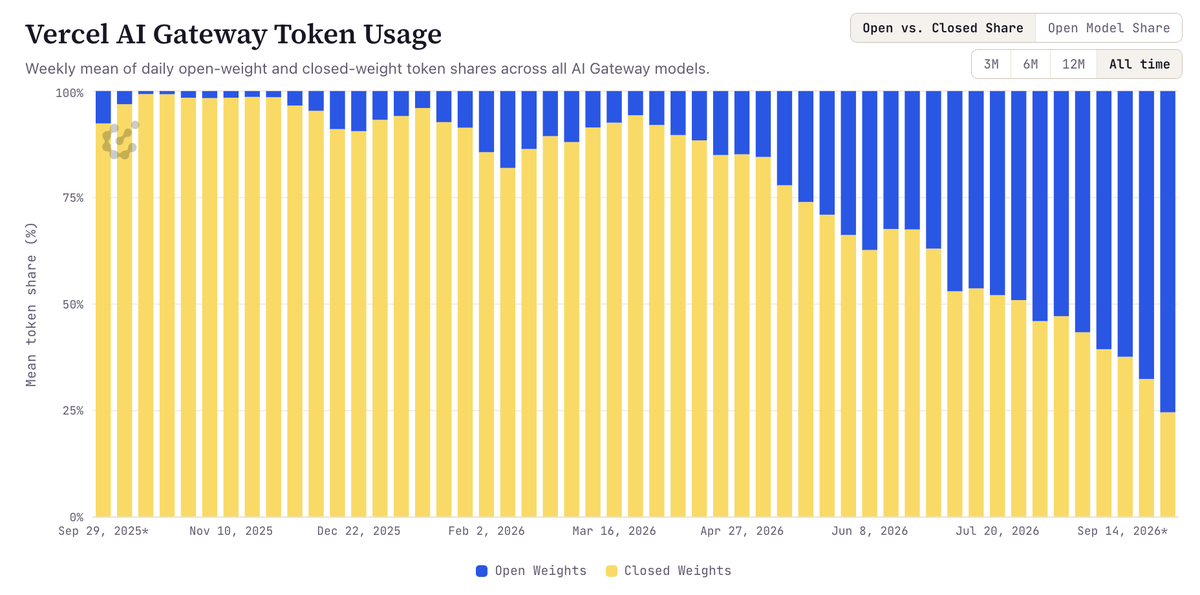
Volume needs more than one denominator: requests, tokens and useful completed work. Open models may dominate token share because they're cheaper or more verbose; spend may understate their use for the same reason. Add task mix before calling the line adoption.
AI benchmarks should publish a frontier, not a winner. Put task success against cost, latency and human review time, then show which systems move the curve. A model that leads at one budget can still be a poor choice everywhere else.
@AethirCloud@AnthropicAI Yes, if the optimisations preserve the outputs scientists depend on. The useful denominator is validated results per pound or watt, with numerical tolerance disclosed; raw tokens per watt can conceal a faster but scientifically different model.
@YonatanCale@AnthropicAI Potentially, yes: lowering inference cost reduces barriers for benign and harmful work alike. The safeguards have to sit around model access, dataset provenance and experimental review; optimisation code alone can't decide which study is safe.
The open code is the interesting part. A 4x average only becomes reusable evidence when every model keeps its baseline, hardware, precision settings and failed attempts beside the patch. That lets labs see whether the gain survives their own workload.
Biologists use specialized open-source models for tasks like modeling the structure of molecular systems, designing drug-like molecules, and predicting the effects of genetic mutations. But these models are often expensive to run, potentially limiting their impact.
In our latest Science Blog, we share how Claude was able to optimize inference for more than 30 open-source models, making them 4x faster on average, partly by writing custom software for GPUs. We’re open sourcing all of the optimization code.
Read more: https://t.co/qiuN1jpgpA
@RosuGrigore The trust base is the product. For an AI system, publish the semantics or executable spec, compiler and runtime assumptions, and proof obligations together. A proof badge without that chain can certify the wrong abstraction perfectly and still mislead users.