Top scientists say the recent review, which states vaping causes cancer, overstates the risks by using selective evidence and weak methods. @mohfw_India
https://t.co/9IgJ3djhk3
Article points out India is hitting the cap beyond which raising cig tax will do more harm. Here on, the most effective means to reduce harm would be to allow access to low-risk substitutes.
@PMOIndia@JPNadda@nsitharaman@piyushgoyal@NITIAayog@kharge
https://t.co/s4PRENPuO9
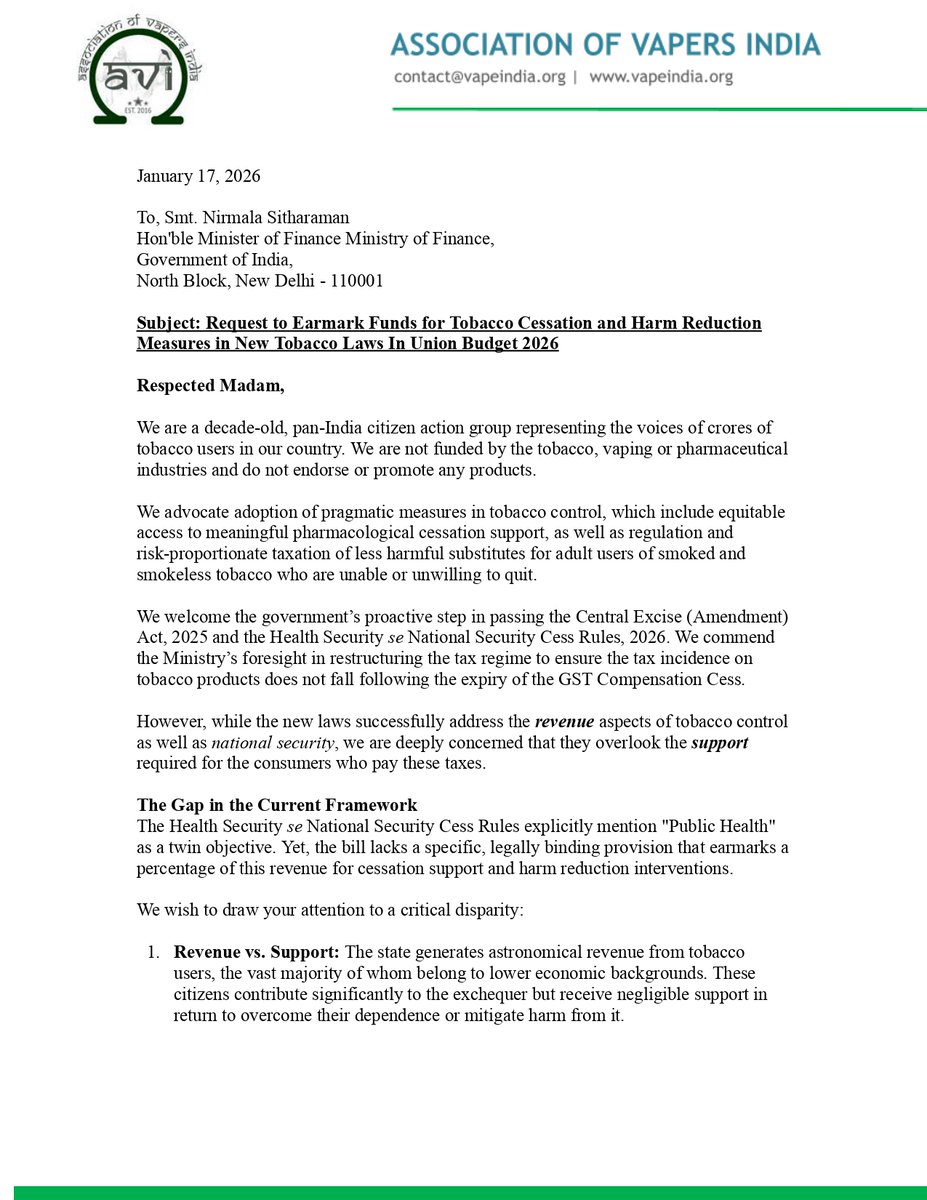
We have written to Hon'ble FM ahead of #Budget2026 to seek earmarked funds in the new tobacco laws for cessation support, which is currently a meagre 0.07% of tobacco tax revenue. We have also sought inclusion of pragmatic harm reduction measures in tobacco control.
India's failed vape ban: E-cigarette seizures (~10% of the black market) rose 7100% in 2 years!
These untested products are easier for youth to access, pose health risks to adult smokers trying to reduce harm (vaping is 95% safer), and cause major tax loss. #EndVapeBan
Ex-ASH director Clive Bates concludes the recent @icmrdelhi study adds no useful insight and may mislead the public by implying vaping causes heart attack or stroke, potentially discouraging smokers from switching to a safer alternative. @PMOIndia
We inspect 4 key agendas for FCTC #COP11 and find them unfit for Global South where 80% tobacco users live; and propose a Fund to help poor nations develop context-based policies than the current top-down coercion.
@WHO@fctcofficial@mohfw_India
https://t.co/GJ0Sx6cZhD
We see new campaign of lies against vaping with hashtag #VapeFreeBharat.
5,500 kids start smoking/khaini in India everyday, 9% are regular users. A tiny number (way <1%, rich kids) are vapers.
Let's focus on the real problem.
@narendramodi@jpnadda@rahulgandhi@amitmalviya
"The idea was that you just kept puffing in high-stress environments and work deadlines. It just seemed like a convenient thing to do...but then it became a habit."
https://t.co/meEvZPdL8S
@gulbahaara dives into the banned world of vaping in India. Why are Indians still using it?
More Indian doctors – Dr Pawan Gupta from BLK-MAX Hospital and Dr Sunaina Soni from AIIMS-CAPFIMS – are calling for harm reduction strategies, including regulated access to safer alternatives like vaping & pouches.
@PMOIndia@JPNadda@kharge@RahulGandhi
https://t.co/BLZwHYp1uw
Fair mapping of tobacco control hurdles by @IndiaToday. Our brief critique follows: first, there's no mention of tobacco harm reduction measures, which have led to steep smoking declines in pro-THR nations.
https://t.co/3AnJXljsP6
Second, we are happy that some of the new ideas we have been talking about—increasing taxes is not a magic pill and needs to be backed by wider and meaningful cessation support, the disconnect between COTPA and the undue focus on awareness without backing it with effective pathways—are gaining support in the TC community.
But here lies the problem: all the people quoted in the article are part of a very small cabal, in major part funded by a single prohibitionist US nonprofit backed by WHO, which decides the nation's tobacco policies.
With varying degrees, each toe the line of their funders (PGIMER is among the biggest recipient of funds from Bloomberg Philanthropies), without investing original thought or reevaluating proposed policies in the Indian context. For instance, what is the point of barring a street vendor from point of display (PoS) advertising when his little stool is all he got?
All in this cabal are guilty, championing the vape ban in India where risk prevention is the most effective way to deal with issue as the public healthcare system is inadequate, as the article points out.
Here are some instances where the article sounds like a joke:
1) These are the same people who at the start of every budget session will write long articles on why taxing tobacco users, most from poor sections, is a 'win-win' strategy. See their fake sympathy now ;)
2) These are the same people who say, especially Dr Pankaj Chaturvedi who was quoted in TOI saying since hardly any users quit anyway, it's better to just focus on youth uptake prevention... yeah, lives of 270 million tax-paying Indians doesn't matter.
3) The article doesn't acknowledge that this tiny cabal of bureaucrats (who get invited on junkets and functions world over) and superbly funded NGOs are all linked to same funding source, and are pushing policies that are outright unimplementable in Indian context.
Template: we really really really need to ban, and then... govt isn't doing enough to enforce our policies so it's not our fault. If you advocate for growing mangoes in the desert and the crop fails, of course it is your fault. Why would anyone do this? The junkets and millions in funding?
These people have been in-charge of solving India's tobacco problem for two decades and have gotten nowhere, except they are all rich.
Yes, they fought decadeslong battles to restrict smoking and heartfelt kudos to them for that, but now they have too much baggage and have lost all touch with ground reality—they keep harping on quitlines, which they charge minimum $500k to set up one and then publish data claiming stopping at 2 weeks is considered quitting, lol. These are just show measures and easy money.
Then there is the issue of safer substitutes for deadly smoking and khaini/gutka, Both exist, and have shown tremendous potential to reduce use of toxic tobacco. Anyone interested in solving India's tobacco crisis would be interested in them, but because their funders have taken a hardline view, this cabal is parroting it by the word.
If we are to manage recreational nicotine use in modern India, this old cabal has to go. The system needs to be professionalised—we need more psychologists and therapists who understand addiction than the current lot of physicians and pomologists running the show.
We also need to find away to marry public health goals to market dynamics. 'Ban kar do' only and only means a few babus and netas will make money and not the state coffers. This cabal enables that, though we don't accuse anyone of collusion.
@Geeta_Mohan, your reporters did speak to a THR expert but simply incorporated his views without attributing anything to him. This isn't fair. Harm reduction is a well-known strategy in narcotics control and not everyone talking about it is an industry shill.
For that, we rate your article 5.5/10. Do better.
@vapeindia By denying a safer alternative to smoking in Vapes. The one thing that the "mother's against Vaping" will one day remember these words by John Greenleaf Whittier
For all sad words of tongue and pen, The saddest are these, 'It might have been'.
@mpprataprao@MoHFW_INDIA Youth must not vape, but it can help India's 120mn adult smokers as it's much safer than smoking, acc to US FDA, NHS, WHO etc (https://t.co/KwzHF0weZp) and 2x effective than NRTs (https://t.co/pUMOJJ4VwI). Govt should help both, not spread lies.
@PMOIndia@nsitharaman@JPNadda
Cost of misinfo: A Mumbai woman was harassed for using a vape days after health ministry published tweets falsely claiming use (https://t.co/1bIxbOIEbu) and possession (https://t.co/yCB76xaoN2) of e-cigarettes is banned in India. It also claimed vaping is as harmful as smoking (https://t.co/8QjBSSEkFU).
Some of these tweets now have community notes on them correcting the falsehoods, including the one retweeted by MoS Health, Mr Jadhav (https://t.co/gbxMGpJNOZ). Yet the real-world consequences are exactly what Dr Harshvardhan had pointed out in Parliament – that banning personal use & possession will lead to harassment of people and infringement of personal liberties and freedoms (https://t.co/4vVziOrF7o).
Thanks to smart actions by the woman and commendably quick justice by @MumbaiPolice, the culprit has been caught and booked (see article below). But the culpability of the health ministry in facilitating harassment of lay Indians by spreading fake info cannot be ignored.
This incident has become known, but thousands of Indians across the country are being harassed and fleeced on this issue, with one person in Bengaluru forced to pay bribe of ₹1L! In a rare instance, two cops were suspended in Bengaluru for extorting vape users (https://t.co/EWGVB9UKFN).
The problem is that despite official, written assurances by both Union home and health ministries that vape users won't be criminalised, the vape ban law (PECA) does not clearly state personal use and possession of vapes is not illegal. And now the health ministry is ad hoc tweeting, without basis, that use/possession is banned. We had infact sought an RTI reply from health ministry asking in yes/no if personal use and possession is banned and under which specific provision, but it refused to give a direct answer!
This wilful and unlawful ambiguity has emboldened corrupt cops and scamsters. There is urgent need for the government to settle this issue by clarifying that personal use and possession of vapes is not a crime.
Legal discourse: The argument that anything that is banned to sell must automatically be banned to use is faulty for three main reasons:
a) if that were so, why didn't PECA state as much, and why did Dr Harshvardhan assure Parliament that users won't be criminalised, along with home & health ministries?
b) many products across categories, including smuggled or duty/excise unpaid cigarettes and goods, are banned to sell, but not to use.
c) Some health ministry bureaucrats have argued the intent was to provide temporary reprieve – ostensibly to allow current vape users to transition back to deadly smoking, which is an evil in its own right as vaping is a 95% safer alternative to smoking – but even if this is true, when did the personal use ban come into force? What is the punishment or fine for this crime? Why is this being done clandestinely, without consulting Parliament? Any ban needs to be explicitly spelt out, not inferred or guessed. Is it being done this way as the govt too knows such a ban is untenable in courts?
We request the government, the opposition and the courts come to the rescue of thousands of tax-paying vape users in India whose only crime is to engage with recreational nicotine in safer ways instead of the govt-sanctioned deadly products such as cigarettes, bidis, khaini, gutka etc. which kill 13.5 lakh Indians every year. It is also not their fault that the govt's vape sale ban has utterly failed and these products are available in every panshop across the country.
@narendramodi@AmitShah@PMOIndia@HMOIndia@JPNadda@nsitharaman@piyushgoyal@AnupriyaSPatel@mpprataprao@drharshvardhan@BJP4India@RahulGandhi@kharge@Pawankhera@KapilSibal@INCIndia@MamataOfficial@derekobrienmp@MahuaMoitra@AITCofficial@mkstalin@ArvindKejriwal@AtishiAAP@mieknathshinde@AUThackeray@AjitPawarSpeaks@TOIMumbai@HTMumbai@mid_day@livelawindia@ANI@PTI_News@THMumbai@ndtv@TimesNow@republic@MLJ_GoI@PIB_India@PIBMumbai
Article: https://t.co/A5y7jlDQJD