We already dropped the news: Chain of Events is joining @hyvegroup.
But announcements only tell half the story, so our founders Charlie Meraud (@CharlieMero) and Michael Amar (@amarmic) sat down with John Furrier (@furrier) at The Cube, from @NYSE, to talk about what this means for Chain of Events, Signal Week, @RAISESummit, and @MACHINASummit, and what comes next.
The short version: the team stays, the formula stays, and everything gets bigger. This is meant for scale.
RAISE Summit is doubling. MACHINA is expected to grow three to four times its 2026 size. The Hyve Group brings Fintech Meetup into the same week as Signal Week, and US expansion is already on the roadmap.
But not everything is changing. The founding team, the formula that made the events successful, the content, the people, and the communities we have built around Signal Week, RAISE Summit, and MACHINA Summit remain exactly what they are.
The founders put it best: they are insiders of the industries they build for. The Hyve Group gives them the infrastructure to take that expertise global without losing what makes these events work.
This isn't an exit; it's the moment our founders stop building alone and start building at a scale big enough to match the industry we've always believed in.
Signal Week. Paris. July 6 and 7, 2027. The best is very much still to come.
MiCA didn't just regulate Europe's crypto market. It shrank it.
"I believe firmly that 80% of the exchanges in Europe will not survive MiCA."
Erald Ghoos (@okx ) took the stage to explain where that prediction comes from. Smaller competitors had been approaching OKX for over a year, ready to "throw in the towel". The burden goes beyond MiCA, the EU's Markets in Crypto-Assets regulation. It also covers DORA, the EU's rules on digital and cyber resilience, GDPR, the EU's data protection law, and the consumer protection safeguards built around all three. For firms without the technology to comply, it's a heavy build. His forecast: a wave of consolidation as the transition period closed.
That period ended on 1 July 2026. Only around 244 firms had been authorised across Europe by then, and an estimated 75–80% of pre-MiCA platforms are leaving or have left the European market.
Fewer players. Higher standards. A market built for institutions.
This is the conversation that shows how regulation is reshaping Europe's crypto market, and it is the conversation that Signal Week 2027 will take further, 5–7 July at the Palais des Congrès and Château de Versailles.
Watch the full conversation on YouTube. Link in the comments.
Is agentic payments the next wild west? Bybit’s CEO isn’t convinced.
“AI is only the means to the end.”
Asked by Brian McGleenon whether agentic payments, where AI agents make transactions on a user’s behalf, are the industry’s next frontier, Ben Zhao (@Bybit_Official ) took a more grounded view. AI doesn’t rebuild the rails, he argued: it runs on existing financial infrastructure as a tool, much like Excel when it first arrived. Bybit has already launched AI sub-accounts, separate accounts where a client’s AI agent can operate and even trade within set permissions. Clients are connecting their AI tools to Bybit’s API (the interface that lets software pull data from the exchange) to fetch price data and run analysis. What hasn’t followed yet is the trading.
The agents are plugged in. The trades are still waiting.
This is the conversation that separates the hype around agentic payments from what is actually happening, and it is the conversation that Signal Week 2027 will take further, 5–7 July at the Palais des Congrès and Château de Versailles.
Watch the full conversation on YouTube. Link in the comments.
Stablecoin volumes are now rivalling Mastercard’s. Should Mastercard be worried?
“I would say that’s an unfair comparison.”
Asked by @gazza_jenks (@TheBlockCo ) whether stablecoin transaction volumes, at times exceeding Mastercard’s own, are a concern, Christian Rau (@Mastercard ) pushed back on the comparison itself. Mastercard’s volumes reflect real-world economic activity: people and businesses paying for goods and services. Stablecoin volumes, he argued, are still driven to a large degree by crypto trading and financial transactions. Big numbers, but not the same kind of activity.
Volume is one thing. Real-world payments are another.
This is the conversation that tests how far stablecoins have really come as a way to pay, and it is the conversation that Signal Week 2027 will take further, 5–7 July at the Palais des Congrès and Château de Versailles.
Watch the full conversation on YouTube. Link in the comments.
Perpetual futures on Tesla. Traded from a self-custody crypto wallet. That’s where Yoni Assia saw TradFi and DeFi start to merge.
“That’s the beginning of that convergence of DeFi and TradFi.”
@yoniassia (@eToro ) took the stage to describe his own aha moment: trading perpetual futures, contracts that track an asset’s price with no expiry date, on Tesla and other regulated stocks, straight from a non-custodial wallet, one where the user holds their own keys. The next step is already in discussion: working with large decentralised lenders like Morpho to let tokenised stocks from eToro be used as collateral, so investors can borrow against them in decentralised finance (DeFi), financial services that run on blockchains without traditional intermediaries.
Regulated stocks. On-chain collateral. One market.
This is the conversation that shows how quickly TradFi and DeFi are converging, and it is the conversation that Signal Week 2027 will take further, 5–7 July at the Palais des Congrès and Château de Versailles.
Watch the full conversation on YouTube. Link in the comments.
You can’t legislate markets into one. You have to rebuild the rails they run on.
“To integrate markets, you have to move them onto shared ledgers, onto distributed ledgers.”
Peter Kerstens (European Commission) took the stage to explain why laws alone have not created one integrated European market. Today’s infrastructure is a set of separate institutions, “scotch taped together”, that spend their time reconciling accounts with each other. His answer: move markets onto distributed ledgers, a single shared record of transactions that every participant works from, and integration follows. The prize: a massive wave of investors and liquidity coming on-chain.
The Commission is already pointing that way. Its proposed Market Integration and Supervision Package would scale up the DLT Pilot Regime, the EU’s framework for trading and settling securities on blockchain, raising its cap to €100 billion per market infrastructure.
Shared ledgers. One market.
This is the conversation that shows how Europe plans to integrate its markets, and it is the conversation that Signal Week 2027 will take further, 5–7 July at the Palais des Congrès and Château de Versailles.
Watch the full conversation on YouTube. Link in the comments.
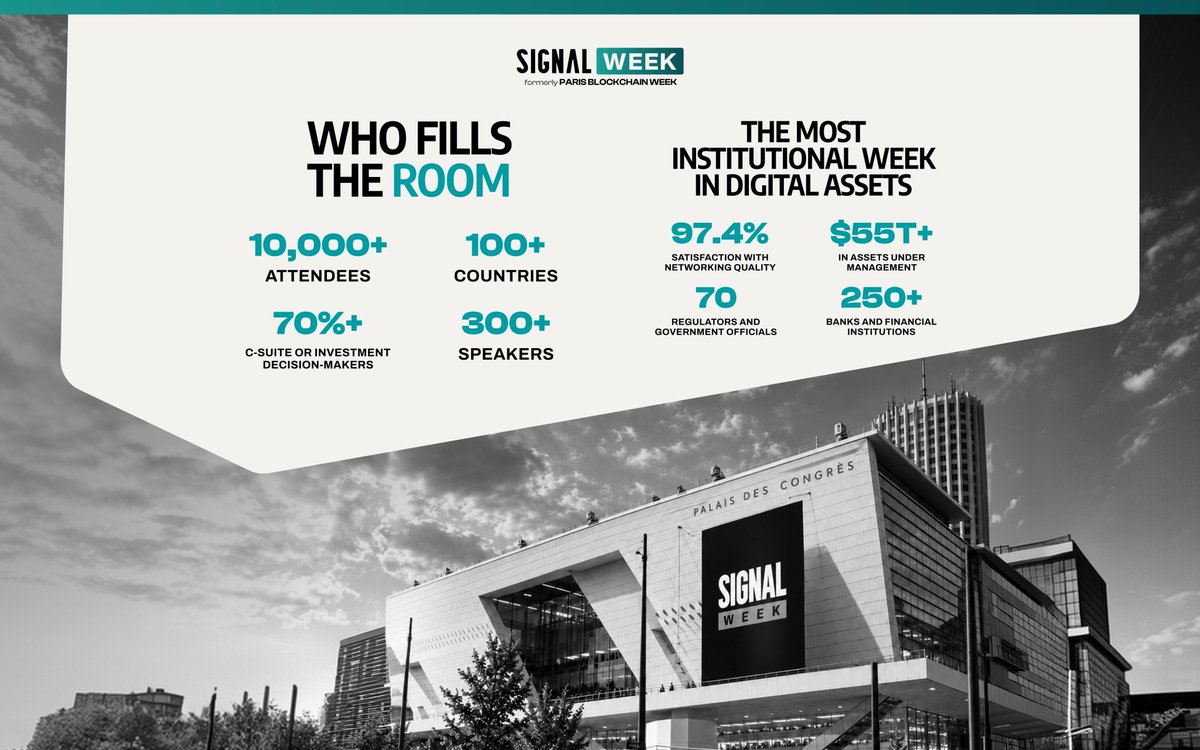
Signal Week has a new home: the Palais des Congrès.
From the Louvre to the Palais. The room got bigger. So did the stage.
→ 32,000 m² of space, a 3,723-seat Grand Amphithéâtre and 100+ conference and meeting rooms
→ 10,000+ attendees from 100+ countries and 300+ speakers
→ 70%+ C-suite or investment decision-makers
→ $55T+ in assets under management, 250+ banks and financial institutions, 70 regulators and government officials
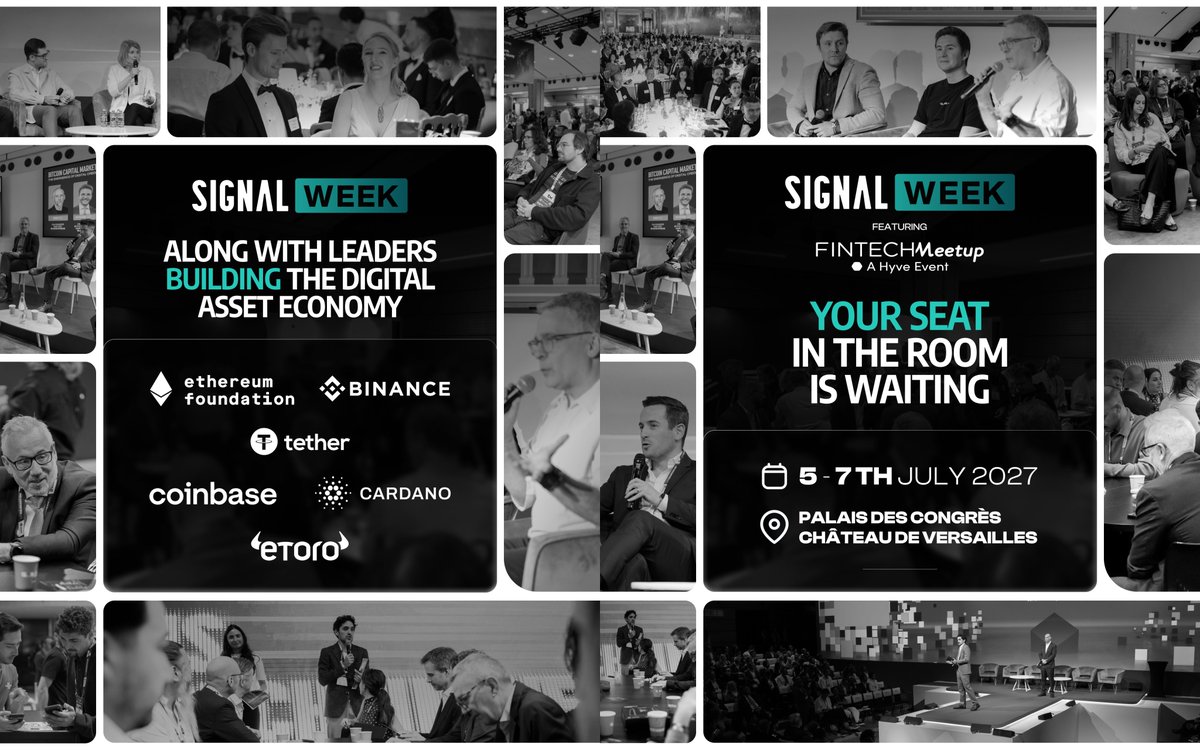
The institutions shaping global markets, from @BlackRock , @GoldmanSachs and @MorganStanley to @DeutscheBank , @bancosantander and the @LSEplc . Alongside them, the leaders building the digital asset economy: @ethereumfndn , @binance , @tether , @coinbase and more.
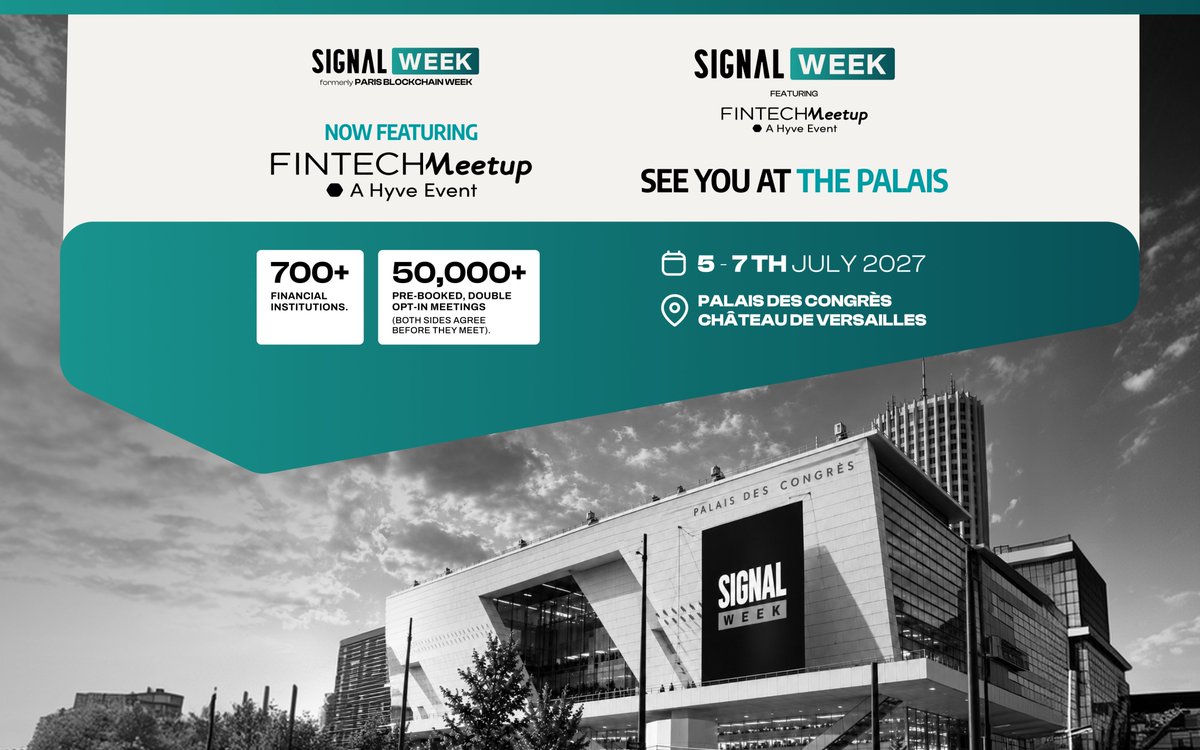
Now featuring Fintech Meetup, bringing 700+ financial institutions into the room.
The VIP Dinner stays where it belongs, at the Château de Versailles.
5–7 July 2027. See you at the Palais.
In the US, stablecoin holders can still earn yield, indirectly. In Europe, they can’t. That gap could decide who wins the global stablecoin race.
“We absolutely need to have an equivalence between the two obligations to make sure that European stablecoins can compete globally.”
Stephanie Cabossioras (@SocieteGenerale - FORGE) took the stage to unpack one of the least discussed differences between US and European stablecoin rules: remuneration, or whether holders can earn a return. Under the GENIUS Act, the US federal stablecoin law, issuers cannot pay yield directly, but holders can still earn it indirectly through crypto platforms. Under MiCA, the EU’s Markets in Crypto-Assets regulation, it is forbidden entirely. Her argument: without equivalent rules on both sides of the Atlantic, European stablecoins start the race at a disadvantage.
Same product. Different rules. Uneven competition.
This is the conversation that shows how regulation is shaping the global stablecoin market, and it is the conversation that Signal Week 2027 will take further, 5–7 July at the Palais des Congrès and Château de Versailles.
Watch the full conversation on YouTube. Link in the comments.
The institutions now meet in July.
Signal Week moves from April to 5–7 July 2027, at the Palais des Congrès and the Château de Versailles. New dates, the same room, now featuring Fintech Meetup.
This is where TradFi meets digital assets, and the numbers show it:
→ 97.4% satisfaction with networking quality
→ $55T+ in assets under management represented in the room
→ 10,000+ attendees from 100+ countries
→ More than 70% C-suite or investment decision-makers
The room brings together the institutions shaping global markets, from @BlackRock , @GoldmanSachs , @MorganStanley and @DeutscheBank to @bancosantander , @InvescoUS , @SPGlobal , @BNYglobal and the @LSEplc . Alongside them, the leaders building the digital asset economy: @ethereumfndn , @binance , @tether , @coinbase , and @eToro .
Update your calendar. Your seat in the room is waiting.
Institutions said yes to bitcoin. The money hasn't fully arrived yet.
"Institutions are more systematic and process-oriented than that."
Dr Adam Back (@adam3us, @Blockstream) joined @danheld on stage to explain why bitcoin has moved sideways despite the wave of institutional adoption headlines. The market heard "institutional adoption" and expected the buying to land immediately. But institutions move through committees, mandates and allocation processes, not news flow. In his view, most of that capital is still to come.
The headlines came first. The allocation follows the process.
This is the conversation that separates institutional adoption from institutional capital, and it is the conversation that Signal Week 2027 will take further, 5–7 July at the Palais des Congrès and Château de Versailles.
Watch the full conversation on YouTube. Link in the comments.
Signal Week is more than just the main stage.
The stage is where the conversation starts. The rooms around it are where it gets decided.
➡️ An evening at the Château de Versailles: 400+ senior leaders from traditional finance and digital assets at the invitation-only VIP Dinner, more than 90% of them C-suite
➡️ A private room for the C-suite: the CXO Summit, with $55T+ in assets under management represented and every seat reserved for invited executives
➡️ The Main Event: two days, 300+ speakers and 10,000+ leaders bridging traditional finance and digital assets
➡️ Networking at scale: Signal Week x @FintechMeetup, connecting our community with banks and fintech buyers in curated one-to-one meetings
Every room sends a signal. Which one will you be in?
Signal Week 2027 · 5–7 July · Palais des Congrès and Château de Versailles
@BlackRock manages the reserves behind USDC. And when $21 billion was liquidated in a single crash, its institutional bitcoin investors barely moved.
"We are the largest non-bank reserve manager for @circle USDC."
Nikhil S. (BlackRock) took the stage to share how the world's largest asset manager is building for digital assets on two fronts.
First, stablecoins as payment cash, the money that moves, paired with BlackRock's money market funds as investment cash, the money that earns. On its tokenised treasury fund in the US, investors earn yield while they stay in, then swap one-to-one into a stablecoin when they need to pay.
Second, conviction. After the October crash, when a cascade of deleveraging (leveraged positions forced to sell as prices fell) wiped out close to $21 billion, IBIT, BlackRock's flagship bitcoin exchange-traded product, saw only a tiny outflow.
The infrastructure is being built. The institutions are staying in.
This is the conversation that shows where institutional digital assets are heading, and it is the conversation that Signal Week 2027 will take further, 5–7 July at the Palais des Congrès and Château de Versailles.
Watch the full conversation on YouTube. Link in the comments.
Signal spotted in Lisbon.
Across @FintechMeetup Europe this week, Signal Week is on screen. Behind the screens, the first conversations of a collaboration that will bring financial services and digital assets into one room in Paris.
The banks, fintechs and payment leaders here are exactly who Signal Week 2027 is built for. Lisbon is where they first see the signal.
Still on site? Book a meeting with the Signal Week team before Fintech Meetup Europe closes on 8 October.
Signal Week 2027 · 5–7 July · Palais des Congrès and Château de Versailles
$7 billion a day already moves on @jpmorgan's blockchain. Most of the market still hasn't noticed.
"These are 24/7 deposit accounts which are operated on our private permissioned blockchain infrastructure."
Kara Kennedy (J.P. Morgan) took the stage to show what bank-grade digital money looks like in production today. Through Kinexys by J.P. Morgan, clients hold Blockchain Deposit Accounts that run around the clock on a permissioned network, one open only to approved participants. Payments can be programmed, foreign exchange settles within the same system, and the same capability powers Kinexys Digital Assets, the bank's tokenisation platform for solutions across the firm.
Not a pilot. Not a proof of concept. Infrastructure, running now.
This is the conversation that shows how far TradFi has already moved on-chain, and it is the conversation that Signal Week 2027 will take further, 5–7 July at the Palais des Congrès and Château de Versailles.
Watch the full conversation on YouTube. Link in the comments.