Research scholar@INST Mohali, reserach area focuses on preparation of protein based organic-inorganic hybrids, catalytic nanoreactors, compatmentalisation.
@8PMnoCM IndiGo flight made an emergency landing in Malaysia, and we’ve been stuck here for the past 14 hours. There has been zero communication from IndiGo , no response to our calls or emails.
Where do we go for updates?
Join the Sinha Lab at INST Mohali 🧬
Research on biomolecular self-assembly, synthetic biology, and disease mechanisms.
📩 Apply: sinhas[at]inst[dot]ac[dot]in
🔗 More info: https://t.co/rX9aHlan8C; https://t.co/3nwco8yYhr
#PhDPosition#SyntheticBiology#Biophysics
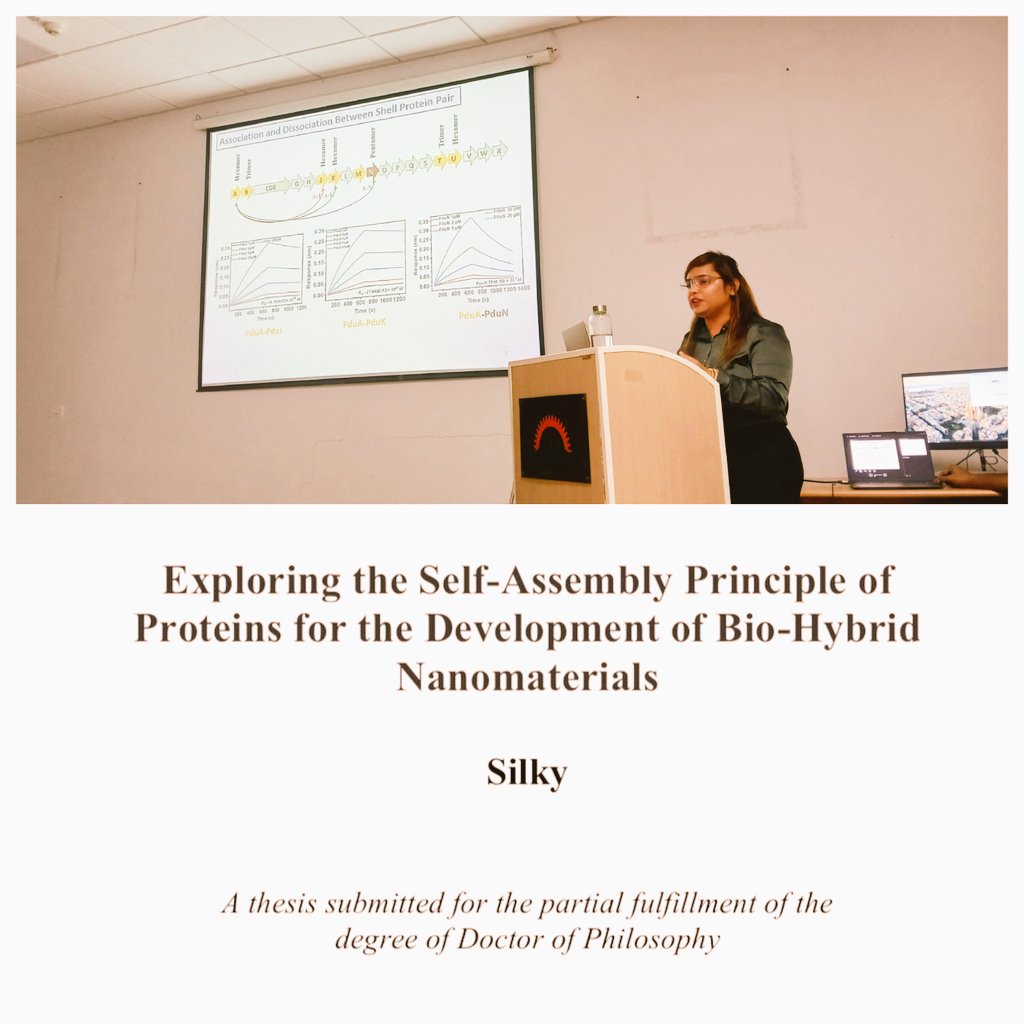
Silky just defended her thesis today! From BMC proteins to bioelectronics wizardry, she's been assembling more than just molecules. Go Dr. Silky!
Dr Asifkhan Shanavas and Dr. Surajit Karmakar along with Dr. Kausik Chakraborty (IGIB) served the committee @Silkybedi2@INSTMohali
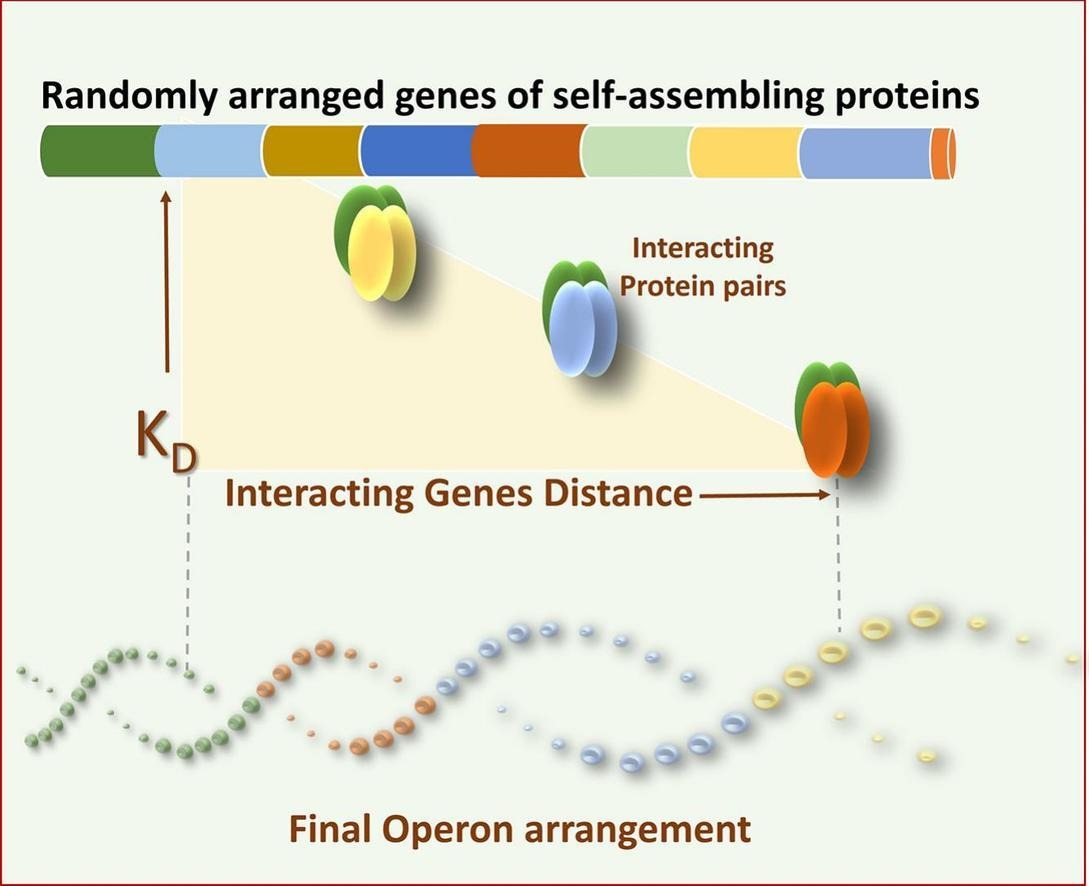
Genes That Stick Together, Work Together!
A molecular life lesson: teamwork and proximity shape success! In nature, who you’re next to matters! Check our latest publication to learn more! https://t.co/w5lx54hKaF @INSTMohali@Silkybedi2@smrose_24
Bile acids stirring the pot in Parkinson’s? Lithocholic acid (LCA) speeds up α-synuclein clumping by 75%, while deoxycholic acid (DCA) takes a 30% nudge. Together, they’re not exactly brain-friendly!
Check out our recent findings at https://t.co/OClDy7Vf4j @INSTMohali@IndiaDST
De-novo design of actively spinning and gyrating spherical micro-vesicles https://t.co/ZmLc7rGjnk
Check out our new bioRxiv article. Here, we harness the force generated by biomolecules to power the movement of giant vesicles, acting as wheels. @IiserMohali
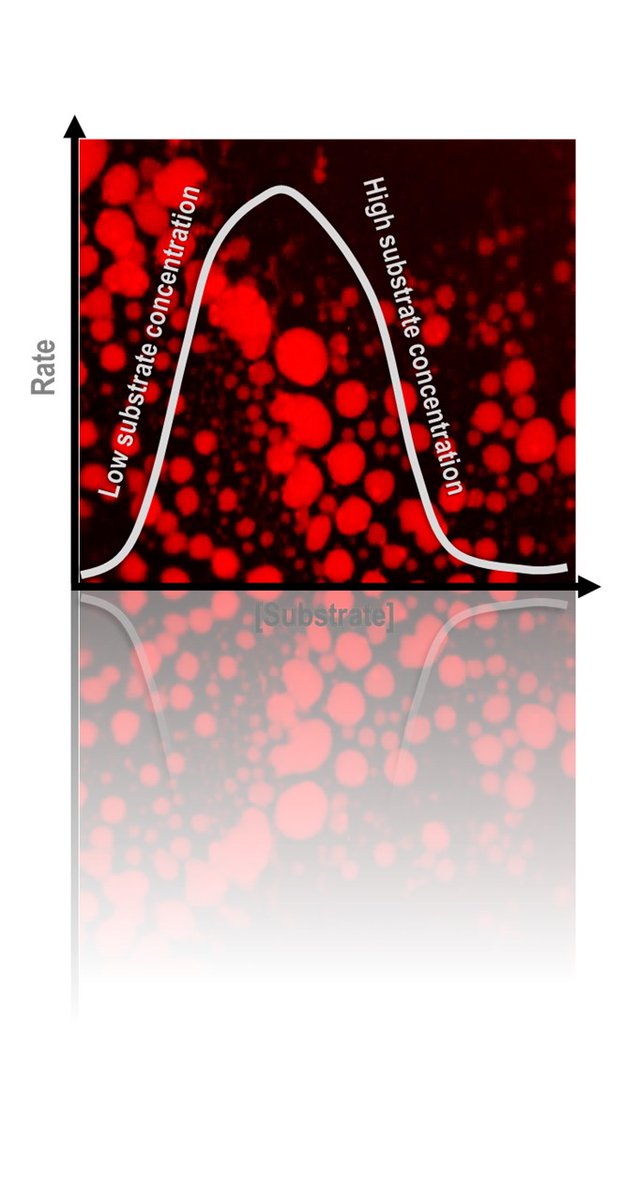
In our latest collaborative research, we delved into the effects of increased substrate concentrations induced phase transition inside the catalytic condensates and its impact on rate of reaction @smrose_24@Rakshits2016@INSTMohali@IiserMohali
LLPS can enhance catalytic reaction rates, but our latest study in collaboration with @Rakshits2016 reveals a twist. At high substrate concentrations, phase transitions in droplets restrict movement, reducing reaction rates. https://t.co/rVtI06UY3y
@Silkybedi2@smrose_24
LLPS can enhance catalytic reaction rates, but our latest study in collaboration with @Rakshits2016 reveals a twist. At high substrate concentrations, phase transitions in droplets restrict movement, reducing reaction rates. https://t.co/rVtI06UY3y
@Silkybedi2@smrose_24
Biomolecular condensates can concentrate macromolecules and metabolites to boost or quench biochemical reaction. But what about gases?
In the preprint below expertly led by @AnkushG60850251, we try to answer this question for oxygen.
https://t.co/tAuQaisnbe
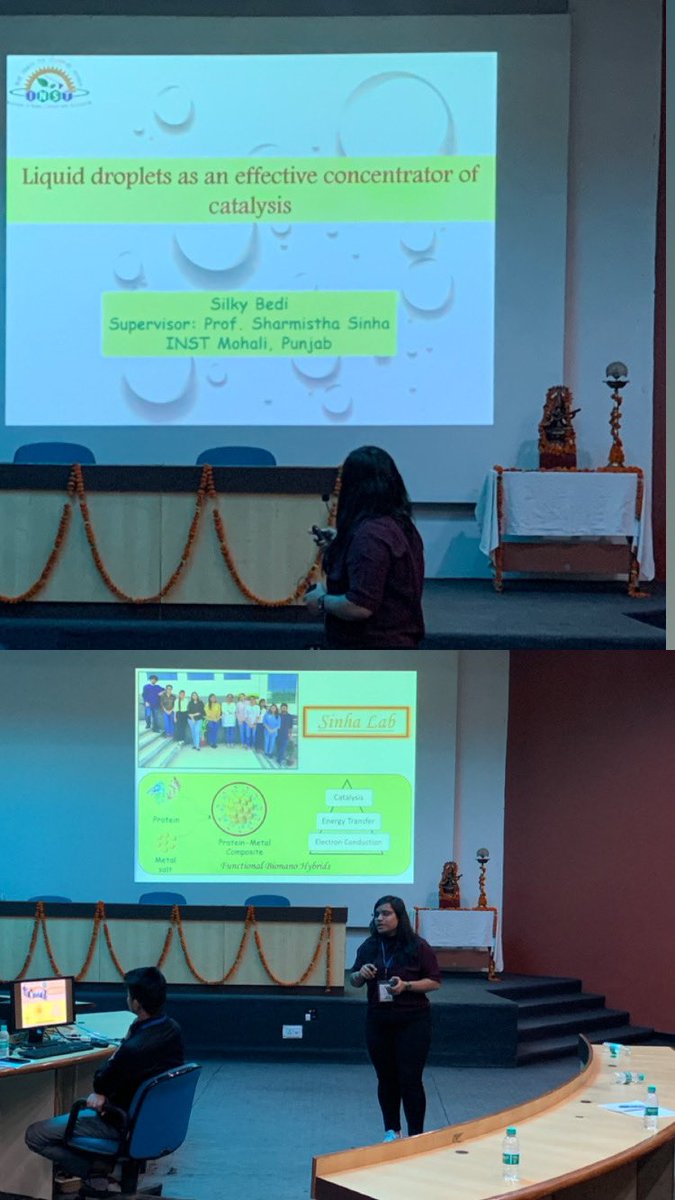
Firsts are always special. My first oral presentation in MMT-2023 @NITKURUKSHETRA . I have explained the confinement of protein capped catalysts in liquid droplets and effect on their catalytic activity.
Firsts are always special. My first oral presentation in MMT-2023 @NITKURUKSHETRA . I have explained the confinement of protein capped catalysts in liquid droplets and effect on their catalytic activity.
Congratulations to Dr.Sharmistha Sinha for being featured as one of the 35 Young Vidushi in the Vigyan Vidushi - 75 Women Trailblazers of Science, a prestigious publication of @VigyanPrasar@IndiaDST
Disordered regions play a crucial role in the structure-function activity of well-structured bacterial microcompartments. Check out the case study done in our lab. https://t.co/NoO9peUBBm
Check out our new report on enhanced catalysis of nanocatalysts in confined microenvironment outfitted by liquid-liquid phase separation- now published in Chemical Communications-https://t.co/iYNpbtwvov @Silkybedi2@K93040866Gaurav@Rakshits2016@INSTMohali
We are happy to share our recent article in Chemical Reviews showing how NMR Provides Unique Insight into the Functional Dynamics and Interactions of Intrinsically Disordered Proteins https://t.co/grENW9JbTz
Fascinating ⬇️ how 'RNA' and 'protein' science travel the structure-disorder continuum:
Proteins were assumed to be folded, but are increasingly recognized as disordered.
RNA was assumed to be disordered, but is increasingly recognized as folded.
https://t.co/u0hQQtSMCZ


![sinhalabinst's tweet photo. Join the Sinha Lab at INST Mohali 🧬
Research on biomolecular self-assembly, synthetic biology, and disease mechanisms.
📩 Apply: sinhas[at]inst[dot]ac[dot]in
🔗 More info: https://t.co/rX9aHlan8C; https://t.co/3nwco8yYhr
#PhDPosition #SyntheticBiology #Biophysics https://t.co/sCdjOT8Mlh](https://pbs.twimg.com/media/GqZxutKWwAAz3dN.jpg)