An Australian scientist took 800,000 human brain cells, kept them alive in a dish, wired them to a computer, and taught the cells to play the video game Pong in five minutes, which is faster than any AI on Earth had ever learned the same game.
His name is Brett Kagan.
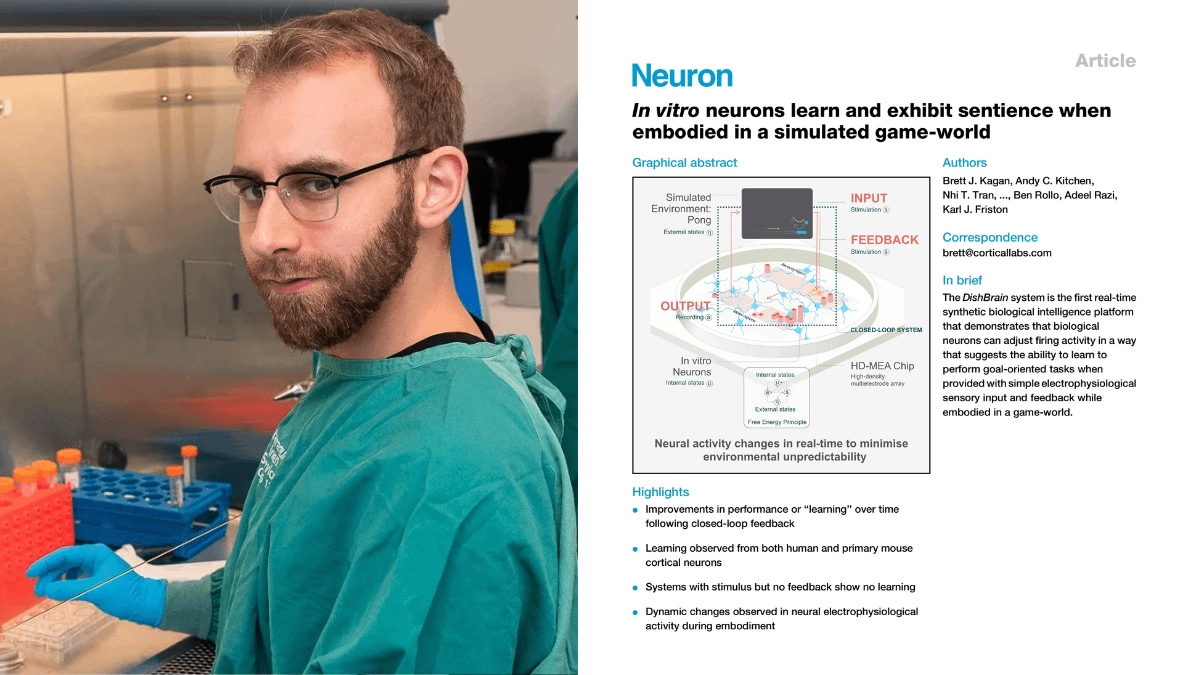
He runs the science team at a Melbourne company called Cortical Labs, and the paper that broke the story was published in the journal Neuron in October 2022. The title sounds like a science fiction novel. In vitro neurons learn and exhibit sentience when embodied in a simulated game-world.
The setup was simple, and that is what made it so strange.
Kagan and his team took some brain cells from mouse embryos. They took some human brain cells grown from stem cells. They placed them on a chip covered in tiny electrodes, the size of a small coin, and they hooked the chip up to a computer running Pong.
The electrodes could do two things. They could read what the cells were doing. They could also send small bursts of electricity back into the cells.
The team used those two channels to talk to the dish.
When the ball was on the left, they fired the electrodes on the left side of the dish. When the ball was on the right, they fired the electrodes on the right. The closer the ball got to the paddle, the faster they fired. The cells could move the paddle by sending their own signals back.
That was the whole game.
Then the team added one more rule, and this is the part that changed everything.
When the cells missed the ball, they got a random, chaotic burst of electricity for four seconds. Noise. Static. Pure unpredictability. When the cells hit the ball, they got a clean, steady, predictable signal.
That was the only feedback the dish ever received.
Within five minutes, the cells started getting better at the game.
The rallies got longer. The hits got more frequent. The dish was not winning, but it was clearly playing, and it was improving, and nobody had told it the rules.
It had figured them out by itself.
The reason this worked is the part that should stop you for a second.
Brains hate surprise. That is the thing they are built to avoid. Karl Friston, who is one of the most cited neuroscientists alive and a co-author on the paper, has spent his whole career proving this. The brain is not really a thinking machine. It is a prediction machine. It runs on a single quiet rule. Make the world less surprising.
The cells in the dish were doing the same thing.
The chaotic stimulus felt like surprise. The clean stimulus felt like calm. The only way to get more calm and less chaos was to stop missing the ball. So the cells learned to stop missing the ball, not because anyone trained them, and not because they wanted a reward, but because the only way to quiet the noise was to play the game well.
They were not learning Pong. They were learning to make their own world more predictable, and Pong just happened to be the world they were stuck inside.
The same thing your brain is doing right now.
Every choice you make today, every word you reach for, every plan you build for tomorrow, is your brain trying to make the next moment less surprising than the last one. The feeling you call thinking is mostly your head doing the same thing those cells did. Trying to quiet the static.
The dish learned Pong faster than any AI had at the time, using around 800,000 cells and almost no power, while the AI systems running the same game needed thousands of times more energy and far longer training runs.
Kagan said it plainly in his interviews after the paper came out.
He said the cells were not trying to win. They were trying to feel less lost. And the moment he said that, half the room realized he was no longer just describing the dish.
He was describing them.
You can’t print molecules (or atoms or joules). $Abaxx is a physically settled commodities exchange that will drive true price discovery and the flow of commodities globally.
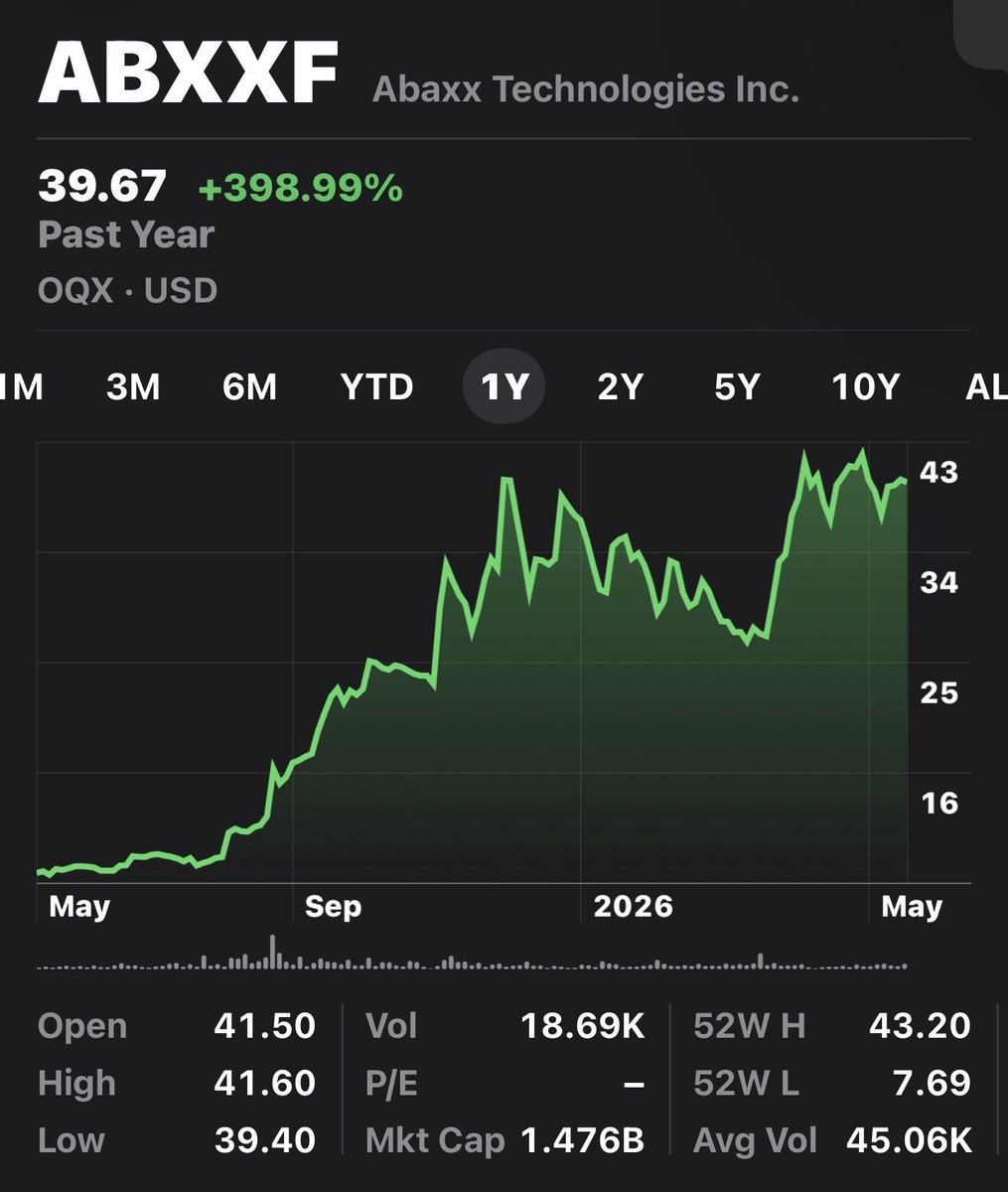
As the picks and shovels play of the most asymmetric trade in financial history, $ABXX has exponential volume growth and a game-changing technology that can enable tokenization of real world assets.
The Abaxx Exchange has been setting new trading volume records, highlighted by its first 50k contract day. The 50k volume level positions ABAXX as an emerging global benchmark exchange while signalling that operating breakeven economics are within reach.
Additionally, $ABXX will be uplisted to the Toronto Stock Exchange this Thursday, opening up potential index inclusion in the weeks or months ahead driving more liquidity and lower cost of capital.
Volumes were primarily driven by the Singapore #Gold Kilobar (SGK) & our emerging flagship #LNG (GOM, NPA) benchmarks.
CEO Josh Crumb and I will be on an ATB client call this Thursday at 11am ET. Please contact your ATB representative for details.
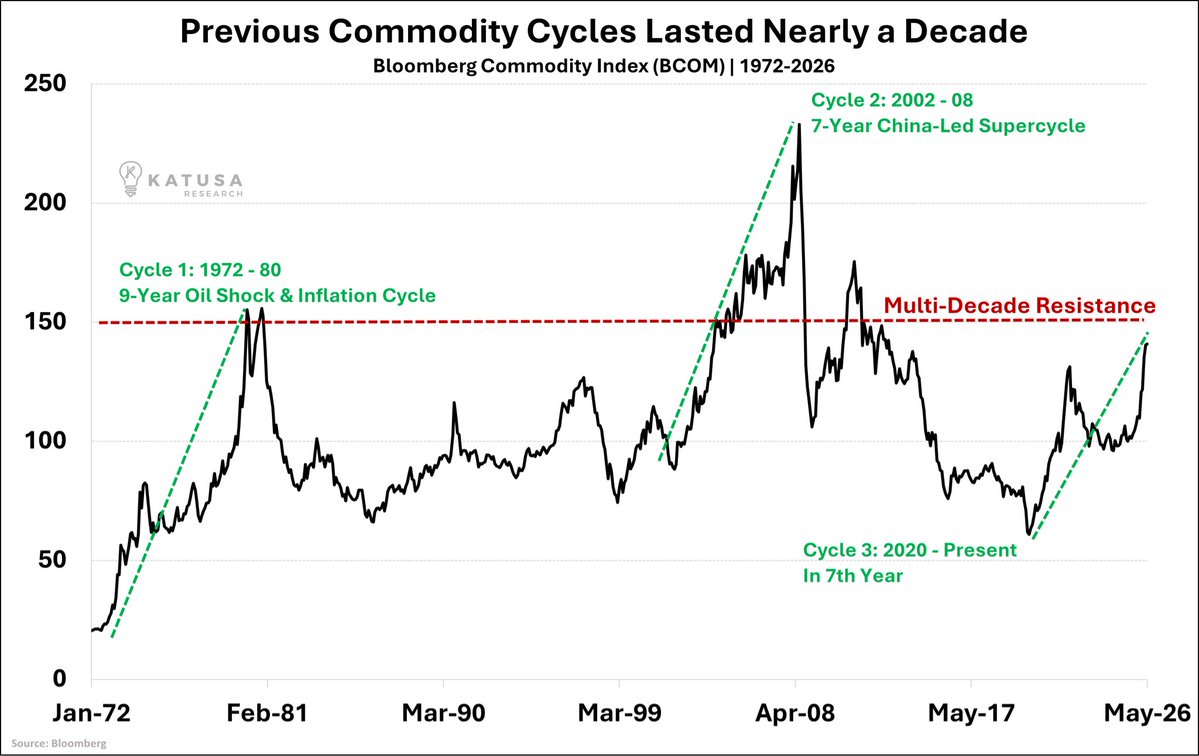
The Last Time Commodities Were Here,
They Doubled
In 2004, commodities crossed a multi-decade resistance line
And ran 55% higher over four years.
That level has only been touched THREE times in 50 years.
We’re at that line again in year 7 of the current cycle.
Two of the three times it held…
the move was just getting STARTED.
I've been a holder of NexGen for the last 5.5 years. Original investment has been multiplied 4-5 X. RR reckons another 10 years to go. No argument here.
Welcome to the most asymmetric trade in modern financial history.
The thread below lays out why. The opportunity exists because capital has chased the AI trade while ignoring the physical assets AI requires to run — assets that have quietly become the best-performing asset class of the decade. Since October 2020 when we first called for the commodity super cycle: QCI Total Return +217%, GSCI Total Return +205%, Gold +140%. NASDAQ trails at +130%. S&P 500 at +85%. The top three are all commodities. Yet oil cannot get out of its own way while copper and the broader atom complex prints fresh highs . That is the dislocation. That is the trade.
Get long. Buckle in. Hang on for the ride.
Forgive the longer posts in this thread — attempting to mimic my old 10-bullet commodity takes. On to it.
Next stop, $ABXX.NE to become $ABXX.TO 🇨🇦
We’re excited to be headed to the main board of the TSX.
Shareholders have been asking for a while, so we’ve started the processes for main board listings as the business(es) scale (subject to meeting all requirements).
🇨🇦 🇸🇬 🇺🇸
This will also change our index eligibility as we’d now be technically eligible for S&P TSX and global small cap index’s as a first step once listed (with est. ~2mm shares of new baseline demand++ to drive more liquidity in our secondary listings — based on a tentative May listing timeline we will get a final confirmation if there’s a process to meet June rebalancing assessments for the main index, or later in the year).
The world needs the next-generation markets and technology that Abaxx has spent years building to reconnect financial markets to physical realities.
I'm excited to build smarter markets with the Abaxx team as Executive Co-Chairman of Abaxx Markets!
@abaxx_tech@abaxx_exchange
We are very close to the birth of the #SovereignComputer.
🆔++
We are currently in the transition stage of AI, quickly evolving from chatbots and monolithic applications adding an agentic help chat, to the early CLI agents executing the blurry line between deterministic software runtime and a random walk of compounding decision agency to reach an outcome.
To run with the PC revolution analogy, I agree that we are in the “Apple II / Commodore PET” era where the ‘hobbyist’ harness engineers of today are showing a sneak peak of the inevitable, moving from personal computing to agentic sovereign computing. What we’re waiting for is our “VisiCalc” moment, ie the birth of the PC spreadsheet. Here’s my thesis:
🔹 The Personal Computer vision moved from debateable to inevitable with the birth of the spreadsheet “cell”.
🔹 The Sovereign Computer vision will move from debatable to inevitable with the birth of a robust Agent Identity application to the harness.
What was so powerful about the spreadsheet? It was a sovereign interface of infinite paths. Before the cell, software was a series of rigid, temporal "if/then" corridors built by a programmer who had to anticipate your every move. The spreadsheet flipped the script. It provided a functional, two-dimensional grid where the user defined the relationship and the engine managed the plumbing. It was a "programmable canvas" that didn't require a computer science degree to master, it just required a mental model of the problem.
In the Sovereign Computer era, the "Skill" is the new "Cell," but the Agent Identity layer is the grid that makes it functional.
The spreadsheet succeeded because it gave the user "Computational Sovereignty", the power to build complex logic without a middleman. But the cell was a static unit, it was a container for data and math. The Agent Identity is the breakthrough primitive because it transforms a static skill into a personalized, executable extension of the self.
When you anchor a Skill to a Sovereign Identity, the paradigm shifts:
🔹Identity as the Primary Key: In a spreadsheet, a cell knows its coordinates. In a Sovereign Computer, a Skill knows its owner. It doesn't need to ask for your name, your preferences, or your history, it inherits them from your Personal Knowledge Graph, and the private "data lake" (ID++ DWN) of your life.
🔹 From "Apps" to "Orchestration": We are moving from a world of "navigation" (opening apps, moving cursors, pulling drop down menus) to a world of "intent." You don’t "use" an application, you grant a Skill the right to represent your Identity. The "Robot Hand on the Doorknob" disappears because the door recognizes your cryptographic signature and opens itself.
🔹 The Sovereign Stack: If the spreadsheet allowed a finance pro to turn their mental model into a tool, the Sovereign Computer allows anyone to turn their Identity context into a swarm of delegated intelligences.
The "VisiCalc moment" for this era is the realization that Identity is the ultimate Integration. We no longer need to wait for SaaS companies to build "bridges" between their walled garden silos. When you own your identity and your knowledge graph, you are the platform. The skills are simply the formulas you choose to run across the infinite grid of your own agency.
The old computer organized your files. The Sovereign Computer organizes an infinitely scalable extension of your left brain.