Don't simplify solutions to scale. Automate complexity to accelerate...
v1.0 of Tesseract Core—"Kubernetes for scientific workloads"—is now live 🙌
https://t.co/l2Z9AOcqcv
🚀 @SimAI4Science
Journal of Open Source Software just published our "Tesseract Core: Universal, autodiff-native software components for Simulation Intelligence", @dionhaefner@AlexLavin_C137 🎉
https://t.co/OiZJ6S88bj
I also just recorded a quick overview video for our new PICT solver: https://t.co/dsgG40CXCG , enjoy! In case you missed it: PICT provides a new fully-differentiable multi-block Navier-Stokes solver for AI and learning tasks in PyTorch, e.g. learning turbulence closure in 3D
Today we launched @SimAI4Science "Insights": https://t.co/JiYDy5t4Pr
where we’ll share perspectives and learnings on all things Simulation Intelligence—from technical posts on autodiff and applied physics, to dialogues on frontier-tech startups and philosophy of science.
Awesome intro to what we do @ @SimAI4Science!
In short: "What if that sim-to-real delta could be optimized to zero by making digital engineering with differentiable software?"
https://t.co/VWLr6XeZrM
https://t.co/hmoKe7jCDg "heliolab" showcase happening now!
Physics-AI applications in the @NASA Digital Twin Earth portfolio, led by partners @GoogleAI@NVIDIAAI@SimAI4Science (https://t.co/5desx2LA64)
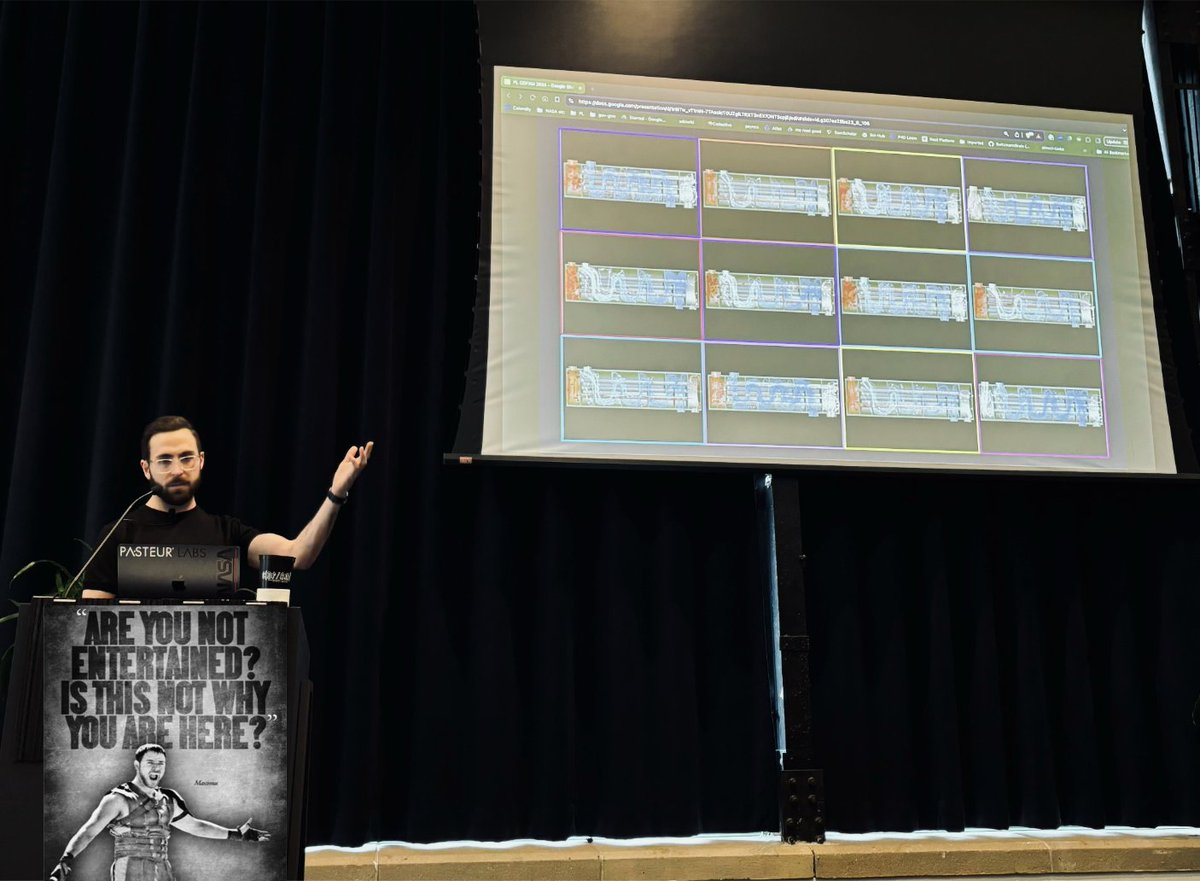
fantastic lecture on "Differentiable Physics Programming"—yes we're building it at Pasteur Labs—by @felix_m_koehler (@thuereyGroup@TU_Muenchen), our brilliant Simulation Intelligence Advocate.
I gave a lecture on autodiff & adjoint methods for differentiable physiscs as part of our master course on "Advanced Deep Learning for Physics" and just posted the recording on Youtube: https://t.co/61SzfQmwAg
Slides: https://t.co/NHufkV9DyM
We're expanding our wet lab at FutureHouse, and looking for exceptional junior bio researchers. Our AI systems are designing protocols & experiments to make basic science discoveries in biology. If you want to see the future of wet lab research, apply: https://t.co/REwatCOOkm