PhD graduation @UniofNewcastle complete 🙏🏾
Grateful to the community that got me here, including my partner, family, friends, supervisors & mentors. We did it 🖤 🇯🇲
#PhDone
Interested in early life immune development? Come join us. 1. Postdoc: fetal responses to maternal vaccination. 2. Postboc working with @madisonstrine and Brett Vahkal on immune epi cross talk and 3. CC of translational studies https://t.co/im98i3N0tJ @YaleMed@YalePediatrics
Excited to share our new work. Over the past decade, single-cell genomics has transformed our ability to map cellular systems. But a major question remains:
Can we predict how perturbations reshape cellular trajectories over time?
In 2018, we first showed that it is possible to predict cellular responses to perturbations — ranging from disease signals to chemical treatments — even in unseen contexts. In 2022, we introduced CPA (MSB 2022; NeurIPS 2022), extending this idea to predict responses to unseen chemical and genetic perturbations, including their combinations.
Since then, the field of perturbation modeling has grown enormously. The community has pushed the space forward with many creative ideas and powerful models. It’s exciting to see how fast things are moving — even though many fundamental challenges remain.
One of the biggest is that cells are not static. They move through trajectories during development, immune responses, and disease. Yet most current models still predict perturbation effects within a single state, rather than how early perturbations propagate across future states and reshape downstream outcomes.
To address this, we developed PerturbGen, a trajectory-aware generative AI model that predicts how genetic perturbations reshape downstream cellular states.
Huge credit to the people who made this work possible. Thanks to co-first authors @lifeisscience_5, @Adib_m_, @Tomo_Isobe, @Amirhossein Vahidi, @delshadveghari & Anthony Rostron. Special recognition to @lifeisscience_5 and @Adib_m_ for driving this work over the finish line.
Grateful for our outstanding collaborators from @HaniffaLab, @BertieGottgens lab @GosiaTrynka and many others — a true cross-institute effort across @SCICambridge, @OpenTargets ,@sangerinstitute and @Cambridge_Uni.🎉
PerturbGen learns transcriptional dynamics across cellular trajectories. By introducing perturbations at an early source state, it can simulate how these effects propagate into future states along differentiation trajectories.
Scaling this across genes enables the creation of dynamic in silico perturbation atlases — maps of how perturbations reshape biological trajectories over time.
We explored this idea across three biological questions.
First, in a human in vivo LPS immune challenge, PerturbGen predicted that perturbing a transient IL1B signal dampens downstream inflammatory programs in myeloid cells, with pathway changes reversing signatures observed in an independent IL-1β stimulation experiment.
Second, in human hematopoiesis, PerturbGen predicted transcriptional responses to CRISPR transcription factor knockouts and enabled construction of perturbation atlases revealing lineage- and age-specific regulatory programs. These programs could also be linked to human genetics and blood diseases, including recapitulation of signatures associated with ETV6-related thrombocytopenia.
Finally, we asked whether perturbation modeling could help improve complex tissue models.
We built a dynamic perturbation atlas of human skin organoids to identify perturbations that could guideorganoid cells towardhuman fetal skin states.
PerturbGen prioritized activation of Wnt signaling via GSK3β inhibition. Experimental validation confirmed the prediction: treatment with CHIR99021 induced stromal gene programs and shifted organoid fibroblasts toward transcriptional states observed in fetal skin stroma.
Together, these results show how trajectory-aware perturbation modeling can connect gene perturbations to developmental programs, human genetics, disease mechanisms, and experimental interventions.
More broadly, we think these point toward a future where single-cell atlases become predictive systems.
As atlases expand across tissues, developmental windows, and modalities, models like PerturbGen could enable dynamic, virtual perturbation atlases— allowing us to simulate interventions, generate hypotheses, and design experiments before stepping into the lab.
Preprint
https://t.co/3peW7du2qM
Code
https://t.co/cmK0ymY5X7
Excited to see how the community builds on this work.
Excited to share our new work on building a multimodal atlas of human skin in health and inflammatory disease — a project I’m especially proud of, bringing together AI, high-throughput genomics, and clinical science to accelerate discovery.
Over the past decade, single-cell genomics has transformed how we map cells in human tissues. But a major challenge remains: can we systematically decode how cells organize into functional niches in situ — including those invisible to standard histopathology?
To address this, we integrated large-scale scRNA-seq, spatial transcriptomics, histopathology, and AI-driven modeling frameworks to build an in situ atlas of human skin across health and disease.
Led by Lloyd Steele, an MD/PhD student working between @HaniffaLab and my lab at @sangerinstitute and @Cambridge_Uni . Another amazing collaboration with Muzz Haniffa, the mastermind behind the work as part of @humancellatlas.
A key part of this study is that we didn’t build everything from scratch — we leveraged and combined AI methods that actually work! and showed how they can be used together to extract biological insight at scale.
We used:
• scArches to build and map into a reference scRNA-seq atlas of human skin: https://t.co/c5TgcG7PU4
• NicheCompass to identify and characterize spatial niches: https://t.co/c5TgcG7PU4
• MINT-Flow to extract microenvironment-induced cell states and gene programs: https://t.co/sfE47AnF3c
Together, these enabled an end-to-end workflow from atlas construction to spatial mapping, niche discovery, and cell state decoding.
At scale, we integrated ~5 million cells and 100+ spatial sections, enabling a systematic view of tissue organization. Using this framework, we identified 26 niches in skin, including known histopathologic structures as well as hidden disease-associated niches not visible on H&E.
Among the most striking findings were a resident memory T cell-rich sebaceous gland niche and a plasma cell-rich sweat gland niche, suggesting that appendageal structures act as active immunological microenvironments and may contribute to inflammatory memory and disease persistence.
Importantly, this atlas is not just descriptive — it is usable. It can support mapping of new datasets, resolve finer cell types and niches, extract microenvironment-driven programs, and enable predictive analyses at scale.
More broadly, this work shows what becomes possible when AI, spatial genomics, and atlas-scale data are integrated end-to-end: not just mapping tissues, but systematically decoding them.
This was a massive collaboration, and I’m very grateful to the amazing scientists April Foster, Kenny Roberts, and Chloe Admane.
Lloyd is an amazing scientist, and I’m especially excited for the community to see more of his work soon — stay tuned.
The data and pre-trained models will be released soon.
Preprint: https://t.co/LeWxOKkgMt
Single-cell technologies now let us profile entire transcriptomes in individual cells. But how do we make sense of this complexity in a biologically meaningful way? Many methods summarise cells into a single embedding, but this often comes at the cost of interpretability, especially when multiple gene programs are active at once.
We developed Tripso, a self-supervised transformer model that represents cells through multiple gene program-specific embeddings, while also uncovering new programs directly from the data. Instead of collapsing biology into a single vector, Tripso decomposes cell state into multiple representations, each reflecting a different gene program.
We explored this across multiple systems.
In human hematopoiesis, spanning development to aging, Tripso identified distinct age-associated program activity, including stronger JAK-STAT signalling in early life and dynamic IKZF1-related changes during B cell maturation.
By comparing in vitro culture conditions with in vivo hematopoietic stem cell states, Tripso suggested that targeting the SEC61 translocon could enhance stem cell maintenance ex vivo, a prediction that we subsequently validated experimentally. In parallel, we identified a previously uncharacterised tissue-resident memory T-cell program associated with atopic dermatitis and mapped it to distinct spatial immune niches
Together, these results show how modelling cells through gene programs can lead to interpretable and experimentally testable insights. More broadly, this work points toward a more interpretable and biologically grounded models of cell state. As single-cell datasets continue to grow, we hope approaches like Tripso will help bridge the gap between data-driven representations and biological insight.
This work wouldn’t have been possible without the contributions of an amazing team. Thank you to co-first authors @mariemoullet, @Tomo_Isobe, @AmirhVahidi, @CarloLeonardi7, and everyone from @roserventotormo's Lab, @HaniffaLab, Nicola Wilson and @BertieGottgens's Lab, bringing together expertise across @SCICambridge, @OpenTargets, @sangerinstitute and @Cambridge_Uni.
@mariemoullet is one of the very best PhD students I have ever supervised. She is truly a force of nature, exceptionally resourceful, deeply innovative, and one of the most impressive scientists I have worked with. I am immensely proud of her and all that she has accomplished. As she begins her internship at @genentech , I have no doubt she will do amazing work there and continue to make her mark.
paper:https://t.co/jkQagOPNxE
code: https://t.co/2xnQWMcqbA
I'll soon be recruiting a postdoc fellow to join us @ MRC LMB to continue developing our programme to understand neuroimmune modulation 🧠🔬🧬🩸🫁
If you're interested in joining us check also @MSCActions, @wellcometrust &
https://t.co/TkP61a8iPd & DM'me
https://t.co/RxDcklWOsX
Attention researchers from all over the world🙃
The #HFSPResearchGrants Call for Letters of Intent is closing soon!🚨 Have you already initiated your application? The deadline for this stage is 18 March 2025📢 https://t.co/mn1ZLQaDlV
#InternationalCollaborations#LifeSciences
On rare diseases day, I am really happy that our website for the SAIL study is now live. We are collecting clinical/research data & parent reported outcomes for this rare disease in the U.K. Thanks to @CRUKresearch @GOSHCharity for the funding https://t.co/wLhRjlc2MS
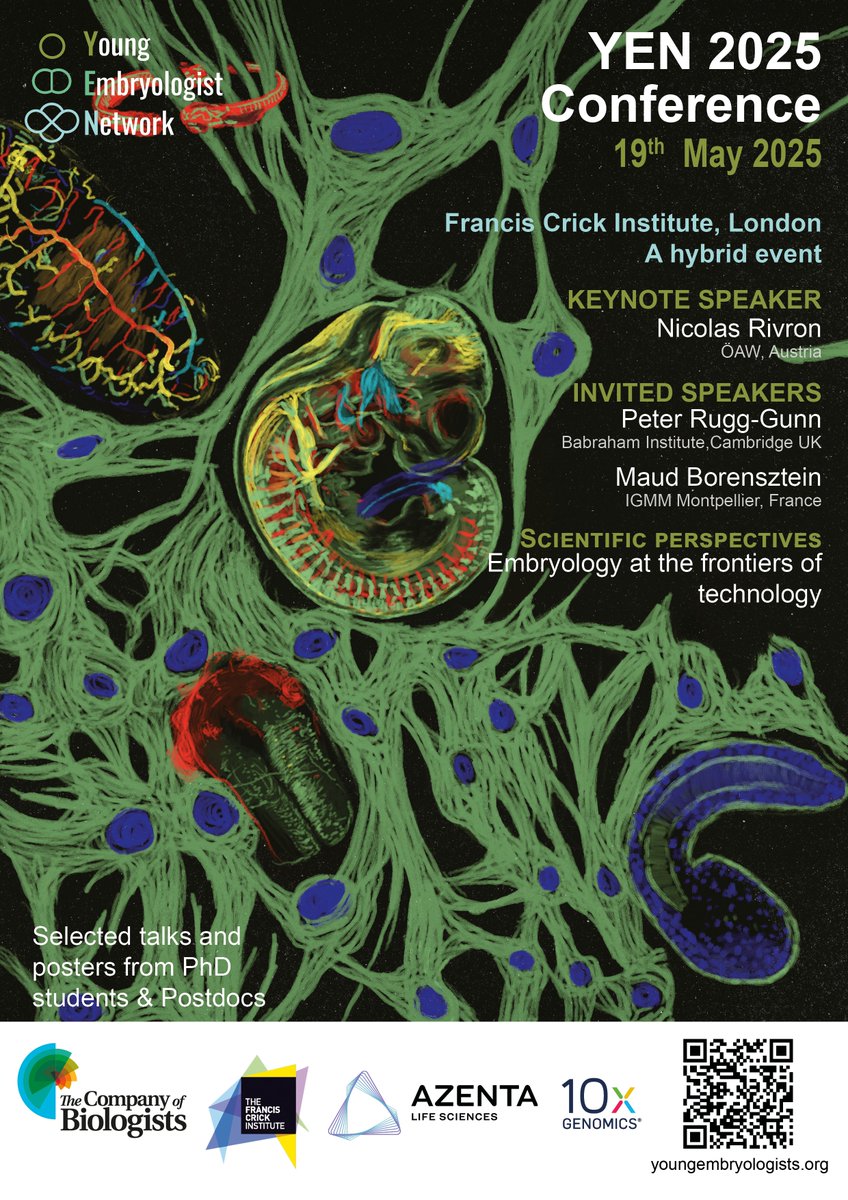
Registration and abstract submission for YEN 2025 is officially open!
We are looking forward to seeing you at the 17th Young Embryologist Network Conference on the 19th May 2025.
Attendence is FREE thanks to our amazing sponsors: @Co_Biologists@10xGenomics@AzentaSciences
FastOMA is out now in Nature Methods 🎉: https://t.co/6nNVfbCVqr A new orthology inference algorithm that scales linearly and is highly accurate. FastOMA can process all >2000 eukaryotic UniProt ref proteomes <24 hours 🚀. Try it out at https://t.co/QUPiRx33J9
📢We're excited to announce our new #fellowship call will open 19 February 2025.
We’re offering up to £750k to support excellent mid-career #researchers in the field of #arthritis and related #MSK disorders for 5 years.
Learn more: https://t.co/MnBQrMyC26
Exciting news! The {ggfigdone} #R package is getting an LLM-powered upgrade to make your #ggplot2 figures more interactive than ever 🎨🤖 Now you can explore and fine-tune plots through natural language prompts! Keep an eye out for the Christmas holiday release. 🎁🌟 #RStats
The 'Celebrating Success' event last night, recognising my OPERA (Outstanding Pharmacy Early career Researcher Award) shortlist 💊
S/O to Dr @SimSci9 for her development fellowship and MPharm student Joy Eze, on her sporting success!
@NCL_Pharmacy@PJOnline_News@NewcastlePSRC