"As drafted this bill would criminalise normal, healthy Christian ministry, along with normal, responsible Christian parenting."
Sign our new letter to the Westminster Government, opposing the draft 'conversion practices' Bill.
https://t.co/eUaWzrryR6
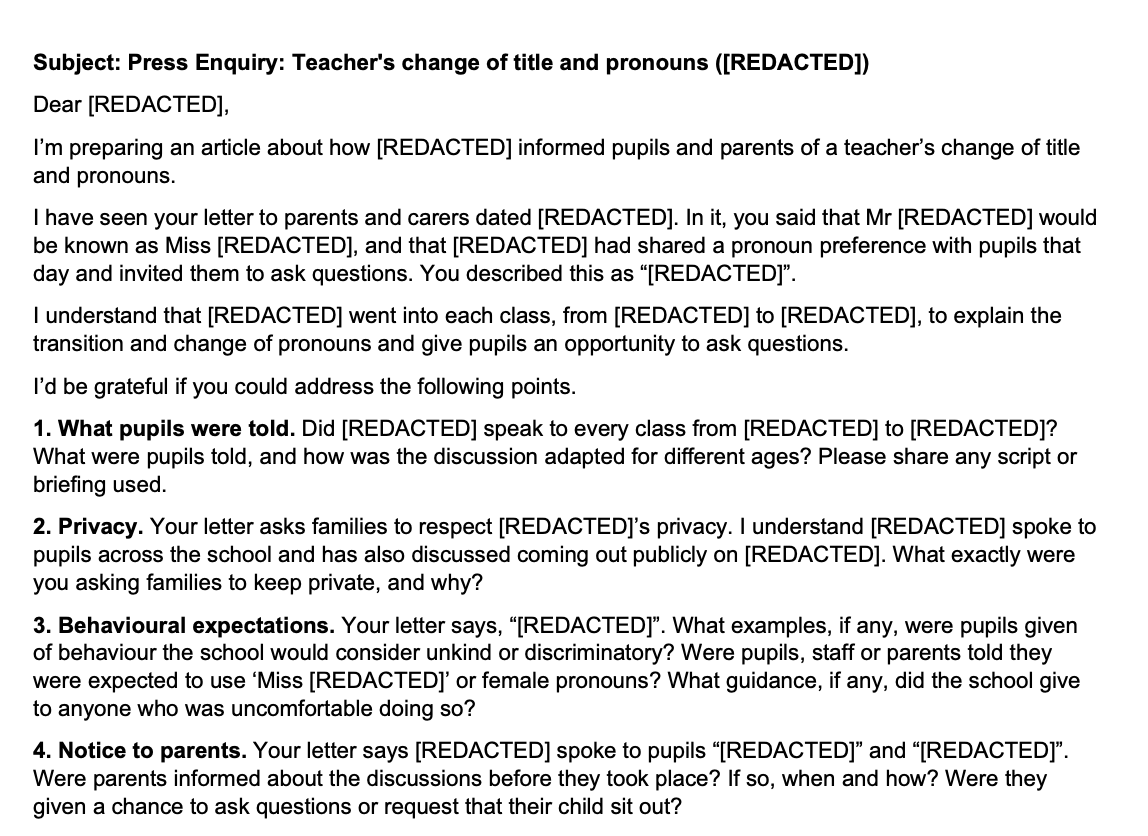
A headteacher wrote to parents to tell them Mr X would now be known as Miss X. I've seen the letter.
The letter said 'Miss X' had already spoken to pupils about his pronouns. It also praised his courage and warned that unkindness towards him would not be tolerated.
And, basically, told families that talking openly about it would be disrespectful to the teacher involved.
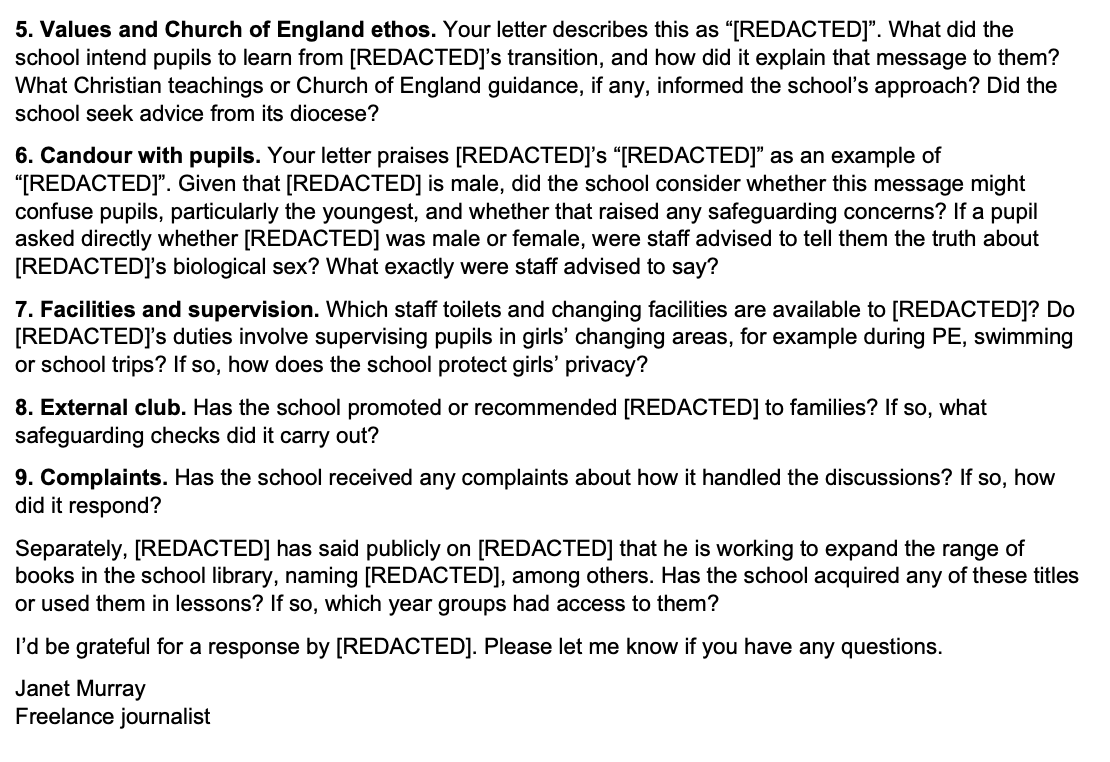
Here are some of the safeguarding questions I’ve put to the school in my 'right of reply' request (heavily redacted to protect identities):
- Should a male teacher be telling young children he identifies as a woman and asking them to call him ‘Miss’?
- Were parents informed about his 'pronoun talk' beforehand? Could they ask for their child to sit out if they felt the subject was unsuitable?
- If pupils have been told a male teacher is a woman, what safeguarding implications did the school consider?
- Does the teacher use any female-only facilities? Do his duties involve supervising girls in toilets or changing rooms, including when they go swimming?
- Could a child be disciplined for saying the teacher is male or declining to call him ‘Miss’?
Then there’s the question of what happens when parents or staff raise concerns. Will the school take their gender-critical beliefs seriously or will they be told they’re discriminating against the teacher?
Given the person who highlighted this to me asked to remain anonymous, it doesn't look promising.
I’ll wait to hear what the school has to say. But parents shouldn’t need a journalist to find out what their children were told in class, what they were expected to say in response, or how the school would handle it if they disagreed.
Please sign and share this letter from @GLDeclaration to the Equalities Minister.
If the bill passes it will be state sponsored persecution of Christian pastors and parents.
https://t.co/CXFsi2KwjR
From a leading law firm specialising in education: “The [Conversion Practices] Bill is broadly drawn and raises difficult questions for schools and colleges about where legitimate safeguarding ends and potential criminal conduct begins.
Those questions are particularly important when the Bill is considered alongside KCSIE and other guidance and legislation applicable to children. KCSIE requires schools to take a careful approach to children who are questioning their gender. Staff may need to ask difficult questions, involve parents and make safeguarding decisions which do not accord with a child's wishes.”
https://t.co/fuKFmySizm
Conversion Practices Bill. Let's look at just a small piece of the evidence given by the proponents - exorcisms. Far be it from us to reinvent the wheel, here's the long read: https://t.co/Oh3IeeFpp8. We'll give a summary of this and add in our take too. Starting with, a table. /2
Just five days left to speak up in defence of churches and parents. Respond to the Conversion Practices Bill call for evidence TODAY! https://t.co/VCI618tAwg
Jayne Ozanne has spent years campaigning for a conversion practices ban that targets Christian teaching – all while continuing to claim to speak on behalf of Christians.
She made no secret of these ambitions in her evidence to the Committee.
She claimed that “everyday prayer counselling” accounts for “the vast majority of” conversion practices. She also said she hoped a ban would “put the fear” into friends and family praying for their loved ones.
https://t.co/HqgEcvV4ce
The Catholic Bishops of England and Wales @catholicEW have issued an important warning about the Government’s deeply troubling Conversion Practices Bill, with Archbishop John Sherrington calling for it to be abandoned.
The issue here is not whether people should be protected from coercion or abuse. Of course they should, and the Church has no difficulty affirming that. The question is whether the State is about to acquire powers that could make the ordinary expression of Christian moral teaching a matter for criminal investigation.
As Simon Calvert has warned, the implications could extend into the confessional itself. What happens when a priest advises a penitent according to Catholic moral teaching? What happens when a Catholic teacher counsels a troubled pupil, or explains the Church’s understanding of the human person, sexuality and marriage?
The consequences for Catholic education are particularly disturbing. Clause 5 of the draft Bill provides for criminal liability extending beyond an individual offender to certain officers of an organisation, potentially including school governors. In the circumstances specified by the legislation, a teacher's actions could therefore expose others in the school’s leadership to prosecution.
Consider the extraordinary position this creates. A Catholic parent should be free to teach their child the faith at home. Yet when that same child attends a Catholic school, could the very same moral teaching, offered as personal pastoral guidance, become grounds for a criminal complaint?
The Government insists that ordinary conversations will not be criminalised, but if that is its intention, why does the legislation leave such serious questions about the boundaries of lawful pastoral care?
And we should not underestimate the chilling effect. A Catholic teacher does not need to be convicted of anything to have their career destroyed by an allegation, a safeguarding investigation or professional disciplinary proceedings.
Religious freedom means very little if Catholics are permitted to believe their faith privately but must fear the consequences of teaching and practising it publicly.
Archbishop Sherrington is right to challenge this legislation. The Church must be able to proclaim its understanding of the human person without seeking permission from the State.
A genuinely free society protects people from abuse without treating orthodox Christian belief as something potentially abusive in itself.
https://t.co/ciwTiIRrjH
RC Church firmly rejects conversion practices bill: “People of faith must remain free to express their beliefs through speech and prayer. We call on politicians to abandon this Bill and focus instead on enforcement of existing protections and accessible support for anyone facing abuse or coercion.”
💥Labour MPs urge @andyburnham to scrap trans bill
Fears that parents could be criminalised for having honest conversations with children.
At least a dozen have told whips they are not happy with the draft Conversion Practices Bill.
A number of ministers are said to have “grave concerns”.
@Telegraph
https://t.co/C6jtblIjKt
This was such a telling moment in Ms Ozanne’s evidence. The psychiatrist’s question is surely a reasonable one. But she rejected it.
She seems to want to win a *theological* argument with evangelical Christianity: and is using *criminal law* to do this
In evidence, Jayne Ozanne who appears to believe that her own internal battles with her faith could have been sorted with legislation, was clear that she wants prayer criminalised, including any help sought by the individual in question.
She records a counsellor telling her that she would just have to change her religion if she felt her sexuality was incompatible. But she didn't want that.
Ozanne once told the Guardian that “gentle, non-coercive prayer” should be outlawed. She also wants to ban ‘praying alone’ - who the criminal is in this circumstance is not explained!
Ozanne has admitted she was not open about her sexuality and did not discuss it with her pastoral support group. Later she asked for supportive prayers from "kind and loving" people to ask that she find someone to settle down with and have a family. She claims that at this point she was confused about her sexuality and had boyfriends.
So what does she really want? Ozanne claims to remain an Evangelical Christian so she clearly wasn't kicked out. She wasn't held in a cult or subject to abuse, she simply asked others in a religion she claims she wishes to belong to, to pray for her to achieve happiness.
Freedom of religion is an important human right. The state has a duty to ensure that harm, terror, or abuse is not carried out in the name of faith, but it has no business interfering in anyone's inner life.
The Church of England is right to be concerned.
The religious illiteracy is worth noting. Conversion is a core Christian idea. The CoE along with many religious groups are against coercive and abusive practices which the law already covers. Tom’s language is much wider - is my conversion unacceptable?