Anglican churchwarden who writes about Aztecs: after the human sacrifice there'll be tea & biccies.
Mostly bad jokes with only occasional sweary rants.
Zionist.
Anyway since you now can't buy so much as a cheese grater on Amazon without a note from your mum, why not buy one of my books instead? First two are now available on Kindle (free with an Unlimited sub!)
#ShamelessSelfpromoWednesday
https://t.co/bXGLpjqMhT
Yes, the monarchy was deeply implicated in the slave trade. But not the British monarchy.
The biggest African slavers were not pirates or bandits. They were kings. In the 1750s, King Tegbesu of Dahomey, in present-day Benin, was reported to be making £250,000 a year from selling slaves. That astronomical sum, equivalent to perhaps £45 million today, was vastly more than any British aristocrat
While Tegbesu was trafficking human beings, the future George III, who had recently become Prince of Wales, was becoming a convinced abolitionist. He wrote a monograph arguing that “slavery is equaly [sic] repugnant to the Civil Law as to the Law of Nature”. He went on, as King, to sign the abolition of the slave trade into law in 1807.
That act prompted incredulous rage among West African chiefs.
In the 1840s, King Ghezo of Dahomey, played by John Boyega in the 2022 film, The Woman King, fiercely resisted such pressure.
“The slave trade is the ruling principle of my people. It is the source and the glory of their wealth,” he complained.
Contrast his attitude with that of his British fellow-monarchs. Although Victoria, as Queen, was expected to refrain from expressing political opinions, her husband was under less constraint. Albert made his very first speech as Prince Consort to the Society for the Extinction of the Slave Trade and for the Civilization of Africa. His words are a reminder of how determined Britain was to ensure that ending the Atlantic slave trade did not simply push the commerce eastwards.
“I deeply regret that the benevolent and persevering exertions of England to abolish that atrocious traffic in human beings (at once the desolation of Africa and the blackest stain upon civilized Europe) have not as yet led to any satisfactory conclusion. But I sincerely trust that this great country will not relax in its efforts until it has finally, and for ever, put an end to a state of things so repugnant.”
The difference between the British Crown and contemporary African monarchies can be glimpsed in the story of Aina, a young Yoruba girl owned by King Ghezo of Dahomey.
In 1850, a naval captain called Frederick Forbes came to Dahomey to try to convince Ghezo to stop selling slaves. He was unsuccessful but, during his visit, he was offered Aina as a gift.
Forbes knew that such slaves were generally destined for human sacrifice, so he accepted the child, naming her Sara Forbes Bonetta. When Sara arrived in Britain, Queen Victoria became her godmother, paid for her education and arranged for her to marry a wealthy Yoruba businessman. Are the British really the baddies here?
Critics talk of telling our nation’s story “warts and all”; but they rarely get around to the “and all”. The “and all” surely includes the vast sums devoted to stamping out slavery, calculated by Chaim Kaufmann and Robert Pape as 1.8 per cent annually of GDP between 1808 and 1867, the most expensive moral foreign policy in human history. Even if there were a case for reparations in principle (which there is not) that sum alone – not counting the billions given in aid – would surely have covered any debt.
What we are seeing is not a debate about history, but an argument about contemporary politics. Critics want to convince us that Britain became rich through exploitation rather than, as was actually the case, through private property, free contracts and independent courts.
The easiest way to demonstrate the negative correlation between capitalism and slavery is to look at the places where human bondage is most prevalent today – in order, North Korea, Eritrea, Burundi, the Central African Republic and Mauritania. If William III owning shares in the Royal African Company bothers you more than the continuing abomination of slavery in those places, you need to ask yourself some hard questions about your motives.
Local legend has it that SS Crispin and Crispinian stayed here before setting off for France. I imagine the place has changed hands a few times since then but they'll have had a good breakfast.
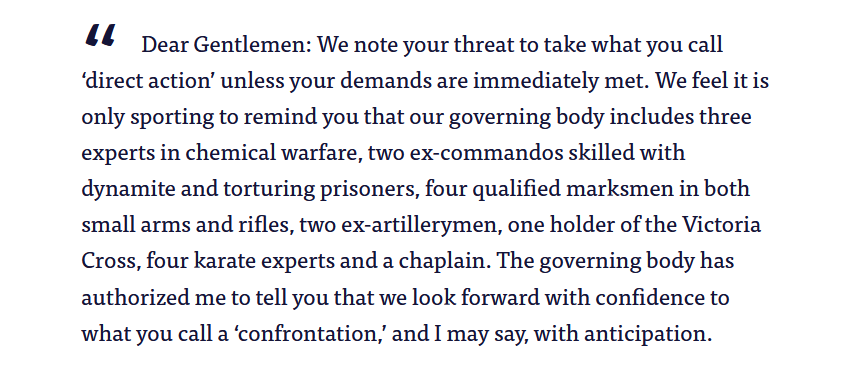
An oldie but a goodie. In 1968 a bunch of entitled hippy bastards sent a letter detailing their specious demands to the Warden and Fellows of Wadham College, Oxford. This was their letter of reply, which speaks to how far the academy has since fallen.
There’s a thing called “cocktail eyes” - when you’re talking to someone and they’re already scanning the room for someone more important.
A lot of our politicians have cocktail eyes about the job itself. And we're the ones they're ignoring.
Local councillors who bang on about Palestine are treating their actual role (bins, hedges, planning, antisocial behaviour - the local good) as beneath them. National politicians who treat e.g. Net Zero as a chance to be “world leaders” are doing the same thing at a bigger scale: chasing status and smugness instead of the national good (energy abundance and security).
In both cases they need to put their eyes back in the room and focus on the people they are meant to serve. As Collingwood says, that alone would radically alter our country.
British does not defend Israel’s national interest. It also does not give unconditional support to Israel.
What Rupert claimed is factually false.
The British state, since 1948, has actively worked against Israel. And the current UK position is to steal Israeli territory and give it to Arab Muslims who self identify as “Palestinians”.
UK wanting to remove territory from Israel is the opposite of what Rupert claimed.
@drcrouchback There were, I think, 13 Liberal MPs in the 74-79 Parliament and what with Thorpe, Cyril Smith, Clement Freud and David Steel (who helped cover some of it up) that's a pretty high proportion of noncery, even by Westminster standards.
@MorganE07969703 The most likeable politician of that era was probably Jim Callaghan, but Maggie beat him too.
Then again everything seems to be vibez and feelz now, so who knows.
Sad news today. After 5 years of medical training, one of my mates has been struck off due to a minor discretion. He slept with one of his patients and can no longer do the job he loves. What a waste of time and money. Genuinely a great guy and a brilliant vet
Shabbat shalom from Tel Aviv.
I am going straight from Israel to an event near, then visiting, Auschwitz. On a Friday night in Israel I am surrounded by vibrant and thriving Jewish existence. A jarring juxtaposition, but together it’s why Israel is so important, especially now.