Fine-Tuning and Model Adaptation – AI Engineering Interview Questions
Q1 - What is fine-tuning, and when should you fine-tune an LLM?
Q2 - Explain the difference between full fine-tuning and parameter-efficient fine-tuning (PEFT).
Q3 - What is LoRA (Low-Rank Adaptation), and how does it work?
Q4 - What is QLoRA, and how does it enable fine-tuning on consumer hardware?
Q5 - How does fine-tuning work?
Q6 - Explain Prefix Tuning and Prompt Tuning. How are they different from LoRA?
Q7 - What is adapter-based fine-tuning?
Q8 - Explain the difference between pre-training, supervised fine-tuning (SFT), and preference optimization (RLHF/DPO).
Q9 - What is RLHF (Reinforcement Learning from Human Feedback), and how is it used to align LLMs?
Q10 - What is Deep RL from Human Preferences, the paper that started RLHF?
Q11 - Why did DPO displace PPO-based RLHF at many labs? When is online RL still better?
Q12 - What is instruction tuning, and why is it important for chat models?
Q13 - How do you prepare a dataset for fine-tuning an LLM?
Q14 - What is catastrophic forgetting, and how do you prevent it during fine-tuning?
Q15 - When should you choose fine-tuning over RAG over prompt engineering?
Q16 - How do you evaluate a fine-tuned model's performance?
Q17 - What is synthetic data generation, and how do you use it for fine-tuning?
Q18 - What are the key hyperparameters for fine-tuning (learning rate, epochs, batch size, LoRA rank)?
Q19 - Do the GPU memory math for full fine-tuning a 7B model in bf16 with Adam. Now with LoRA and QLoRA.
Q20 - How do you fine-tune a model for a specific domain (legal, medical, finance)?
Q21 - What is continual pre-training, and when would you use it?
Q22 - How do you merge multiple LoRA adapters?
Q23 - What is the difference between SFT (Supervised Fine-Tuning) and alignment training?
Q24 - What is RLAIF (RL from AI Feedback), and how does it differ from RLHF?
Q25 - What is Constitutional AI, and how does it differ from RLHF?
Q26 - What is RLVR (Reinforcement Learning with Verifiable Rewards), and when does it beat a learned reward model?
Q27 - What is knowledge distillation for fine-tuning, and what are the legal considerations?
Q28 - Your fine-tuned LLM produces factually wrong outputs due to training data quality issues. How do you fix it?
Q29 - You must choose between LoRA and full fine-tuning for a domain-specific assistant. How do you decide?
Q30 - Your fine-tuned model memorized training data verbatim instead of learning patterns. How do you fix overfitting?
Q31 - Your fine-tuned LLM forgot its general capabilities after domain-specific fine-tuning. How do you fix catastrophic forgetting?
Q32 - Your RLHF preference data has low annotator agreement. How do you ensure data quality?
Complete collection:
https://t.co/yf0yoCI0iM
BREAKING: Petition to reinstate Jensen Huang as Nvidia CEO surpasses 150,000 signatures, including Elon Musk and Ex-Uber CEO Travis Kalanick
Jensen's odds remain at 9% to return.
Are American open-source models starting to adopt architectural ideas pioneered by Chinese AI labs?
Sebastian Raschka recently highlighted striking similarities between Inkling 2 Small and Kimi K3.
Both architectures share several interesting design choices:
Attention Residuals: Reusing earlier-layer outputs through direct connections to token representations.
1M-token context: Support for extremely long context windows.
Sparse MoE: Activating only a fraction of the model's parameters per token. Inkling reportedly activates 17B.
Hybrid attention: Combining GQA, Sliding Window Attention, and short convolutions.
The interesting takeaway is that architectural innovation is becoming increasingly global.
AI research is no longer a one-way competition. Ideas are crossing borders, influencing architectures, and accelerating progress across the entire industry.
Congrats to @MiniMax_AI on H3-Image taking the #1 spot among open-weight models for image editing by Artificial Analysis! 🎉
We’re bringing NVIDIA Vera Rubin support H3-image to vLLM-Omni, and native 4K generation in 0.87 seconds!⚡️
Check it out!👇
https://t.co/j3pVRormHX
The Cybertruck order rate far exceeds our production rate. We will try to make as many as possible before shutting down the line in about 8 months, but will have to return deposits for a lot of people.
This is not a case of Cybertruck being unprofitable, as has been misreported by legacy media, but rather that the opportunity cost of the complexity of Cybertruck is vastly outweighed by the value of incremental Cybercab production.
Today, we are launching a new Knowledge Work interface layout tuned for research, writing, and artifacts: same agent harness, plugins, and MCP tools, without the terminal and git clutter. Select your layout in the General tab of Settings.
Our goal with Antigravity is to help the world deliver value through products and research. Doing that always starts with building the logic, which is why software development is at the core of the product. But turning that work into real outcomes takes every role working together with a shared language and understanding.
you can now build with google maps platform in AI Studio 🗺️📍
go from idea to app powered by @googlemaps in minutes!
what’s new:
- 1-click setup
- create maps apps just by describing your idea, gemini does the rest
- build with map tiles, places, weather, routing, 3D buildings, street view, and more
try it out today: https://t.co/Ea0Cdu0szs
LOS HACKERS NO QUIEREN QUE VEAS ESTO
ENCONTRÉ 3 HERRAMIENTAS DE HACKING DE WIFI QUE PARECEN ILEGALES DE CONOCER.
→ FragAttacks: expone fallos en los protocolos de Wi-Fi que pueden afectar dispositivos de distintas generaciones.
→ AngryOxide: un motor de ataques inalámbricos con estado que puede adaptar su enfoque durante las pruebas.
→ EAPHammer: simula puntos de acceso rogue de Wi-Fi empresarial para probar qué tan fácilmente se podrían exponer las credenciales.
Estas herramientas muestran cómo los atacantes pueden explotar debilidades en la seguridad inalámbrica.
Solo prueba redes que poseas o para las que tengas autorización explícita para evaluar.
REPOS ABAJO
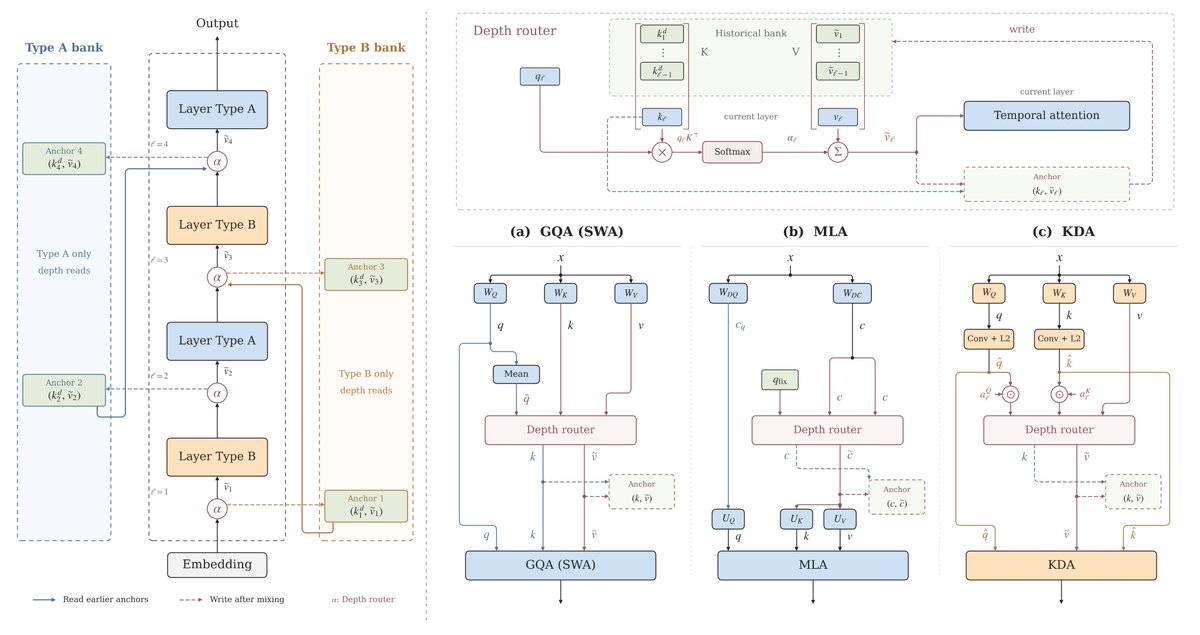
We introduce Depth Hybrid Attention (DHA), which incorporates depth-wise value mixing into hybrid architectures with very little additional compute and cache overhead. By allowing layers to mix information across depth, DHA broadens each layer’s view and increases the model’s expressive capacity.
Our DHA method adapts to multiple hybrid architectures, including Depth Window Attention (DWA) for GQA + SWA and Depth Delta Attention (DDA) for MLA + KDA.
Across loss curves, short-context benchmark results, and long-context retrieval evaluations, both variants outperform their corresponding full-attention and hybrid-attention baselines, while retaining hybrid attention’s low KV-cache footprint.
Project overview & code: https://t.co/Y8rqTaesff
A model that spends tokens reasoning can help train another model to make decisions without generating answer tokens.
This is one of the most interesting ideas in a new paper on Foundation Decision Models. Researchers at Nace AI describe a training method called Reinforcement Learning from Adjusted Feedback (RLAF).
Instead of training only against a single correct label, they use two sources of feedback:
→ A verified outcome, when one is available.
→ A generative reasoning model that assigns probabilities to the available options.
For Drex Max, the judge is the generative Qwen3.8-27B base model, run at high reasoning effort. It can perform extended reasoning before evaluating the options.
The decision model then learns from this feedback through a reward objective, with a KL penalty that penalizes divergence from the supervised checkpoint.
At inference time, it doesn't need to generate the judge's reasoning. It directly produces probabilities over the supplied choices.
In the paper's controlled ablation before vision fine-tuning, RLAF improved the Decision Index score from 64.9 to 66.9 and accuracy on held-out choice decisions from 86.5% to 88.0%.
The underlying idea is worth understanding: expensive generative reasoning can provide a training signal for a model designed to perform a narrower task without answer-token decoding at inference.
That doesn't make it a replacement for general reasoning models, but it is an interesting direction for specialized AI systems.
Do read the research in the comments.