Randomized measurements enable near-optimal estimation of multiple quantum parameters, providing a powerful and practical route to quantum metrology. @SisiZhou_@CSenrui@Perimeter
Read the paper: https://t.co/b05QbTlAx0
Raymond Laflamme 1960-2025. A great scientist, renowned for his pioneering contributions to quantum error correction. A great leader, founding director of @QuantumIQC. A great colleague and teacher whose legacy continues to inspire us.
https://t.co/yvk59a2ayg
Given a set of available operations (gates & SPAM) on a quantum computer, assuming each component suffers from a Pauli noise channel with certain ansatz, can we learn the noise parameters self-consistently, completely, and efficiently?
We provide a solution in our new work 📜
Pauli channels are useful in modeling quantum noise and for quantum error mitigation & correction. Despite existing research, a Pauli noise learning protocol that is self-consistent (using only noisy operations to learn about themselves), complete (extracting all learnable information), and efficient (scalable with system size) has yet to be established.
In a new work with Zhihan Zhang, Liang Jiang and @S_Flammia, we characterize the learnability for Pauli noise models over general gate sets with flexible noise ansätze, and providing a learning protocol satisfying the above three criteria. We achieve this by extending the graph-theoretic framework developed in my earlier work with @lyc1178 et al (https://t.co/JzK4Jvutp3). We analyzed plenty of concrete noise ansätze (e.g. local Pauli noise) and practically relevant gate sets (i.e. parallel CZ gates) with our new framework.
We hope our results demystify Pauli noise learning and offer new insights into quantum noise characterization.
Preprint: https://t.co/Lu94BxP61i
My slides at #APQC: https://t.co/rHhzDPIXUm
Questions and feedback are welcome! 😊
PI’s Postdoctoral Program is accepting 2025 applications!
Join a unique research environment with the freedom to focus on physics problems that drive your passion.
The deadline for applying is November 8, 2024.
Apply here: https://t.co/Jo6MTYybey
Perimeter Institute’s Postdoctoral program is now accepting 2025 applications!
Each year we invite applications for postdoctoral positions, including named fellowships, from new and recent PhDs working in fundamental theoretical physics.
Learn more: https://t.co/BkN5bd5cWj
Can (noisy) quantum entanglement provide advantages in learning physical processes of practical interest?
We give a positive answer to this question, in the task of learning the Pauli noise processes on a quantum device.
Preprint: https://t.co/H6Ae4uYEfu
Pauli noise learning is a well-studied task in the literature of quantum noise characterization. Recent works have proven rigorous efficiency enhancement in Pauli channel learning using entanglement with quantum memory, but it remains unclear whether such enhancement can survive noise and be practically useful.
Inspired by techniques from quantum benchmarking and error mitigation, we develop an entanglement-enhanced Pauli channel learning scheme that is both noise-resilient and provably efficient. Experimental results with IBM Quantum confirm our protocol yield consistent estimates with standard entanglement-free learning schemes, while possesses a significant improvement in sample efficiency, even on current noisy quantum hardware.
Our work showcases quantum entanglement as a resource are already giving us enhancement on current quantum devices. Our protocol also opens up new possibility for quantum noise characterization at scale.
Joint work with @Alireza_Seif, Swarnadeep Majumder, Haoran Liao, Derek S. Wang, Moein Malekakhlagh, Ali Javadi-Abhari, Liang Jiang, @zlatko_minev. Many thanks to my great collaborators!
Check out our new paper! We studied limits of noisy quantum metrology in restricted control settings where quantum error correction is not available and we found various new provable estimation limits.
https://t.co/N0QhwODIUd
Share our recent work (https://t.co/BKOQ8JYwba). We show that a bosonic random displacement channel can be learned to good precision efficiently and robustly with entanglement, while any entanglement-free scheme requires exponentially many samples to achieve the same task.
Check out our new paper! We studied limits of noisy quantum metrology in restricted control settings where quantum error correction is not available and we found various new provable estimation limits.
https://t.co/N0QhwODIUd
@Perimeter's Perimeter Scholars International - Students’ Training Accelerator for Research in Theory (PSI START) program is open. This ten-week online school offers students the opportunity to learn research tools and collaboration skills. (1/n)
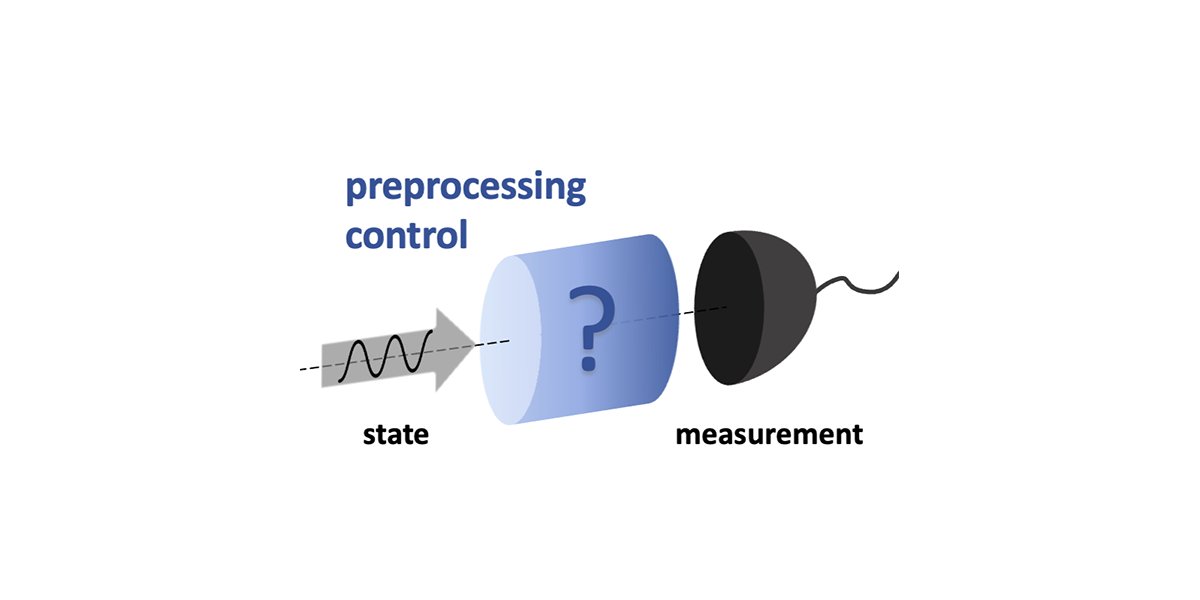
What do you do if your measurement device is noisy, but you need to squeeze as much information out of whatever is about to hit your detector? You “reshape” the signal in a way that is optimal for detection. That way you can fit a square quantum peg in a round hole.
Preprocessing protocols for quantum control are optimized using Fisher information to set ultimate precision bounds for noisy measurements of quantum states. @IQIM_Caltech, @SisiZhou_, @quantum_spiros
https://t.co/mTKHh3WtZo