I am looking for my next role in cybersecurity!
If your team is hiring, or you know someone who is, please feel free to contact me.
DMs are open and any reposts or leads are appreciated!
Last chance to sign up for my Entra ID class in The Hague, starting November 16th.
If that doesn't work out, I will also be back teaching at Insomni'hack next year in the first week of February.
More info: https://t.co/RowaIQlU5e and https://t.co/J7yYUnMHc3
I'm hiring! Looking for a german speaking Pentester in my team:
https://t.co/uD4uxa277O
If you want to work with me and my team feel free to apply. 🫡
Full remote work possible.
Fun fact: `--dangerously-skip-permissions` doesn't actually approve EVERYTHING—we still block some obvious things like `rm -rf ~`. But today's release will let you disable this if you really want, by setting a new env var `CLAUDE_CODE_EVEN_MORE_DANGEROUSLY_SKIP_PERMISSIONS=1`
One of our security researchers at Delphos Labs, Kamil Leoniak, triggered kernel memory corruption on Windows using a custom USB device and a user-mode stress PoC. Microsoft assigned CVE-2026-50321, classified it as a Windows USB Driver elevation of privilege, and shipped the fix on July 14.
The bug is that the freed object reference stayed reachable long enough for another path to use it.
WinUSB_FreePipe frees a pipe context and only nulls the shared pointer afterward. In that window the interface pipe array still points at freed memory, and device-control IOCTLs dispatch on a WDF parallel queue, so nothing serializes access to that array.
16 threads were enough. 12 calling pipe policy APIs, 4 toggling alternate settings. A policy call read the stale pointer and took a spinlock inside a freed 0xF0-byte NonPagedPool object. Without Special Pool that allocation stays mapped and reclaimable. With it, the machine bugchecks.
Full writeup on the Delphos Labs blog, with the PoC on GitHub.
https://t.co/FswODrY3Cl
hashcat v8.0.0 released!
The largest update in the history of hashcat, with PCFG attacks, hash recipes that crack hashes without a hash-mode, and bcrypt on FPGA boards.
Release notes: https://t.co/0ffrO586PJ
Download: https://t.co/Grn4jZmAWr
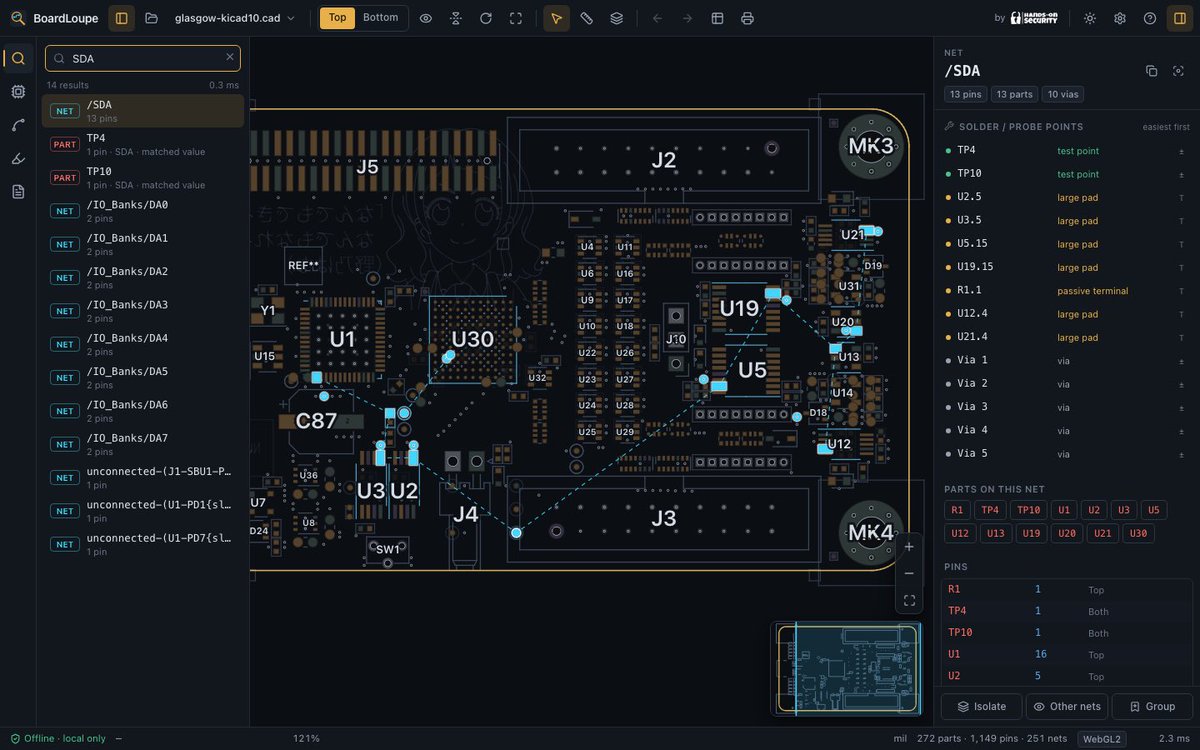
🔍 One loupe to find the chip. Another to follow the signal.
Meet BoardLoupe — our new open-source boardview tool for hardware hackers and reverse engineers!
Already being put to work by students at our Breaking BitLocker training in Zurich. 🔬💻
🔗 https://t.co/9yxBsxNdMU
#HardwareHacking #OpenSource #DigitalForensics