A bit of fun: The Trial of Alexander Sokratis (A Modern Fable about AI), will be published by Stoney Creek Publishing in Fall '27.
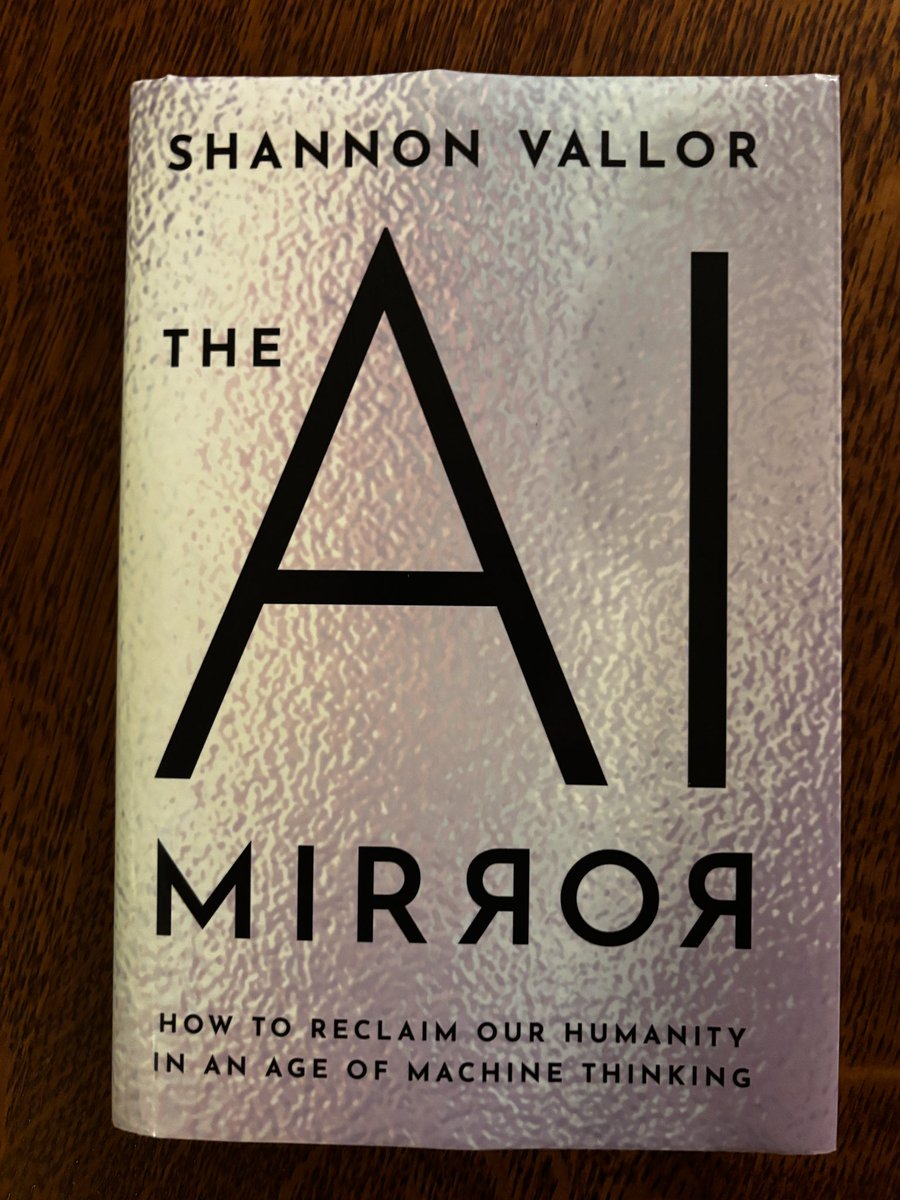
It's a novella treating AI as Sophie's World treats philosophy and is aligned with the books The AI Mirror (Shannon Vallor) and The AI Con (Emily M. Bender and Alex Hanna).
Great point.
Agentic AI systems can’t be compelled to adequately handle customer interactions of extremely limited scope without constant human oversight. But a cure for Alzheimers? That’s no problem!
Do interviewers ever give these CEOs any fact-based pushback on their outlandish claims?
My impression, based on using LLMs, is that their effectiveness in solving mathematical problems depends heavily on the quality and untapped potential of the existing literature underlying those problems.
If that is correct, I wonder what will happen once that potential has been exhausted, especially if mathematicians become overly reliant on LLM assistants and the literature is not replenished by genuinely new, sufficiently deep insights.
In other words, I’m not entirely sure we aren’t entering a creative rabbit hole.
@GaryMarcus So far all it’s been accomplished is to accelerate coding. Alzheimer’s? Prove at least one medical breakthrough Dario and I might start asking questions about how you did it. But … people will line up to give him their money.
@Yuvelir_22 At present, I don’t see AI creating abundance, I see it consuming abundance. I work with it every day. Leaving abundance aside, the threat of mass ignorance will undo any gain AI could give. A revival of animism and mass superstition is the last thing we need.
It’s not my experience that they’re better than master and architect level engineers, but they are certainly faster at basic coding. And maybe adequate for simpler standalone systems. Not using them to assist is a mistake mainly in how fast things can be accomplished, but there are downsides, including developers’ failure to understand how the system is working internally, which will lead to problems in production lasting longer than they should.
100% agree.
Anyone who actually works with LLM’s (even ones that have been organized into small swarms of agents that identify tasks to execute in a workflow) recognizes that they can only get to about 85% accuracy on whatever task it is they’re trying to do that an average human being does with nearly 100% correct results.
The question is no longer whether the financial bubble will burst, but when.
• Valuations will be crushed
• Bailouts will be sought
• Pure scaling is done.
• Neurosymbolic AI won. More or more focus will be on harnesses, loops, tools, and other techniques that leverage ideas from classical AI. Giant neural nets are on their own are not enough.
• LLMs will remain, but the search for better tech (largely neurosymbolic) will intensify.
Scientific discovery is not complete simply because a computer calculated some hypotheses. That’s the easy part. Science is about designing experiments and carrying out those experiments to see if the hypotheses are true. And those experiments are run over and over again, mixed in with even more new experiments that are run over and over and over again.
No amount of AI acceleration is going to speed that process up.
How many predictions has Alphafold made that have been verified experimentally? How is it actually being used to advanced genomic or other science? At what pace?
Each of Alphafold’s predictions (outside if training) stands as a hypothesis that needs validation and verification before it can be accepted as scientifically established fact.
The same is true for every other scientific hypothesis that AI calculates in whatever field.
So let’s not claim that the ability to formulate hypotheses at the speed of light is the same thing as advancing science.
What is in fact happening is that hypotheses are being stacked up at rates impossible to be experimentally verified.
@GregoryConti19@demishassabis
When you look at a frozen river, you must also imagine the current raging beneath the ice. I think all three big labs have achieved autonomous research and their internal models can now choose their own research directions. We will begin to see the fruits of this work this month.
Scientific discovery is not complete because a computer calculated some hypotheses. Science is about designing experiments and carrying out those experiments to see if the hypotheses are true. No amount of AI acceleration developing hypotheses is going to speed that process up. How many predictions that Alphafold has made have been verified experimentally? How is it actually being used to advanced genomic science? Each of its predictions stands as a hypothesis that needs validation and verification before it can be accepted as established fact.
I say that’s not true. Because science isn’t about conjecture and hypothesis only. You have to test it. And these systems don’t test things—they hypothesize and simulate. I have a couple of recent posts related to this nonsense. The people writing these little clips don’t understand science very well.
It’s a false promise just like Marxist communism was.
It won’t pay your bills. It won’t provide unlimited abundance at the press of a button. It will enforce lack of social mobility, destroy merit, return human knowledge to the level of the dark ages because no one will bother learning anything anymore and they won’t understand the world any better than someone from the 14th century.
The people who own AI will exclusively manage the distribution of limited, finite resources—and they won’t be the ones who are denied access to the goods.
Elon Musk told Joe Rogan that one day, working will be optional.
Everyone heard "free money."
Almost nobody heard the next sentence.
I went back and watched the AI part of that conversation. 9 minutes. It's the most important thing he's said about your future, and it's buried in a 3-hour podcast.
Here's what I took away.
1. The tsunami hits desks first.
Musk didn't say AI is coming for jobs "someday." He called it a supersonic tsunami.
And it starts with digital work. Email. Phones. Spreadsheets. Anything that doesn't involve moving atoms.
If your job happens entirely on a screen, you're first in line.
2. The people we told to "get a real degree" might be the last ones standing.
Welders. Plumbers. Cooks. Farmers.
Physical jobs last longer. A generation was told to avoid the trades and sit behind a laptop. The laptop is exactly what AI eats first.
3. It's not universal basic income. It's universal HIGH income.
This is the part that went viral:
"Ultimately, working will be optional because you'll have robots plus AI. And we'll have, in a benign scenario, universal high income, not just universal basic income."
And then the line that made people stop scrolling:
"The problem with communism is universal low income."
His argument: capitalism plus AI might deliver the abundance that every utopia promised and never delivered.
4. And now the sentence nobody quotes.
Right after promising a world where anyone can have anything they want, he said this:
"But there will be a lot of trauma and disruption along the way."
Read it again.
The richest man on Earth, who is building the AI and the robots himself, is telling you the road to paradise goes through pain.
And notice the 3 words he slipped in before "universal high income":
"In a benign scenario."
Not guaranteed. Conditional.
My takeaway:
Everyone is arguing about the destination. Utopia or dystopia.
Almost nobody is talking about the journey. The years between "AI took my job" and "AI pays my bills."
That gap is where most of us are going to live.
The warning is free. It's sitting in a 9-minute clip with 1.4 million views.
So here's my question for you:
If AI paid all your bills tomorrow, would you still work?
Tell me below. I really want to know.
What if the foundational metaphor of modern neuroscience and AI is completely wrong?
For decades, we’ve treated the brain as hardware and the mind as software. If that’s true, conscious AI is inevitable.
But philosopher Dorothea Olkowski contends that the "brain-as-computer" metaphor is a fatal scientific error.
True consciousness doesn't emerge from cold calculation in the cortex, but from the ancient brainstem, steeped in hormones, emotion, and bodily chemistry. You cannot reduce a living, chemical signalling system to binary logic.
Tap the link to read more. https://t.co/m4qEr3xWp6
You don't need to ban recursive self improvement (RSI) because it's non-existent.
Artificial intelligence (AI) left to build itself would simply go in model collapse due to its statistical nature.
RSI is not possible with statistical models.
Reality already banned RSI.
You may find this hard to believe, but for all of the papers and announcements in science and health from, from @GoogleDeepMind , 🔺 NONE are routinely used in real life 🔺Oh, but Alpha-Fold (discussed frequently; had not led to actual drug development),
“In short, the strongest “routinely used” examples so far are in specialized genomics analysis and research support, with clinical pilots and screening evaluations for imaging and conversational AI. Direct, widespread bedside or standard-of-care deployment.””