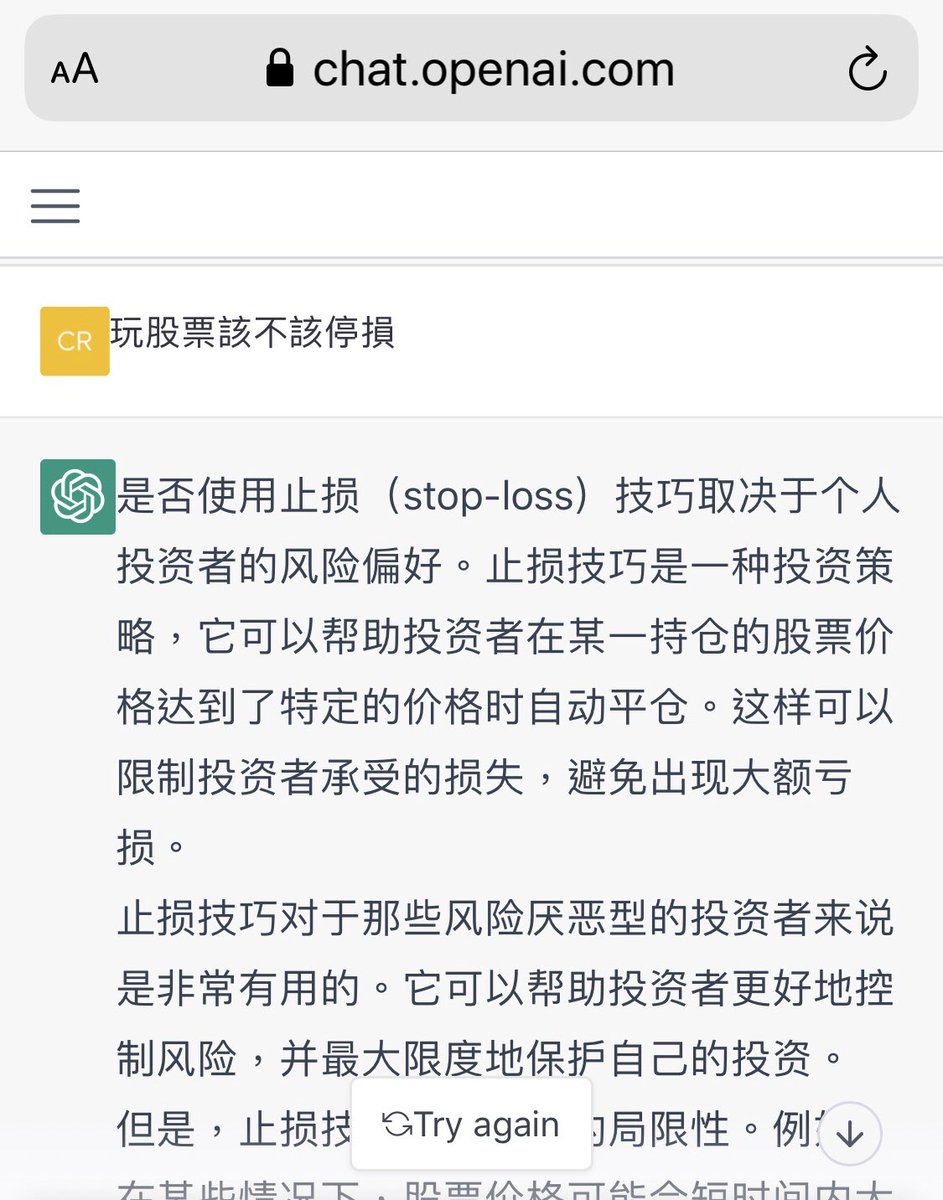
No, it's not!
I can't believe how many people still think changing the label somehow changes the math. Calling it an "investment" instead of a "trade" doesn't make a loss any smaller or improve the odds of recovery. A 50% loss is still a 50% loss.
Just because you intend to hold a stock for years doesn't magically improve the risk/reward. Nobody has a crystal ball. Investing, regardless of style is a business of probabilities. And the probabilities aren't so good that you can ignore risk.
Even Warren Buffett has endured multiple 50–60% drawdowns. Buying a "quality company" doesn't eliminate risk. If you held through big declines and the stock came back, you were simply fortunate.
I'm tired of hearing this nonsense repeated by people who either don't understand risk management or have simply been lucky enough not to learn the lesson yet.
Unfortunately, it's new investors who pay the price. They're told they don't need a stop because they're investing for the long term in a great company. That's wishful thinking.
Hope has never prevented a large loss, only risk management does. And for every investor that holds the next Amazon, there's dozens who hold losses, underperform and blow up.
We heard this nonsense from the Diamond Hands a few years back. One bear market and you never heard from them again.
Taiwan solved tax evasion in 1951 with a trick so cheap it should embarrass every tax authority on the planet.
The problem was an all-cash economy full of small shops. A merchant pockets the cash, skips the receipt, and the sale never existed. Auditors can't catch what was never recorded, and hiring enough of them to watch every noodle stand costs more than the missing tax.
So finance chief Ren Xianqun flipped the incentive. Print a lottery number on every receipt. Draw winners every two months on live TV. Top prize today: NT$10 million, about $310K.
Suddenly the customer and the shopkeeper want opposite things. The merchant wants the sale off the books. The customer wants the ticket. And there are millions more customers than merchants. Every transaction now carries a built-in witness demanding the paper trail.
Year one, reported tax revenue jumped 75%, from NT$29 million to NT$51 million. Seventy-five years later, roughly 70% of Taiwanese still play. Convenience stores redeem the smallest NT$200 prizes at the register, so even a coffee receipt feels like a scratch card.
The elegant part is what the audit force costs. The prize pool runs about NT$7 billion a year, roughly $20 million. In exchange, the government gets 23 million unpaid auditors working every checkout line in the country, forever. No inspector general on earth delivers that coverage at that price.
Greece, Italy, Portugal, and Slovakia all copied it. The most effective compliance tool ever built looks like a game, and that's exactly why it works.