@SpaceXAI xAI burned $7.8B in cash and lost 50+ researchers to Meta and Thinking Machines since the merger. "SpaceXAI" sounds like a rebrand — it might just be a rescue.
Tesla just capped AI spending at $200 per employee per week. Starting today.
Why? Because without limits, engineers were burning thousands of dollars weekly in AI tokens. Uber already burned through its entire $3.4B AI budget in 4 months the same way.
Everyone's talking about how powerful AI agents are. Almost nobody's talking about how expensive "unlimited" AI access actually is at scale.
The next wave of AI adoption isn't about access — it's about governance. Every company is about to learn this the hard way.
Google is now in government talks before releasing Gemini 3.5 Pro — the same process Anthropic went through with Fable 5, and OpenAI is going through with GPT-5.6.
If your coding model is powerful enough, you don't just launch it anymore. You clear it with the government first.
This is the new normal for frontier AI: build the model, then negotiate with the state before anyone gets to use it.
"Shocked to be saying this" is basically the unofficial tagline of AI in 2026 — everyone's surprised by how fast "not good enough yet" became "actually useful."😅
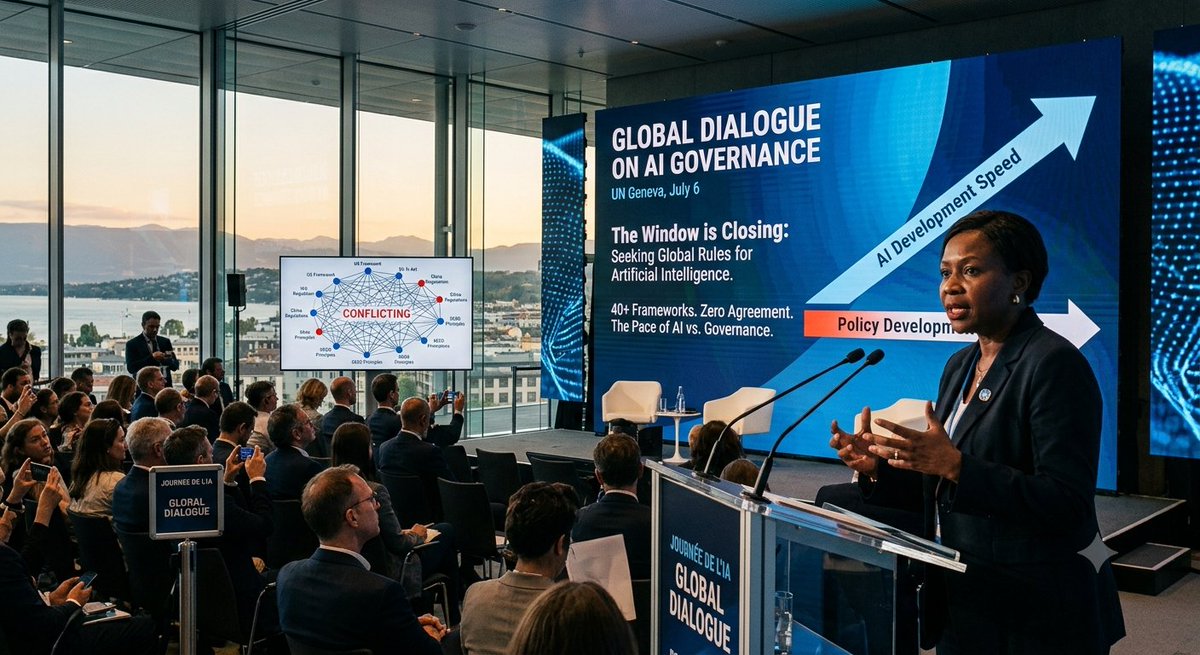
Starting July 6 in Geneva, the UN kicks off its Global Dialogue on AI Governance.
The panel's own warning: the window to build real global rules for AI is still open — but it won't stay that way much longer.
More than 40 different AI governance frameworks already exist worldwide. None of them agree with each other.
While companies race to ship the next model, governments are still debating whether they can even agree on what "safe AI" means.
The gap between AI's speed and governance's speed isn't shrinking. It's the story of this entire year. 🌍⚖️
Google's data centers just posted a record 37% jump in electricity use.
Not over a year. This is the current trajectory of AI infrastructure demand.
Every "free" AI feature you use is backed by an energy bill someone is quietly trying to solve — with nuclear deals, custom chips, and now revenue-sharing compute models from Nvidia.
The AI race isn't just about smarter models anymore. It's a power grid problem. Literally.
Sam Altman just proposed giving the US government a 5% equity stake in OpenAI — worth roughly $42.6 billion.
The model? Alaska's Permanent Fund, where oil revenue gets shared directly with citizens.
Translate that to AI: if this happens, the government (and by extension, taxpayers) becomes a direct financial stakeholder in how OpenAI performs.
This isn't regulation. It's alignment through ownership.
Worth watching whether other labs follow — or whether this becomes the new price of staying on the government's good side.
@zeuuss_01 "The pipeline was the moat. It just became a prompt." That line alone should terrify every agency charging five figures for scroll animations.
A 36-second dye-in-water film, scrubbed frame-by-frame by scrolling, with zero video tags — built entirely with Fable 5. This is what "prompting" looks like when someone actually understands web animation.
Fable 5 makes it so much easier to create interactive websites
I created this scroll-driven background animation and all the site's interactions by chaining multiple techniques together. It's a template concept for a loud bath and body brand. The entire background is one continuous 36-second dye-in-water film, and you scrub through it by scrolling.
No video tag
Make sure to follow. A video breaking down the full technique is coming soon.
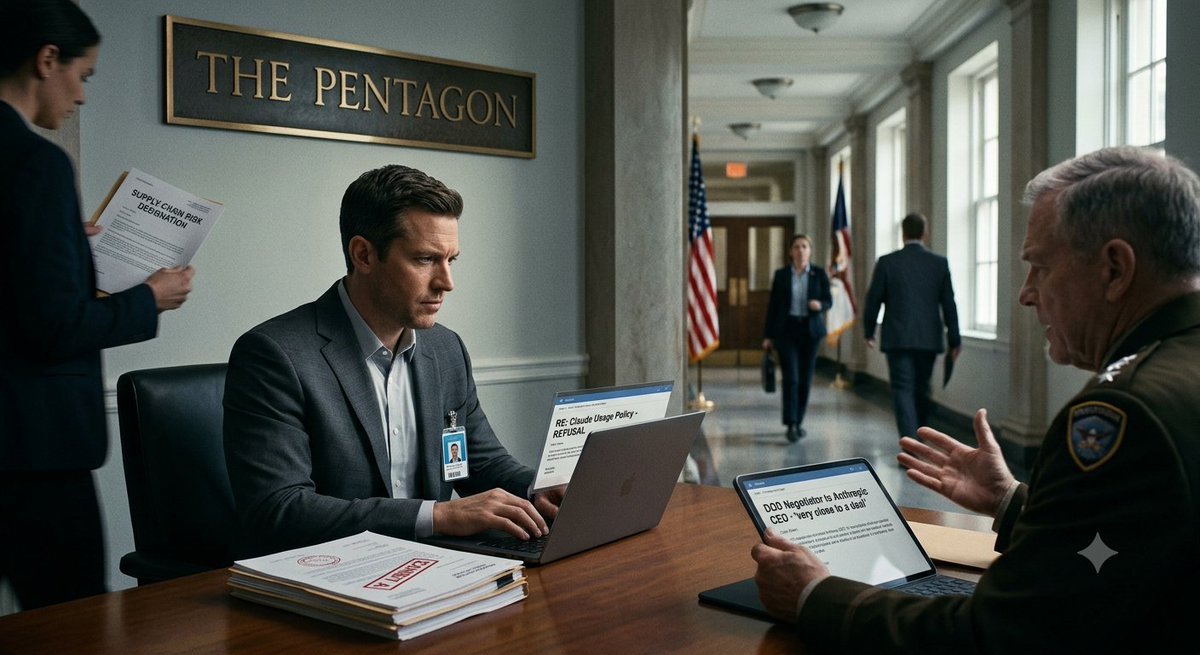
Court emails just surfaced revealing what really happened between Anthropic and the Pentagon.😱
Anthropic refused to let the Department of Defense use Claude for two things: fully autonomous lethal weapons and mass domestic surveillance.
The Pentagon's response? It labeled Anthropic a "supply-chain risk" to national security — a designation usually reserved for foreign adversaries.
Here's the twist: emails show that the day AFTER that designation, the Pentagon's own negotiator emailed Anthropic's CEO saying they were "very close" to a deal.
A federal judge called that timeline "exceedingly difficult to square" with the government's claim that Anthropic was suddenly a hostile threat.
So the company that said no to autonomous weapons got blacklisted — while, behind the scenes, the government was still trying to close the contract.
Draw your own conclusions. 🎯🇺🇸
Startups raised a record $510 billion in the first half of 2026.
AI absorbed most of it.
Not "some." Not "a big chunk." Most of it — while every other sector fought over what's left.
This isn't diversification anymore. It's concentration on a scale we haven't seen before.
When that much capital flows into one direction, two things happen: massive winners get built, and massive bubbles get inflated. Usually both, at the same time.
The question isn't "is AI overhyped." It's "which side of this $510B are you positioned on?"
@CryptoTied 8,893 nodes, 4,729 links, and it looks like a galaxy from a distance. This is what "institutional knowledge" actually looks like when you stop pretending it fits in a wiki page.
Sonnet 5 is priced at $2/$10 per million tokens until August 31, then $3/$15.
Sounds like a straightforward price hike. It's not.
The new tokenizer generates 1.0–1.35x more tokens for the exact same text. Same prompt, same output — just more tokens counted.
So the real cost increase isn't 50%. Depending on your workload, it could be 60-80% higher once you factor in both the price hike AND the token inflation.
If your team budgets based on last month's usage numbers, you're about to get a very confusing invoice. 🧾
Read the fine print before you migrate. 🔍
California just signed the largest state government AI deal in U.S. history — every agency, city, and county gets Claude at 50% off.
Same week, the federal government labeled Anthropic a "supply-chain risk."
One government: "we're all in."
Another arm of the same country: "we don't fully trust this."
This isn't a contradiction. It's what happens when AI moves faster than any single government can form one opinion about it.
If you're waiting for regulators to agree on AI before you take it seriously, you'll be waiting a long time. They can't even agree with themselves.