❌ Tired of messy spreadsheets & lost cases?
✅ There's a smarter way.
Meet SmartCase Manager 🗂️ — the Law Firm Management solution built to keep your business organised, efficient & ahead.
🔹 Track every case in real time
🔹 Automate workflows
🔹 Collaborate seamlessly
#LawFirmManagement #SmartCaseManager #LawFirms
Honoured to share that I have been promoted to the position of Senior Associate at @Signumadvocates. Grateful to the Partners and the Team at Signum Advocates for their trust, mentorship, and support throughout this journey.
Looking forward to this next chapter.
Long before the debate on Uganda’s Protection of Sovereignty Bill began, I had already wrestled with the question of Identity and state power in my book Identity: Lost in History – Found in Purpose.
Through my own journey, and the stories of those who came before me, one pattern kept showing up. From traditional systems and colonial rule to the modern post-colonial governance. There has always been a tension between power and people.
The law has often tried to define citizens on paper. But identity has never been that simple.
Yes! Sovereignty matters. Every nation must protect it. But sovereignty is not just about control. It is about people. It is about dignity. It is about ensuring that the very citizens who give the state its strength are not reduced to subjects of it.
When laws are created in reaction rather than in response to a nation's deeper social realities, we risk missing the actual realisation of Sovereignty.
Sovereignty is therefore not just a legal question to be resolved and ticked off; it is about the people! Who are you protecting?
In this reflection, my partner, @xcenneth , offers a glimpse into some of the issues I explore in my memoir. The intersection of law, identity, and purpose is where the real conversation begins.
Because at the heart of sovereignty… is identity.
@UGgov@kta_law@kenethkipaalu@edtabaro@edwin_tabaro@JustusKaruhanga
Get your copy of my book today 👇🏾👇🏾
🔗Amazon: https://t.co/aJyxc7jOnE
🔗Momo Marketplace: https://t.co/v9C2CJUTt1
#Identity #Leadership #Governance #Uganda #Sovereignty #PurposeDriven
Ongoing: The Chief Justice, Justice Dr. Flavian Zeija, has officially opened an Alternative Dispute Resolution (ADR) training programme for lawyers from the Central Region at the Supreme Court Conference Hall in Kampala.
The training, organized by the Judicial Training Institute, is aimed at promoting the implementation of the National Alternative Dispute Resolution Policy, 2025, the Judiciary Alternative Justice Systems Strategy, 2023, and the Judicature (Court Annexed Mediation) Rules, 2026.
In his remarks, the Chief Justice emphasized that advocates are “gatekeepers of justice” and noted that embracing ADR strengthens justice by giving citizens choice, businesses certainty, and timely resolution of disputes. He observed that with Uganda’s expanding economy and increasing financial disputes, delayed litigation continues to strain economic liquidity and increase the cost of borrowing.
Justice Zeija noted that in banking and credit-related matters, delays in dispute resolution are not merely legal challenges but economic setbacks that freeze capital in courts and undermine confidence in the financial sector. He urged advocates to transition from being “gatekeepers of litigation” to “engineers of economic liquidity” by guiding clients towards faster and more sustainable dispute resolution mechanisms.
The Chief Justice further underscored that ADR should become the preferred first step in resolving financial disputes, adding that delayed resolution of cases negatively affects borrowers, businesses, and public confidence in the financial system. He reassured advocates that ADR would not diminish their professional relevance, explaining that clients who recover through mediation are more likely to retain confidence in legal services than those whose businesses collapse during prolonged litigation.
Justice Zeija also highlighted key reforms introduced under the Judicature (Court Annexed Mediation) Rules, 2026, including the mandatory conclusion of mediation within 60 days, accreditation of mediators under a strict Code of Conduct, enforceable settlement agreements recorded as consent judgments, and cost-free access to court-annexed mediation services funded by the Judiciary.
The Chief Justice reiterated the Judiciary’s commitment to integrating Alternative Justice Systems (AJS) alongside formal legal mechanisms, noting that cultural and religious leaders play a critical role in promoting reconciliation and restorative justice within communities. He stated that the Judiciary seeks to move away from overly adversarial approaches by embracing systems that preserve relationships, social harmony, and dignity while ensuring justice is served.
He further revealed that the Judiciary has already launched AJS pilot engagements in Gulu and Lira under the leadership of the Principal Judge and announced that Buganda and Karamoja will follow as pilot regions. According to the Chief Justice, integrating cultural and religious leaders into the ADR framework is aimed at professionalizing indigenous methods of dispute resolution and making justice more meaningful and accessible to ordinary Ugandans.
Justice Zeija also announced that the Judiciary will conduct a Mediation Settlement Fortnight from May 18 to May 28, 2026, aimed at accelerating the resolution of disputes and unlocking billions of shillings tied up in litigation. He encouraged advocates to use the ongoing training to prepare clients to actively participate in the initiative.
He concluded by urging lawyers to evolve from being “warriors in court” to becoming “architects of resolution,” emphasizing that justice must not only be fair, but also swift and economically responsive.
The Chairperson of the Governing Council of the Judicial Training Institute and Justice of the Supreme Court, Justice Mike Chibita, welcomed participants to the training and described the rollout of the new mediation rules as a critical step in strengthening ADR mechanisms within Uganda’s justice system
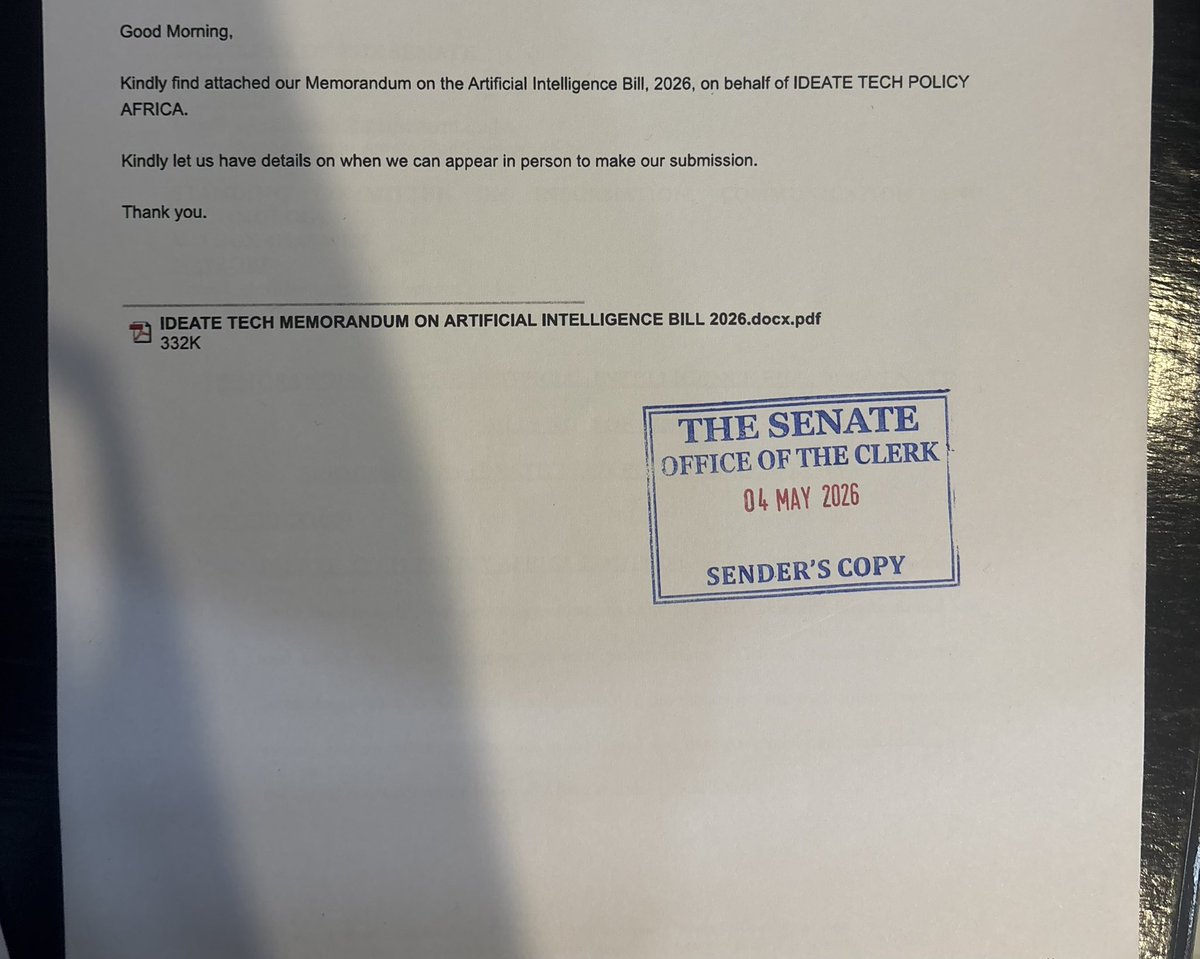
We have so far submitted 3 memos to the Senate on the Artificial Intelligence Bill, 2026. Key proposals include:
1) Creation of an Internet Court (Division) or something similar to the Beijing Model. The Beijing Internet Court that deals with all tech law related disputes, including IP, e-commerce platforms, internet related disputes, platform liability and accountability etc
2) Inclusion of a representative of @lawsocietykenya to the Advisory Committee on Artificial Intelligence.
3) Qualifications of the AI Commissioner to exclude the requirement of “at least 10 years experience in management of public or private institutions”
4) Harmonization of Clause 32 of the Bill with Section 35 of the Data Protection Act which deals with automated decisions.
5) Public Service Commission taking over the appointments pursuant to Article 234 of the Constitution. The Bill usurps the role of the PSC on recruitments and removal from office.
Cc @IdeatePolicy
Nalujja Federesi v Nabbosa Scovia (Miscellaneous Cause No. 32 of 2025) [2026] UGHC 450 (5 May 2026)
Decree-holder may execute a consent decree despite a caveat, but removing a deceased caveator’s caveat requires notice or joining the estate.
👉:https://t.co/ghhSISlfBg
Your law firm is doing the work. But is all of it showing up as revenue? Most firms lose up to 50% of billable revenue — not from lack of clients, but a broken billing structure. SmartCase Manager fixes that. Same workload. Double the revenue. 👇 https://t.co/pPuGr5bo0X #LawFirm #LegalBilling #SmartcaseManager #LegalTech
Managing Partners of Law Firms - What if the Revenue Gap in your Law Firm isn’t a Client Problem?
It’s a Billing Structure Problem.
SmartCase helps Law Firms capture every Billable moment and double Revenue without adding more work.
Ready to see the difference?
#LawFirmManagement #SmartCaseManager




![Uganda_LII's tweet photo. Nalujja Federesi v Nabbosa Scovia (Miscellaneous Cause No. 32 of 2025) [2026] UGHC 450 (5 May 2026)
Decree-holder may execute a consent decree despite a caveat, but removing a deceased caveator’s caveat requires notice or joining the estate.
👉:https://t.co/ghhSISlfBg](https://pbs.twimg.com/media/HHlZB6iXAAYSNg7.jpg)


