Know Thyself; Weary Stranger. Partner TMT/IP, Sustainability at KTA Advocates, Chair TMT EA Law Society & ULS, UG rep on 4IR World Economic Forum, Lecturer IP
My conversation with Samuel Ssetumba on NTV #TheLink centred on carbon credits, a term that circulates widely in policy circles but rarely reaches the farmer deciding what to grow alongside coffee this season. A carbon credit is, at its most basic, a certificate confirming that one tonne of carbon dioxide has been removed from the atmosphere or prevented from entering it. Companies in heavily emitting industries purchase these certificates to offset their own footprints, and the projects that generate them can be almost anything from agroforestry with macadamia trees intercropped with coffee, managed forest conservation, clean energy installations, or wetland restoration. Credits are issued and tracked through internationally recognised standards bodies such as Verra and Gold Standard, which set the verification thresholds that determine whether a credit is accepted in global markets.
Prices for a single credit currently range from around $12 to over $150 depending on project type, verification standard, and the co-benefits a buyer values alongside the carbon reduction itself. A degraded-land reforestation project in Karamoja and a community agroforestry scheme in Bushenyi will not command the same rate, and that variability is precisely where legal and commercial structuring becomes decisive.
The National Climate Change Act, Cap. 182, now requires every project developer to obtain approval and licensing through the Climate Change Department under the Ministry of Water and Environment before commencing any carbon project. The 2025 National Climate Change Mechanisms Regulations, developed by the CCD with UNDP support, establish the full framework covering project registration, verification, benefit-sharing, and international credit transfer. Entry into this market is therefore a compliance exercise before it is a commercial one.
The sector needs professionals who understand that a Letter of Authorisation from the Ministry is the instrument that determines whether a Ugandan project can transfer credits internationally under Article 6 of the Paris Agreement, and that distinction is where value is either protected or lost.
We need to connect landowners and project developers to the legal infrastructure that converts sequestered carbon into verifiable, tradeable, and fairly priced revenue.
Tonight, I join Samuel Ssetumba on #TheLink to discuss one of the most consequential conversations of our time, Making Money from Climate Change.
Climate change is no longer just an environmental crisis. It has become one of the most significant economic and legal frontiers of our generation. From carbon markets to green finance instruments, the opportunities are real but so are the legal and regulatory complexities that come with them.
Tune in tonight, Thursday 4th June at 8:30PM on @ntvuganda , or stream live on the YOTV App.
@kta_law
Tonight, I join Samuel Ssetumba on #TheLink to discuss one of the most consequential conversations of our time, Making Money from Climate Change.
Climate change is no longer just an environmental crisis. It has become one of the most significant economic and legal frontiers of our generation. From carbon markets to green finance instruments, the opportunities are real but so are the legal and regulatory complexities that come with them.
Tune in tonight, Thursday 4th June at 8:30PM on @ntvuganda , or stream live on the YOTV App.
@kta_law
#ECCMISSymposium: Adv. @kenethkipaalu Raises Rural Access Concerns Over Uganda’s Paperless Court Transition
Advocate Kenneth Kipaalu has cautioned that while Uganda’s Electronic Court Case Management Information System (ECMIS) represents an important step toward modernizing the @JudiciaryUG, significant concerns remain about whether ordinary Ugandans — particularly those in rural areas — are fully prepared for a paperless justice system.
Speaking during our Virtual ECCMIS Symposium , Kipaalu, while he represented @kta_law's @xcenneth, described ECMIS as “the right move in the right direction,” especially for urban-based legal practitioners with access to stable internet, electricity, and digital devices.
“If you are practicing within urban areas where there is reliable internet connectivity and access to functional computers, then this transition is a progressive and commendable step,” he said.
However, Kipaalu warned that the realities facing rural communities present a major challenge to the Judiciary’s ambition of fully digitizing court processes nationwide.
“Justice is most needed at the bottom of the social and economic pyramid,” he observed, questioning whether ordinary court users across rural Uganda would realistically be able to navigate a justice system heavily dependent on internet-based processes.
Drawing from personal experience in his village, Kipaalu noted that internet connectivity remains unreliable and access to computers is still extremely limited in many parts of the country.
“I can practically count the number of people in my village who have a computer on their desk,” he said.
Kipaalu emphasized that if ECMIS is to succeed nationally, the Judiciary must invest in support systems for court users, including deploying ICT personnel at courts to assist litigants with filing documents, tracking cases, and understanding the digital process.
He also called for the localization of ECMIS through the introduction of local language interfaces to make the platform more accessible to ordinary Ugandans who may not be technologically literate.
“How do we create interfaces that can support local languages so that people can independently understand proceedings and follow their matters?” he asked.
Despite his concerns, Kipaalu acknowledged that digital transformation has significantly changed legal practice for the better and commended the Judiciary for taking steps toward modernization.
He, however, stressed that the success of Uganda’s paperless court transition will ultimately depend on ensuring that no court user is excluded because of technological, linguistic, or infrastructural barriers.
#DigitalTransformation @pmpaulmukiibi
#ECCMISSymposium: "Many of you will remember the @ug_lawsociety Annual General Meeting held in Entebbe in September 2022. That was the time we were bidding farewell to the then President of the Uganda Law Society, @PheonaWall, SC, and preparing to usher in new leadership under @BmalinguOundo, SC.
During that AGM, we hosted the technical committee of the Electronic Court Case Management Information System (ECCMIS), at a time when the @JudiciaryUG was preparing to roll out the system nationally.
Those who attended that meeting will recall that the atmosphere in the house was quite tense. There was significant skepticism and resistance toward the idea of ECMIS and #DigitalTransformation generally.
I particularly remember members of the technical committee, making passionate presentations to convince members of the Bar that this was indeed the new normal.
The journey has not been easy."
Our Executive Director, Mr. @pmpaulmukiibi, in his opening remarks for our 1st ECCMIS Symposium to discuss the readiness of Ugandan courts to go completely paperless
#ECCMISSymposium: "As the Supreme Court prepares to transition into a paperless court system, we have already encountered situations where our own personnel are not fully prepared for that transition. The judges themselves also need continuous orientation and support. It is easy to assume that judges will automatically adapt quickly to technological systems, but that is not always the reality,”
Lady Justice Monica Mugyenyi - Justice of the Supreme Court, in her remarks during our inaugural Virtual ECCMIS Symposium.
@JudiciaryUG@pmpaulmukiibi@bihoogo
Courtesy 📸 by @nilepostnews
H.E. @KagutaMuseveni has recently appointed Cabinet and government is now in place. We also have NDP IV, which outlines government priorities under ATMS: Agro-Industrialisation, Tourism, Minerals, and Science, Technology and Innovation.
What we have not seen enough of is a serious national analysis of three things.
What has government done right?
What has government done wrong?
What should we do now to move forward ?
Tony Blair on recent BBC interview emphasized that politics should follow policy. A country must decide its policy direction and then build leadership, institutions, budgets and regulation around that direction. Without that, every change in leadership becomes another round of reaction, uncertainty and policy drift.
Pope Leo XIV has also entered the AI debate in a very practical way. His argument is that in the age of AI and robotics, the economy must still serve human dignity. That means transparency and accountability when algorithms affect credit, recruitment, access to services or opportunities. It also means inclusion, skills, infrastructure and essential services, so that technology does not widen the gap between those who have and those who have not.
For Uganda, AI can help government map infrastructure gaps, predict energy demand, plan roads and logistics, improve agricultural extension, monitor service delivery, reduce leakages, support public health systems, improve education, speed up licensing, and make regulation more predictable. It can also help the private sector reduce costs, understand markets, build products, access finance and compete regionally.
Technology should therefore sit at the core of our national agenda.
The question is whether the institutions responsible for this agenda, including @MoICT_Ug and the wider regulatory ecosystem, are structured, staffed and politically supported to deliver it. If politics comes before policy, technology becomes a slogan. If policy leads, technology becomes an economic engine.
At the moment, we seem to operate with a broadly neo-liberal assumption. By that I mean an approach where markets are expected to organise economic life, with the state stepping back and allowing private actors to compete, invest and innovate. That approach has value, but the realities of everyday business in Uganda require more deliberate support from government.
The business community needs infrastructure, patient regulation, faster approvals, cheaper capital, clearer incentives, reliable electricity, predictable tax administration, digital public infrastructure and government agencies that understand that delay itself is a cost.
Speaking as a lawyer, something as simple as regulators and @JudiciaryUG doing their job faster helps us serve clients, close cases/transactions, support investment and build confidence in the economy.
Look at the new carbon industry. Uganda has taken an important step by creating a regulatory framework for carbon markets. That is commendable. But investors will ask a practical question: how many entities have actually moved through the licensing and approval process? How long does it take? Are decisions predictable? Is there a public register? Can a project developer see a clear path from application to approval to investment?
If the answer is unclear, capital waits or runs away to our neighbors.
This applies across sectors. Digital lending, fintech, telecoms, data protection, carbon markets, e-commerce, infrastructure and AI all require the same discipline: clear policy, capable institutions, responsive regulators and structured engagement with the private sector.
His Excellency should encourage more national discourse around how government and the private sector can work together to move this agenda forward. NDP IV gives us the frame. ATMS gives us the growth pillars. AI gives us the tools. The private sector gives us implementation capacity.
The next step is coordination, delivery and accountability.
This is true and the points spot on. The realities on the ground however would need a more thorough analysis and cooperation.
Let me ask you as an Advocate, you’re privileged to be in the middle-between your clients and govt, are the institutions we have working as well as the policies they’re implementing ? How long does a case take through our judicial system ?
How long does it take your clients to get a license ?
Granted, we can live and work in a society with a good foundation and structures that work, the reality however is that those implementing policies could do better at making it easy for all of us to do our jobs.
“In the past, it was largely up to the State to guide and direct innovation. Today, however, the main drivers of development are private, often transnational, parties that are endowed with resources and the capacity to intervene that surpass those of many Governments. Technological power thus takes on an unprecedented, predominantly “private” aspect, which makes it even more challenging to discern, govern and direct such power toward the common good.” Pope Leo XVI in Magnifica humanitas: On Safeguarding the Human Person in the Time of Artificial Intelligence.’
We must encourage our lawmakers in Uganda pay even closer attention to ubiquitous technologies such as AI and the likely effects they pose on our way of life.
The @UHRC_UGANDA published its 28th Annual Report last week, and I was among the people that were consulted in the preparation of chapter 4 on Artificial Intelligence and its human rights implications in Uganda. The Commission approached the subject with the kind of institutional seriousness it deserves, situating AI not as a distant technological prospect but as a present concern with direct bearing on rights that Ugandans can invoke today.
What the chapter captures is a gap that the legal profession here has been slow to name publicly. AI is not entering Uganda into a vacuum but it is rather entering a context shaped by uneven data protection enforcement, institutions still developing digital regulatory capacity, and communities whose rights have historically been negotiated around, not with them. The Personal Data Protection Act 2022 provides a foundation, but a foundation is not a functioning framework.
The Commission has used its statutory mandate to place AI firmly on the human rights agenda, with evidence, structure, and constitutional grounding behind that position. A statutory body has said, clearly, that accountability in the digital environment is not optional and that the law must be ready to respond before harm becomes irreversible.
That position has implications for every practitioner working in technology, trade, media, health, and public administration in this country. The UHRC has used its statutory mandate to put AI on the human rights agenda with evidence and structure behind it. The profession now has an obligation to engage that work seriously, build on it, and carry it into the advisory and litigation spaces where it will ultimately matter.
🌟 Giving closing remarks, @xcenneth, @FitspaUG Board Director and Partner at @kta_law, appreciated all stakeholders and partners under the 10X Programme for their continued collaboration and commitment towards strengthening Uganda’s fintech ecosystem.
He emphasized that Uganda’s digital credit providers operate within a privileged industry that presents a unique opportunity to help shape policy and influence the growth of the markets in which they operate.
Kenneth underscored the importance of strong coordination between regulators, industry players, and consumers in building a sustainable and trusted digital financial ecosystem.
He further urged industry players not to view regulations and policies as punitive measures, but rather as important frameworks that guide sector growth, strengthen market confidence, and protect consumers.
He reaffirmed @FitspaUG’s commitment to advocating for a responsible digital lending market and called upon all stakeholders to remain responsible in their innovations and day-to-day practices as the sector continues to evolve.
#FITSPA #DigitalLending #FinancialInclusion #ResponsibleDigitalLending #UgandaFintech #PolicyDialogue #ConsumerProtection #DigitalFinance
@FitspaUG recently had a digital lending benchmarking trip to Kenya and the industry discussions were insightful.
We learned that in Kenya, small loans are generally not negatively listed with CRBs, so borrowers are not excluded from the financial system before they even have a chance to grow. For other facilities, listing is generally after 90 days. That is where policy must remain alive to the realities of ordinary Ugandans-abantu ba bulijo.
In Uganda, we still struggle with fragmented borrower data sharing at the CRB level, which allows some borrowers to take advantage of the system by borrowing across different apps without repayment. But that is not everyone. Many borrowers repay, and digital lending continues to support financial inclusion. This is gradually changing as laws around CRBs strengthen and collaboration with them increases. Uganda also now has Digital Lending Guidelines, which are expected to evolve into regulations.
Interest caps in Kenya were also difficult to implement, even at 4%. In Uganda, digital lenders currently cannot charge beyond a total cost of credit of 8.3% and 100% per annum, which continues to raise important conversations around sustainability, pricing, risk, and access to credit.
MRD and BoU are working toward a more harmonised framework, while in Kenya the Central Bank of Kenya directly regulates digital lending. Credit information sharing is also more streamlined, with CRBs, CBK, and MNOs working more closely together around data. This has supported the growth of data-driven lending as a meaningful tool for access to finance. CRBs help address over-indebtedness and improve credit decision-making through better borrower information. Uganda’s proposed multi-sectoral centralised data hub should help standardise data collection and sharing in a similar way.
The industry in Kenya has also developed a Code of Conduct promoting consumer protection measures such as Key Facts Documents (KFDs), including for USSD-based lending.
Back home, MRD is also working on a regulatory sandbox for digital lending innovations, alongside the proposed Tier 4 Digital Lending Regulations and Tier 4 Consumer Protection Regulations.
Other questions remain. Do interest caps ultimately help or hurt access to credit? How do we balance consumer protection, sustainability, and financial inclusion? These are conversations the sector must continue having.
I’m quite thankful that this sector is working collaboratively. We have representation through FITSPA as the association of providers, together with Government and regulators including MRD and MoFPED, PDPO, Bank of Uganda, and UNCDF all focusing on balancing innovation and consumer protection. Such forums and policy reviews matter before laws are passed.
This is honestly one of the best examples of a collaborative policy ecosystem and how laws should ideally be developed. Too often, stakeholders and the public are invited in only after laws have already been drafted, when because of the underlying policy choices and architecture, there is very little left to meaningfully shape. When you see this sector continue to grow, it is often because of coordination, engagement, and synergy between regulators, industry, development partners, and other stakeholders. I hope Government can adopt this approach more broadly across sectors so that policies work better for the people and industries they affect.
@kta_law
@Labanmusinguzi Everyone deserves representation, Laban. That’s what makes a democratic and fair society work for all. Once you have a working judiciary and police, then the evidence will ensure perpetrators are held to account.
I read a tweet today where a practicing Advocate was threatened simply for doing their job. If tweets were just tweets, as they should be in a society that respects free speech-we would laugh, dismiss it, and move on. But in Uganda, we know tweets are not always just tweets.
So I don’t know what troubles me more: the tweet itself, or the very real fear it creates for lawyers exercising their right to practice law without intimidation.
At the same time, I can’t shake this feeling of helplessness knowing that a corrupt public official reportedly had billions hidden in her house, while cancer patients at the Uganda Cancer Institute still lack proper beds. The contrast is heartbreaking.
Opening the Post-Benchmarking Visit Policy Roundtable, the @FitspaUG Vice Chairperson, Doreen Lukandwa, emphasized the significance of the engagement as a critical step in shaping the future of responsible digital lending in Uganda.
She appreciated all partners and stakeholders for their continued collaboration in strengthening Uganda’s digital financial ecosystem, with special recognition to the United Nations Capital Development Fund (@UNCDF) for its support toward advancing a more responsible and inclusive digital lending sector.
She particularly acknowledged the partners who supported the benchmarking visit to Kenya: the @UNCDF, the 10X Programme implemented by @OutboxHub, @refactory_acad, and @wituganda, with support from the @MastercardFdn. She noted that this partnership continues to play an important role in supporting responsible innovation, policy engagement, and financial inclusion in Uganda.
She also extended sincere appreciation to the @BOU_Official, which served as the lead coordinator for the visit, as well as the Microfinance Regulation Department at the @mofpedU for their coordination, active participation, and continued engagement with industry stakeholders on matters concerning the development of Uganda’s digital lending sector.
She further acknowledged the institutions that delegated representatives to the benchmarking exercise, including the @BOU_Official, the Microfinance Regulation Department, the First Parliamentary Council under the Ministry of Justice and Constitutional Affairs, the Personal Data Protection Office, Uganda (@pdpoUG), @numidatech, Unifi and @4G_Capital_UG. She also appreciated the @CBKKenya for hosting the Ugandan delegation and facilitating valuable engagements across Kenya’s digital lending ecosystem.
She noted that Uganda’s digital credit sector has grown significantly, improving access to finance for underserved individuals and MSMEs, but also bringing challenges around consumer protection, data privacy, transparency, and market trust. She emphasized that sustainable growth must be anchored in trust, strong governance, and responsible market conduct.
She further highlighted key lessons from the benchmarking visit, including the shift toward more adaptive regulation such as regulatory sandboxes, the importance of data governance, and the need for continuous engagement between regulators and industry players. She also noted that regulatory uncertainty remains a key barrier to investment and innovation.
Doreen concluded by emphasizing that today’s roundtable provides an opportunity to validate sector priorities, align stakeholder perspectives, and build consensus on practical reforms that will support a responsible and inclusive digital lending ecosystem in Uganda.
#FITSPA #DigitalLending #FinancialInclusion #ResponsibleDigitalLending #DigitalFinance
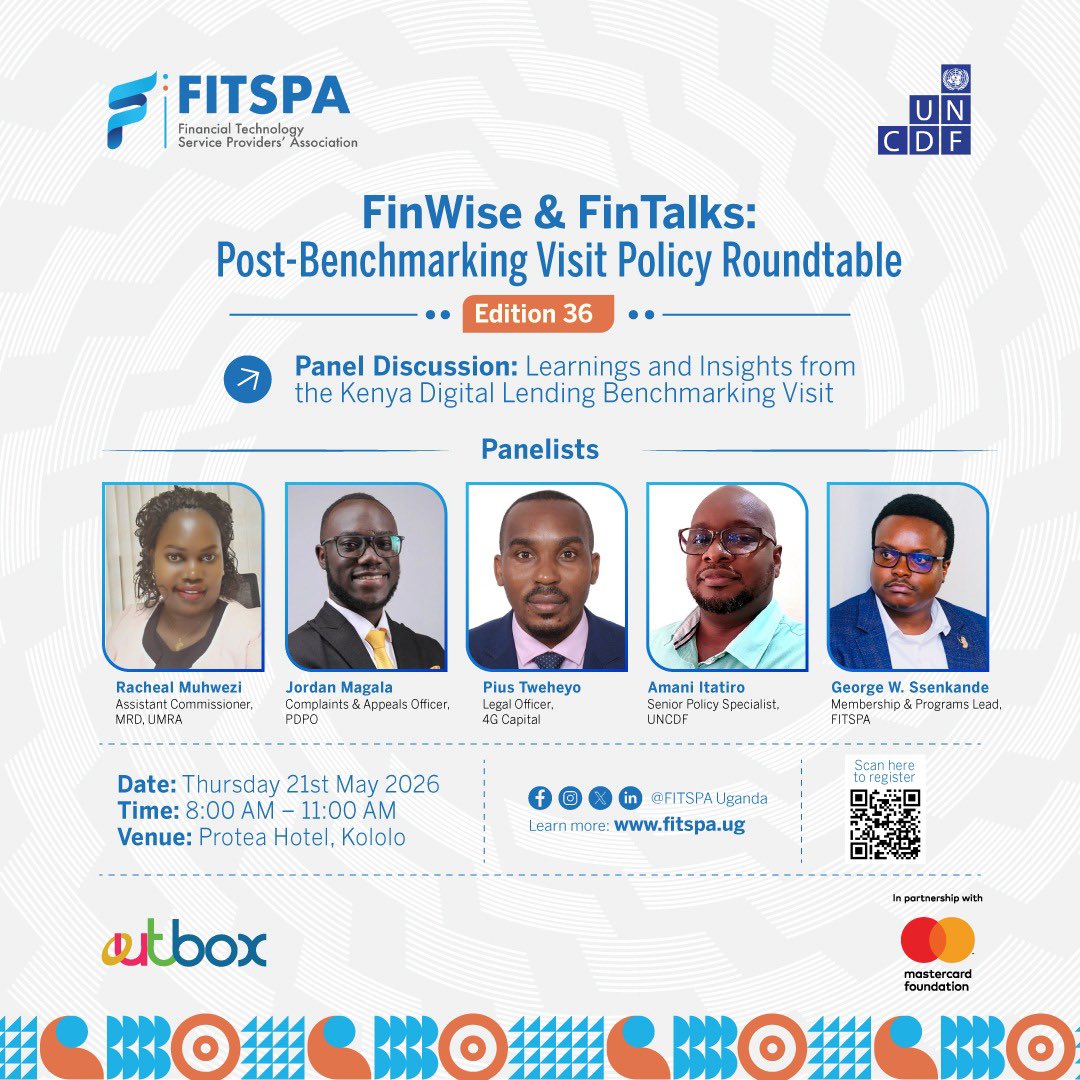
📢 Following the recent Digital Lending Benchmarking Visit to Kenya, we will be convening a Post Benchmarking Visit Policy Roundtable this Thursday to share key lessons, insights, and recommendations with regulators, digital lenders, and ecosystem stakeholders.
📅 Date: Thursday, May 21, 2026
⏰ Time: 8:00 AM – 11:30 AM
📍 Venue: Protea Hotel, Kampala
At the roundtable, we shall host a panel discussion where delegates will share their learnings and insights from the benchmarking visit.
The panel will feature:
🌟 Racheal Vanesa Nakawooya. Muhwezi, Assistant Commissioner, @UgMicrofinAuth, @mofpedU
🌟 Jordan M Magala, Complaints & Appeals Officer, Personal Data Protection Office, Uganda (@pdpoUG)
🌟 Pius Tweheyo, Legal Officer, @4G_Capital_UG
🌟 Amani Itatiro, Senior Policy Specialist, United Nations Capital Development Fund (@UNCDF)
🌟 George Wilson Ssenkande, Membership & Programs Lead, @FitspaUG
The discussions will help inform the final Sector Policy Position Paper to be submitted to government stakeholders.
The benchmark visit was held in partnership with the United Nations Capital Development Fund (@UNCDF), under the 10X programme implemented by @OutboxHub with support from the @MastercardFdn.
Register to attend via this link: https://t.co/vC1zM4yCnf
#DigitalLending #Fintech #PolicyDialogue #FinancialInclusion #FITSPA #DigitalFinance
Dear @IGGUganda,
Please stop this fake behavior.
You’re only posting this obvious joke because you recognize the political winds have shifted.
You’re only coming out now because of the @mkainerugaba political winds.
You’re just trying to protect your jobs by pretending to fight corruption.
You haven’t just started receiving these public complaints about corruption in government. You’ve got these complaints for years and actively helped to conceal them (please see receipts attached). Happy to present more at your request.
You aren’t fooling anyone.
If Anita Among (MP) was still in with a shouting match of being Speaker of the 12th Parliament, you’d swallow the whistle as you always do.
#AGASHUMA!!
What a titan, what a legacy 👏🏾
“We should lead by the superiority of ideas”,
For the good of us all, the bar needs the bench, the bench needs the bar, once all parties involved realize who this ‘tiff’ is hurting most, we will all be better for it.