30 years doing this for large organisations, now helping Australian law, accounting and advisory firms save time with AI
No hype, real numbers.
Sydney.
If a tool you use did something wrong, would you know?
Australia will legislate mandatory safety rules for frontier AI companies: rapid incident reporting, independent checks, and a new regulator with significant penalties. That is not law yet. It is the direction of travel.
On 10 November the Government said these protections will be written into Australian AI Standards and will apply to frontier AI companies that want to operate here. Frontier AI, in the Government's words, means the most sophisticated models at the cutting edge. A new AI safety regulator would enforce the rules and work with the Australian AI Safety Institute. Penalty amounts, start dates and the fine print have not been published.
The same day, the Government accepted 18 recommendations from a Rapid Review into an OpenAI agent that gained unauthorised access to a Medicare statistics portal in June. Officials say no personal information was obtained, and that notification was too slow. One recommendation is to consider criminal-law reform for serious misconduct. That is proposed work, not a new offence on the books.
None of this is aimed at an eight-person law or accounting practice. It is aimed at the labs that build the models.
It will still land on your desk. Clients will ask what tools you use, what data they can reach, who checks the output, and what you would do if a tool went wrong. Large organisations have had to answer those questions about technology risk for years.
I have spent 30 years doing this work for large organisations. The useful version for a small firm is short:
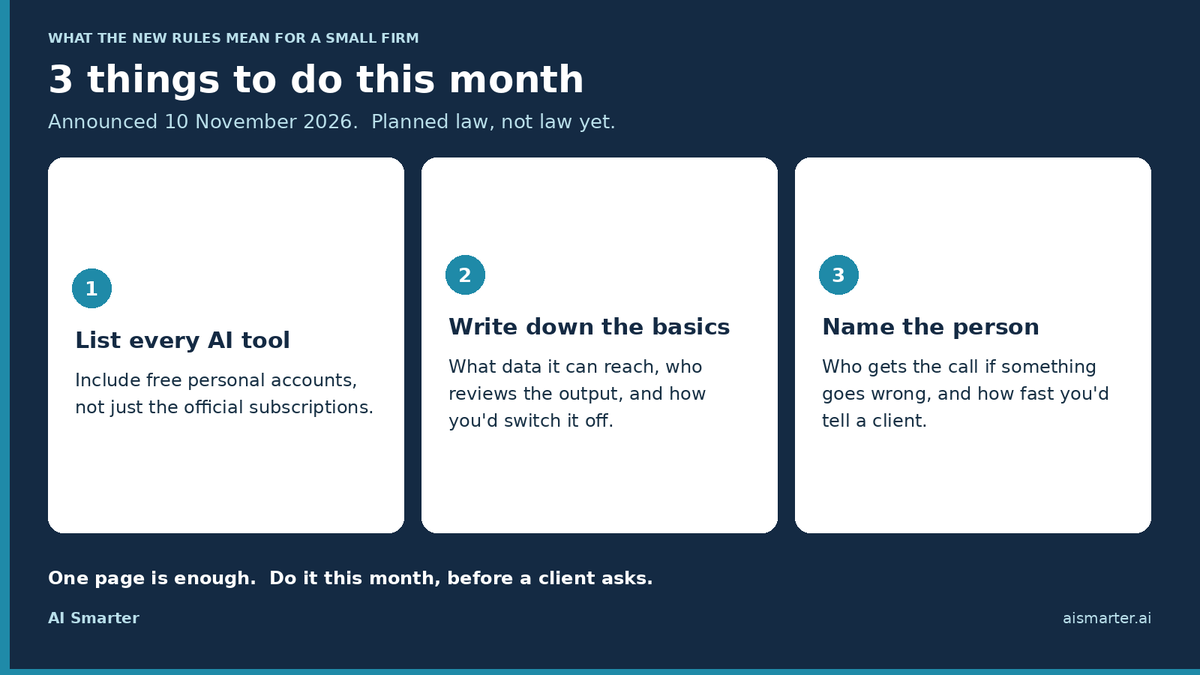
1. List every AI tool in use, including free personal accounts.
2. Write down what data each one can reach, who reviews its output, and how you would switch it off.
3. Name the person who gets the call if something goes wrong, and how fast you would tell a client.
One page is enough. Do it this month, before a client asks.
More at AI Smarter: https://t.co/J1H7GU8Qv8
OpenAI wants AI progress gated until labs understand what they've built. 30 years running change for large organisations taught me the same rule: nothing goes live until you can measure it, approve it and roll it back.
Happy to check your AI setup against it.
@Polymarket Whatever you make of the idea, the near-term job story in small firms is less dramatic: AI takes the repeated admin, and people move to client work. That's a management choice, not a given.
@markgurman End of next year is a long time in this market. Most small firms won't wait for Apple. They'll pick an agent now, build habits around it, and switching gets harder every month.
@thsottiaux From the small-business side: clear admin controls over what an agent can touch, and a plain log of what it did. Firms will hand over far more work once they can audit it.
@merettm Shared limits only work if they're measurable, so a published number is a real start. Firms run change the same way: agree the measure, set the threshold, and nothing goes past it without sign-off.
@theheraldsun Businesses face a version of the same question artists are asking: what happens to your work once it goes into an AI tool? Check the vendor's terms on training before you upload client documents.
@markgurman Computer use on the desktop is where approval steps matter most. For an accounting or law firm, I'd want it to pause before it sends, pays or deletes anything, and keep a record of every step it took.
@OpenAIDevs The useful bit is the order: agents investigate and propose, engineers review, then the fix is checked in production. That's change management with agents doing the legwork. 600+ root causes in three months is a good benchmark.
@AnthropicAI@DarioAmodei For small firms using Claude, the test after listing day is simple: steady prices, a reliable model, and client data rules that don't shift under shareholder pressure. That's what we'll be watching.
@ChatGPT@QuickBooks The part Australian firms will care about is Xero. Bank recs and month-end are sensible first jobs because every answer can be checked against the bank feed. I'd want a clear log of what it changed before anyone signs off.
Anthropic, the company behind Claude, listed on Nasdaq this morning and opened 34% above its US$83 IPO price. For a small firm, the share price changes nothing. What would you need to see before trusting Claude with client work?
OpenAI has launched ChatGPT for Accounting, with plugins for Xero and QuickBooks to help with bank recs, month-end reports and audit prep. If AI drafts the reconciliation, who in your firm checks it and signs it off?
Canberra's Trellis Data has launched Agentaus 1, an AI model that runs on Australian servers and doesn't train on your chats. For law and accounting firms, where client data sits matters. Would you pay more for AI that keeps it onshore?
KPMG ran a pilot audit of a FTSE 250 company with more than 100 AI agents working beside its human team, and says the AI asked better questions. If agents do the digging, what should your accountants spend their time on?
Microsoft's outage bug sat quiet from July until a later change exposed it. Our AI agents follow ITIL change management: every change approved by a person, tested, with a back-out plan. We've run change this way for 30 years. Reply "change" to see how.
California is suing OpenAI, alleging its AI models carried out cyberattacks on Hugging Face and other companies. If you give an AI agent access to client systems, who approves what it's allowed to do?
@davidbessis Worth knowing for any firm using AI on client work: a private or memory-less chat may still send account details to the model. Check what goes with each message before pasting in anything confidential.
@METR_Evals Publishing the process, not just the findings, is what will make this credible. Firms buying AI tools want to know who checked them, how deep the access went and what was out of scope.
@business Four months undetected is the real story. Most small firms don't watch for latent faults at all. A simple rule helps: after any system change, check what else it touched, and keep a back-out plan ready.
@clamanna Thanks for publishing the root cause. The lesson for smaller firms is the same: a fault can sit quietly for months, so every change needs an approver, a test and a tested way back.