I've noticed a pattern when I speak with founders in AI, they always ask about the challenges @emergentlabs faces as we scale rapidly.
It's a fair question. We're all navigating something genuinely new. And each model jump means a new set of challenges, sometimes virtually starting from scratch.
So instead of answering one at a time, I thought: why not just get a few of the best minds in a room?
A small group of AI founders (15 people) talking about what we're building, what's breaking, and where this is all going.
No pressure to "network." Just an intimate dinner, sharing stories... with the best operators in AI.
The first one is in Bangalore this Saturday, March 21. If you're an AI founder or operator actively building, apply here: https://t.co/tAdm9WJM9A
In partnership with @TheProductfolks.
In the high-stakes theatre of international diplomacy, silence is rarely just silence. When U.S. Commerce Secretary Howard Lutnick announced this January that a landmark trade deal with India had stalled because Prime Minister Narendra Modi "did not call" President Trump to finalize the terms, the explanation was as convenient as it was implausible.
To the casual observer, it painted a picture of bureaucratic hesitation. But to those watching the flow of global capital, the silence on the phone line masked a thunderous shift in the global economic order. While Washington focused on tariffs and trade deficits, New Delhi quietly engineered a financial mechanism that the United States has historically treated as a red line: the ability to buy oil without the dollar.
A rigorous analysis of regulatory filings, central bank data, and geopolitical signalling reveals that the trade impasse of early 2026 is not about almonds or steel. It is the first major casualty of the "Petro-Rupee," a strategy that has placed the world’s oldest democracy and its largest democracy on a collision course over the future of financial sovereignty.
The "Red Line" and the Greenback
To understand the gravity of the rift, one must look past the current headlines to the foundation of American power. Since 1974, when the Nixon administration struck a pact with Saudi Arabia, the global oil trade has been denominated effectively exclusively in U.S. dollars. This "Petrodollar" system forces nations to hold vast dollar reserves, which are recycled back into U.S. Treasury bonds, financing American deficits and cementing the dollar's global supremacy. History has been unkind to those who challenge this arrangement. When Saddam Hussein switched Iraqi oil sales to the Euro in 2000, or when Muammar Gaddafi proposed a gold-backed African currency in 2011, the geopolitical consequences were severe. As former Federal Reserve Chairman Alan Greenspan candidly noted in his memoirs, the Iraq war was "largely about oil"—a resource inseparable from the currency used to buy it. So is the case with Venenzula and Iran today, which are pricing their oil outside the US dollar system.
For decades, this was a line no ally would cross. But in the shifting landscape of 2026, India has done just that.
The Smoking Gun: August 2025
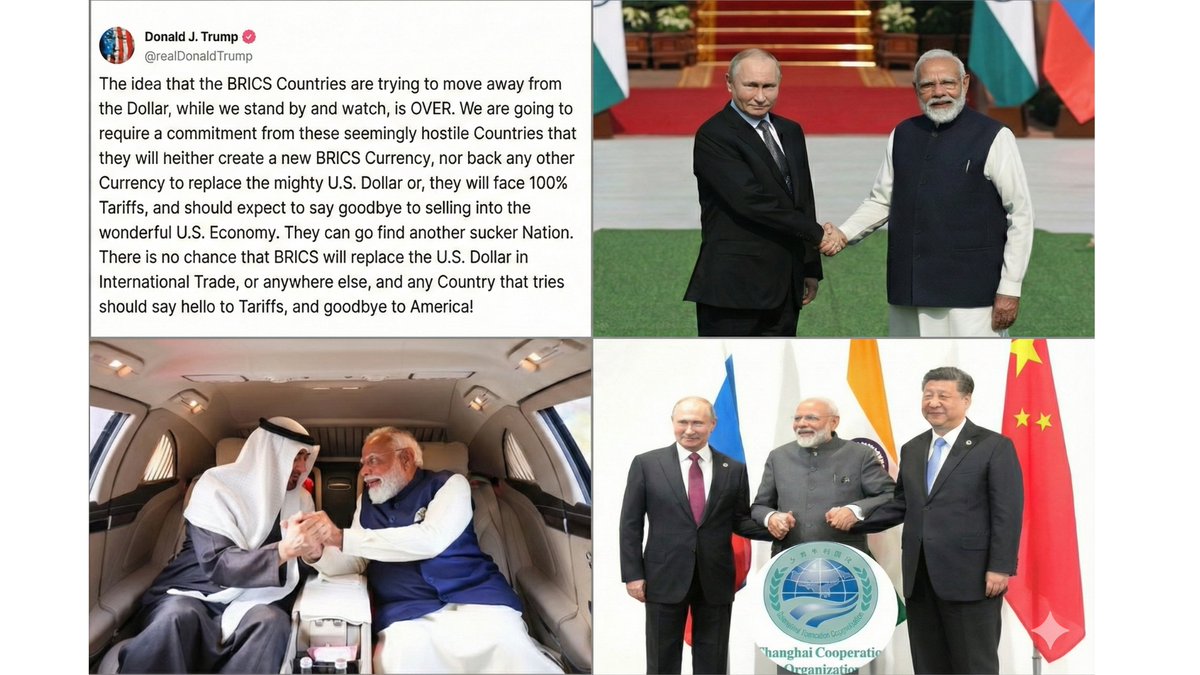
Picture tells thousand words. The deterioration of economic relations can be traced precisely to mid-2025. While public attention was fixed on diplomatic pleasantries, the Reserve Bank of India (RBI) was dismantling the "Rupee Trap" that had hindered its trade with Russia in Rupee.
For months, Moscow had been accumulating billions in Indian Rupees from oil sales that it couldn't spend. Then, on August 12, 2025, the RBI issued a quiet but revolutionary circular. It authorized foreign holders of "Special Rupee Vostro Accounts" (SRVAs) to invest their surplus balances into Indian Government Securities and Treasury Bills. In a move that alarmed U.S. strategists even more, India and the UAE—two key American partners—began operationalizing a Local Currency Settlement system. The Indian Oil Corporation paid for a million barrels of Abu Dhabi crude in rupees, proving the concept worked. By 2025, this corridor had deepened, with the UAE pumping $22.84 billion in foreign direct investment into India to balance the currency flows, and the Abu Dhabi Investment Authority setting up shop in Gujarat's GIFT City.
This was the smoking gun. By allowing Russia to recycle its oil revenue directly into Indian sovereign debt, New Delhi created a closed-loop financial system. Russian oil profits were no longer chasing U.S. Treasuries; they were funding Indian infrastructure. The reaction from Washington was swift. Within weeks, the U.S. imposed tariffs of up to 50 percent on select Indian goods—a punitive strike that signal the partnership was in jeopardy.
By late 2025, this alternative financial architecture had expanded far beyond a wartime necessity for Russian oil. The RBI had permitted 123 correspondent banks from 30 countries—including the United Kingdom, Germany, Israel, and Singapore—to open 156 Special Rupee accounts.
The Last Straw: India Takes the Wheel at BRICS
While the "Petro-Rupee" laid the kindling, the spark that finally burned the bridge was India’s bold assumption of leadership within the BRICS currency project. As the host of the 2026 BRICS Summit, New Delhi has moved beyond passive participation to active architecture. The Reserve Bank of India has formally proposed linking the Central Bank Digital Currencies (CBDCs) of member nations—a project dubbed the "BRICS Bridge."
Building on the 2025 Rio de Janeiro declaration, India is pushing for a proprietary, interoperable payment rail that would allow Russia, China, India, other BRICS members to settle trade instantly in digital local currencies, completely bypassing the U.S. banking system. This is not merely a theoretical exercise; with the RBI actively pilot-testing the e-Rupee’s cross-border capabilities, India is effectively building a "digital SWIFT" immune to Western sanctions. For the Trump administration, this was the final provocation. It wasn't just evasion; it was replacement.
Conclusion: A Monetary Mutiny
This aggressive push for a parallel financial system became the veritable last straw on the camel's back for the stalled trade deal. In December 2024, President-elect Trump issued a blunt ultimatum: any move by BRICS nations to create a new currency or back an alternative to the dollar would be met with 100 percent tariffs.
Washington views India’s 2026 agenda not as economic modernization, but as a "monetary mutiny." The sages who studied the rise and fall of kingdoms would chuckle today, for the lesson is ancient: money is the hard-earned fruit of labor, while currency is merely the paper promise that it still tastes good. Money—like gold and silver—is the crystallized effort of real work. Currency, however, is its excitable younger cousin: useful for trade, but spoiled the moment rulers discover the printing press.
India has chosen to bear the cost of tariffs rather than surrender the sovereignty of its "crystallized effort." The trade deal may be officially "stalled" due to a missed phone call, but in reality, it lies buried under the foundation of the new BRICS financial architecture—a foundation India is now actively pouring concrete for better future.
Manish Bhandari, CIIA, founder of Vallum Capital Advisors, a Portfolio Management firm managing equity investments Based in Mumbai.
Full Article & Research Document Available Below
https://t.co/OsPJLHJ1Db
#Geopolitics #Macroeconomics #USIndiaTrade #BRICS2026 #GlobalEconomy #ForeignPolicy #TradeWar #DeDollarization #InternationalRelations
Thank you North of India, for keeping India safe. It’s because of you all that we in the southern part of the country are sleeping without any worry.
We live in privilege of being far away from the border, but we shall pray for your safety today. A united India is what will defeat the enemy.
I was wondering why Bangladeshis enter India in such a large number. Other people do not do it. Nepalis even go back after few years.
So, I tried to understand the mindset & conditioning of Bangladeshis behind this.
The reason is way older than we think.
1/
The Sanatan Act, an exact clause for clause replica of the Waqf Act, is a must if this country is to be saved. If @narendramodi cannot abrogate acts that discriminate against Hindus, in the spirit of equality and fairness he must promulgate similar acts for Hindus.
My views:
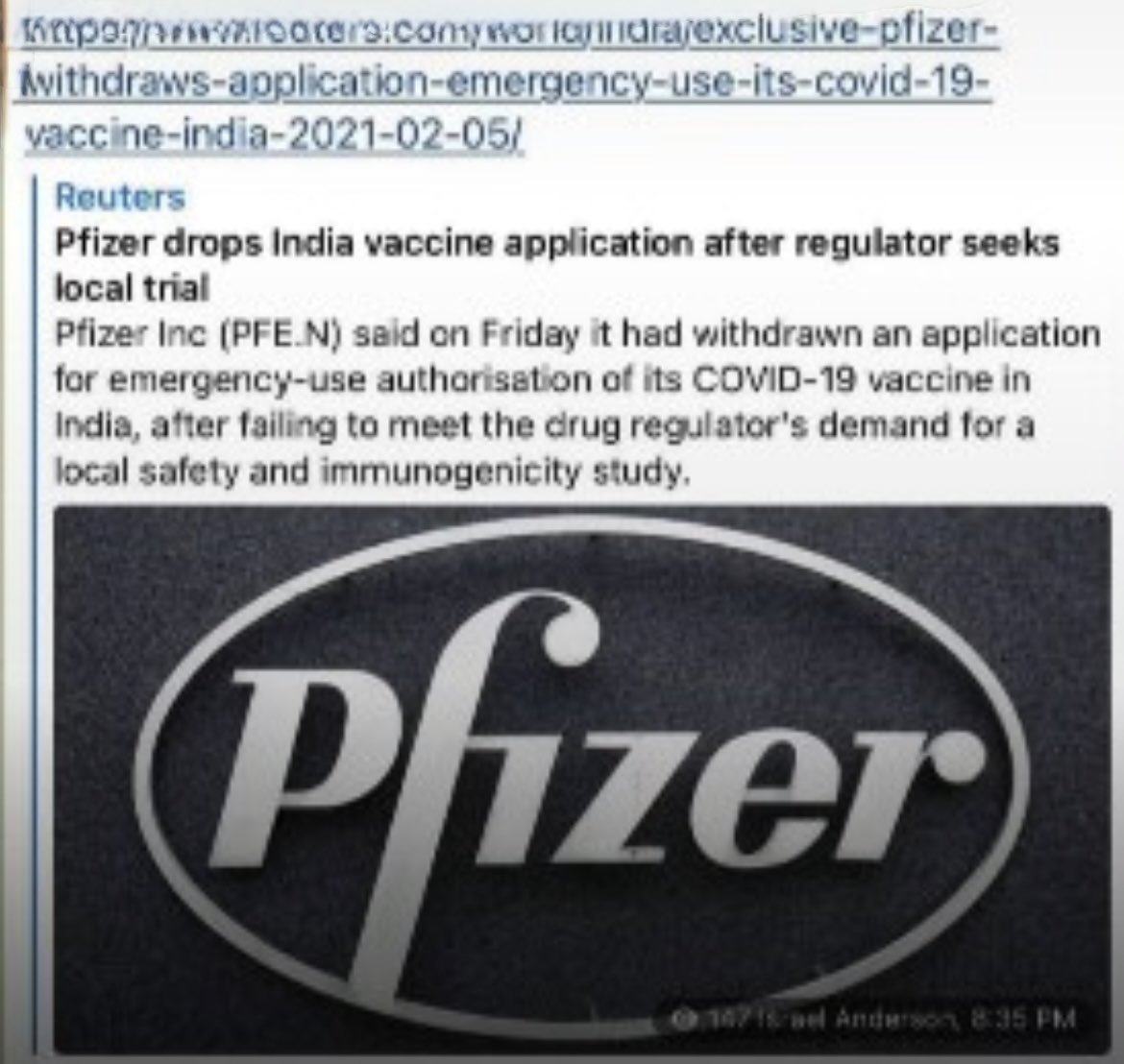
Indian authorities to Pfizer...
“You can either lose 1.38 BILLION customers…or allow us to do an independent investigation to determine whether your product is safe and effective…” -India
“We would rather give up 1.8 billion customers…” -Pfizer
India is so far behind China not because of Indic / Hindu culture — for this same civilization was at the apex of the world economy for 18 of the past 20 centuries — but because the neoliberal virus infected the Indian worldview that mocked at any argument for strategic planning, industrial policies and the like.
Indians were told to quietly accept a place in globalization and dare not attempt moving up the ladder. Comprehensive national power and development cannot occur and is an ideological threat to neoliberal ideas who main aim is to freeze a playing field tilted entirely in favor of western capital and technology. Indian policymakers of all hues and businesses even prided themselves for strictly adhering to this uneven development process. This is even more ironic because of the first hand colonial experience that had relegated India to the bottom of the ladder.
China was told an identical story but its leadership initially modified and then actively defied the neoliberal ideology by globalizing and yet simultaneously modernizing and strengthening at home. This is why China is not stuck at simply assembling iPhones or Japanese automobiles or conducting e-commerce on Amazon or exporting its finest minds to the West and India largely is.
IIT Madras Director Prof Kamakoti is an accomplished researcher and educator.
He gave citations of scientific papers on the beneficial properties of cow urine. Modern science is increasingly recognising the value of our traditional insights. Online mobs are simply channeling their own prejudices, not based on any scientific insight.
Stay strong Prof Kamakoti. Don't give into the attack mobs. 🙏