Why Smith College Physics? integrated, hands-on learning, supportive professors & fellow women physics majors, real research projects, and great physics toys.
This fact has not changed during the year.
We don't need miracle techs to address climate. We need to deploy, deploy, deploy existing techs as fast as possible.
‘No miracles needed’: Prof Mark Jacobson on how wind, sun and water can power the world https://t.co/dxLHdvVtxr
2023 was the warmest year on record globally by a large margin. Another dark red stripe gets added, though I think I need a new colour.
#ShowYourStripes
It was an unbelievable year for global climate.
As data is released in the first two weeks of January, you are going to be hearing all about these new climate change records. Apologies for all my graphs in advance!! 😬
Spiral below produced by @NASAViz: https://t.co/Ejsg0F4wop
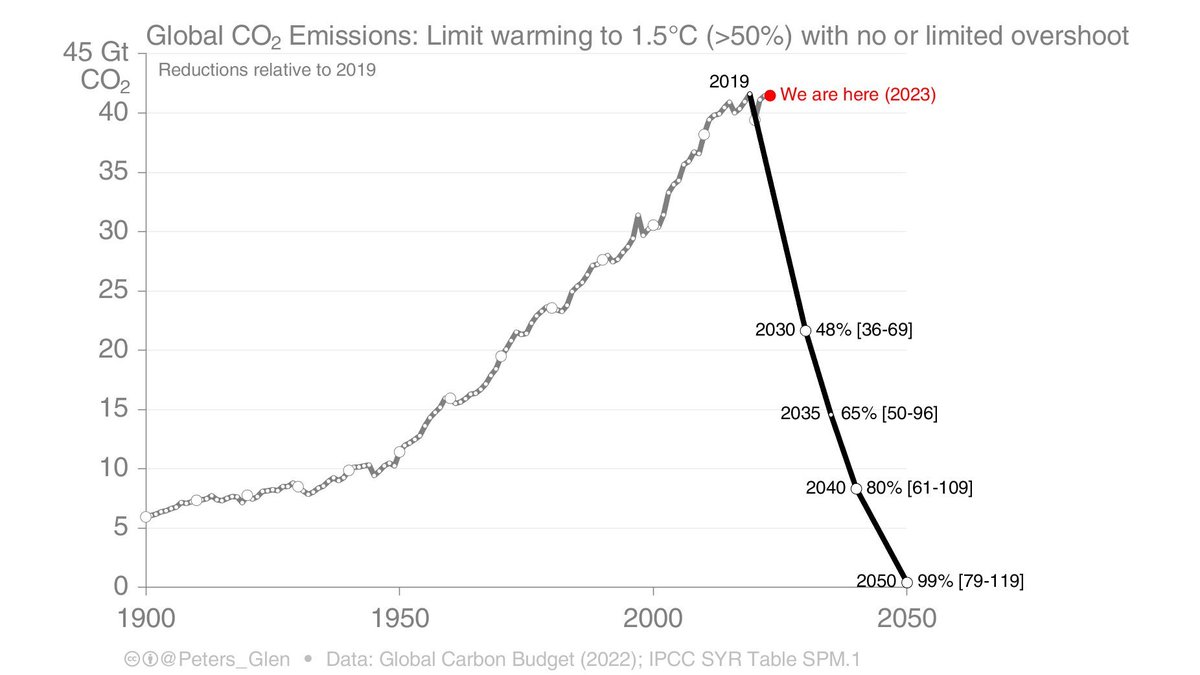
To limit global warming to '1.5°C with no or limited overshoot', the decline in global CO2 emissions relative to 2019 are:
* 48% by 2030
* 80% by 2040
* 99% by 2050
It is 2023 & global CO2 emissions are still rising!
https://t.co/nPsnmjLcjJ
The Dirac equation is a relativistic quantum mechanical wave equation formulated by British physicist Paul Dirac in 1928, which provides a description of elementary spin-½ particles, such as electrons, consistent with both the principles of quantum mechanics and the theory of special relativity. It was the first theory to account fully for relativity in the context of quantum mechanics.
The standard form of the Dirac equation is written as:
iħ ∂ψ/∂t = [cα·p + βmc²] ψ
where:
- i is the imaginary unit.
- ħ is the reduced Planck's constant (h/2π), a fundamental constant in quantum mechanics.
- c is the speed of light.
- t represents time.
- ∂/∂t denotes the partial derivative with respect to time.
- α and β are 4x4 matrices (with complex elements), known as the Dirac matrices. They were introduced by Dirac as a way to make the equation compatible with the special theory of relativity.
- p is the momentum operator, conventionally given by -iħ∇ (where ∇ is the gradient operator, usually expressed in three dimensions, and represents spatial derivatives).
- m is the mass of the particle.
- ψ is the wave function of the particle which encapsulates all the information about the system, and in this case, it's a four-component object known as a 'spinor'. The four components of the spinor represent two degrees of freedom for the electron (spin up or spin down), and two for the corresponding antiparticle, the positron.
The Dirac equation correctly describes particles with spin -1/2, and its solutions have negative energy states. This was a problem until Dirac proposed the concept of the sea of electrons, where all these negative energy states are filled up by electrons in what we call the 'Dirac sea', except for a few missing electrons which we observe as positrons (antielectrons) with positive energy. Thus, the Dirac equation led to the prediction of the existence of antimatter, revolutionizing the field of quantum physics.
It should be noted that the Dirac equation isn't entirely perfect. It assumes the electron as a point particle, which leads to self-energy infinities. These issues were later resolved with the development of Quantum Electrodynamics (QED), which uses a field-theoretic approach incorporating the principles of the Dirac equation.
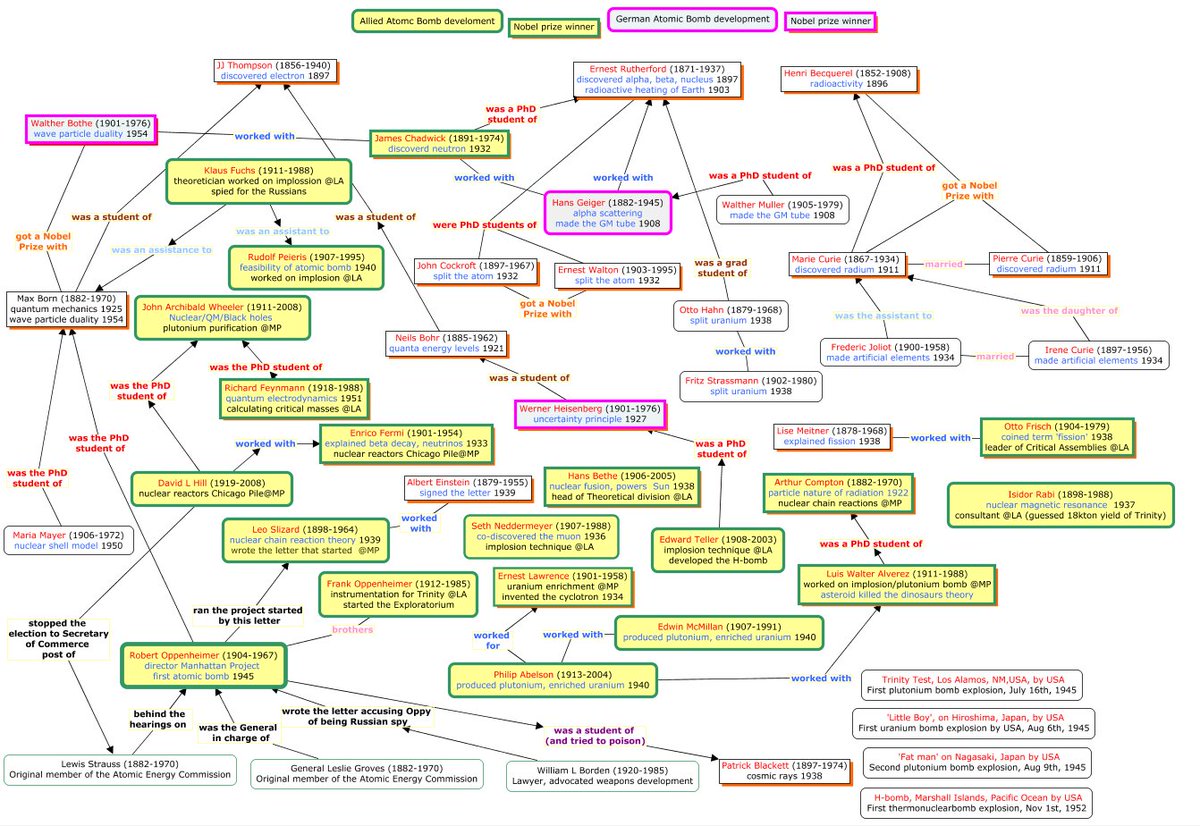
SO much fun making this Physics Family Tree for the Oppenheimer movie. Think it might provide some nice hinterland and discussion points.
#iteachphysics
Today our new director, JoAnne Hewett, will begin leading the Laboratory.
Welcome, JoAnne! We are excited to see you and learn what the future holds. https://t.co/ie3uojDQsu
Watch till the end. Notice a pattern? Global temperature change - 1850 to June 2023. We're quickly spiralling out of control.
No time to wait. #ActOnClimate#climate#energy#renewables
Seismologists have long wondered whether it is possible to predict earthquakes before they happen. Now it seems GPS data could let us do just that - if we solve one problem first https://t.co/Kyj8WA9GjK
What a pleasure to have Dame Jocelyn Bell Burnell at our London office to celebrate some of the awardees of the Bell Burnell Graduate Scholarship Fund, as well as Dame Jocelyn's upcoming birthday.
Congratulations to all the scholars!
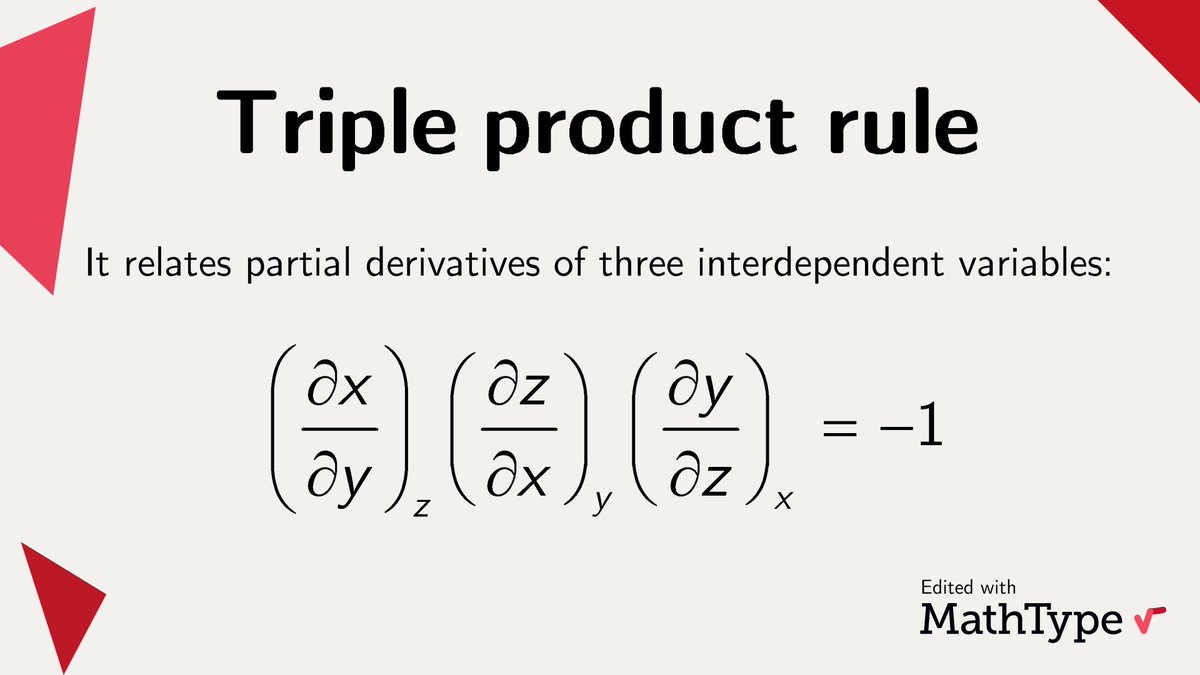
This approach is particularly useful when dealing with partial derivatives that are difficult to experimentally measure, integrate or evaluate analytically.
It has many practical applications in different fields. Could you name one?
#MathType#math#mathfacts
Um, this chart is from @BMcNoldy at the Univ of Miami. It shows incredibly hot--almost hot-tub hot--ocean water.
He said: "I'm not sure I've ever seen the water around Florida look like this...at any time of year."
An artificial neural network is utilized to determine the phase diagram of strongly correlated fermions in the crossover from Bose-Einstein condensates of molecules to Cooper pairs of fermions https://t.co/MMzEkshGrS
The forgotten Physics genius 📰
Oliver Heaviside was a self-taught British physicist and electrical engineer who made crucial contributions to electromagnetism and telecommunications.
He simplified Maxwell's equations using vector calculus, making them more accessible to other scientists. Heaviside also predicted the existence of the ionosphere, which enabled long-distance radio communication, and developed the theory of transmission lines and operational calculus.
Despite being overlooked during his lifetime due to his lack of formal education and unconventional personality, Heaviside's work laid the foundation for modern electrical engineering and physics.


![PhysInHistory's tweet photo. The Dirac equation is a relativistic quantum mechanical wave equation formulated by British physicist Paul Dirac in 1928, which provides a description of elementary spin-½ particles, such as electrons, consistent with both the principles of quantum mechanics and the theory of special relativity. It was the first theory to account fully for relativity in the context of quantum mechanics.
The standard form of the Dirac equation is written as:
iħ ∂ψ/∂t = [cα·p + βmc²] ψ
where:
- i is the imaginary unit.
- ħ is the reduced Planck's constant (h/2π), a fundamental constant in quantum mechanics.
- c is the speed of light.
- t represents time.
- ∂/∂t denotes the partial derivative with respect to time.
- α and β are 4x4 matrices (with complex elements), known as the Dirac matrices. They were introduced by Dirac as a way to make the equation compatible with the special theory of relativity.
- p is the momentum operator, conventionally given by -iħ∇ (where ∇ is the gradient operator, usually expressed in three dimensions, and represents spatial derivatives).
- m is the mass of the particle.
- ψ is the wave function of the particle which encapsulates all the information about the system, and in this case, it's a four-component object known as a 'spinor'. The four components of the spinor represent two degrees of freedom for the electron (spin up or spin down), and two for the corresponding antiparticle, the positron.
The Dirac equation correctly describes particles with spin -1/2, and its solutions have negative energy states. This was a problem until Dirac proposed the concept of the sea of electrons, where all these negative energy states are filled up by electrons in what we call the 'Dirac sea', except for a few missing electrons which we observe as positrons (antielectrons) with positive energy. Thus, the Dirac equation led to the prediction of the existence of antimatter, revolutionizing the field of quantum physics.
It should be noted that the Dirac equation isn't entirely perfect. It assumes the electron as a point particle, which leads to self-energy infinities. These issues were later resolved with the development of Quantum Electrodynamics (QED), which uses a field-theoretic approach incorporating the principles of the Dirac equation.](https://pbs.twimg.com/media/F3A5cHWaYAAKHN6.jpg)