Cet automne, pour la première fois depuis 250 ans, ma famille ne récoltera pas d'olives au Liban.
Nos 600 oliviers ont été arrachés du sol par l'armée israélienne, racines comprises, et emportés. Les plus vieux avaient 500 ans !
Cette terre, mon grand-père la tenait de son arrière-grand-père. En deux siècles et demi, ma famille a acheté de la terre. Elle n'en a jamais vendu un mètre, pas un seul jour. Chez nous, on ne construit pas sur la terre. On y plante. Ces arbres ont survécu à plusieurs guerres. Ils ont survécu à tout.
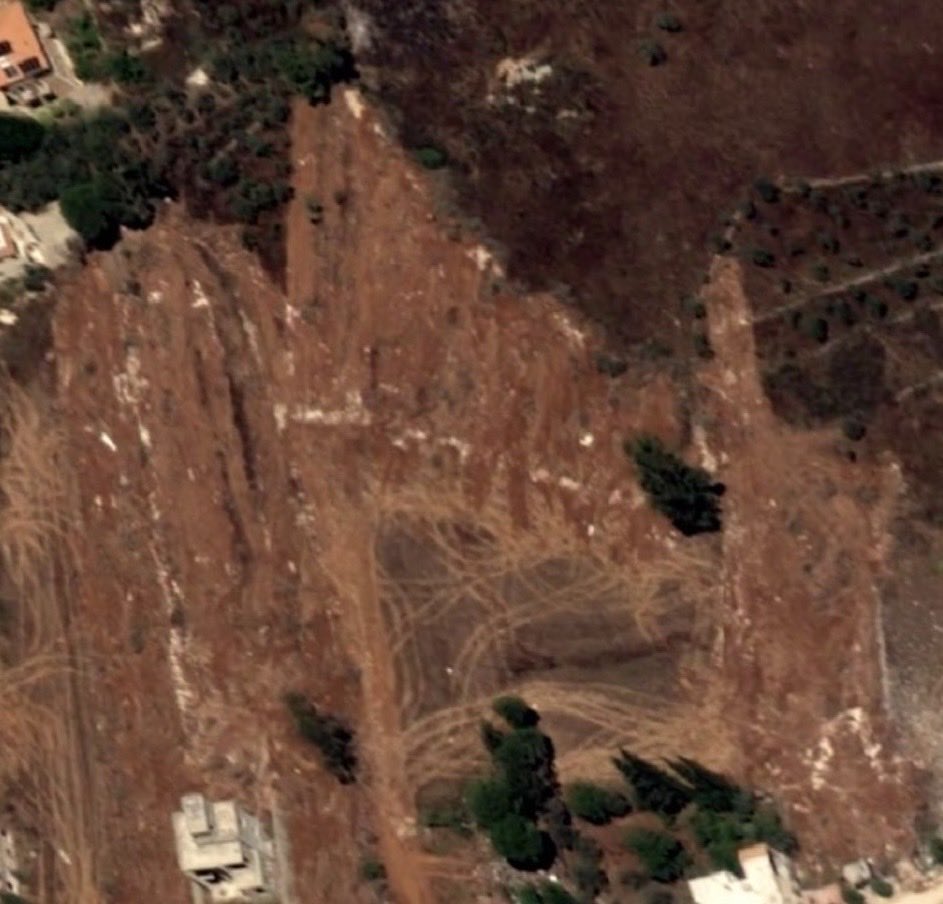
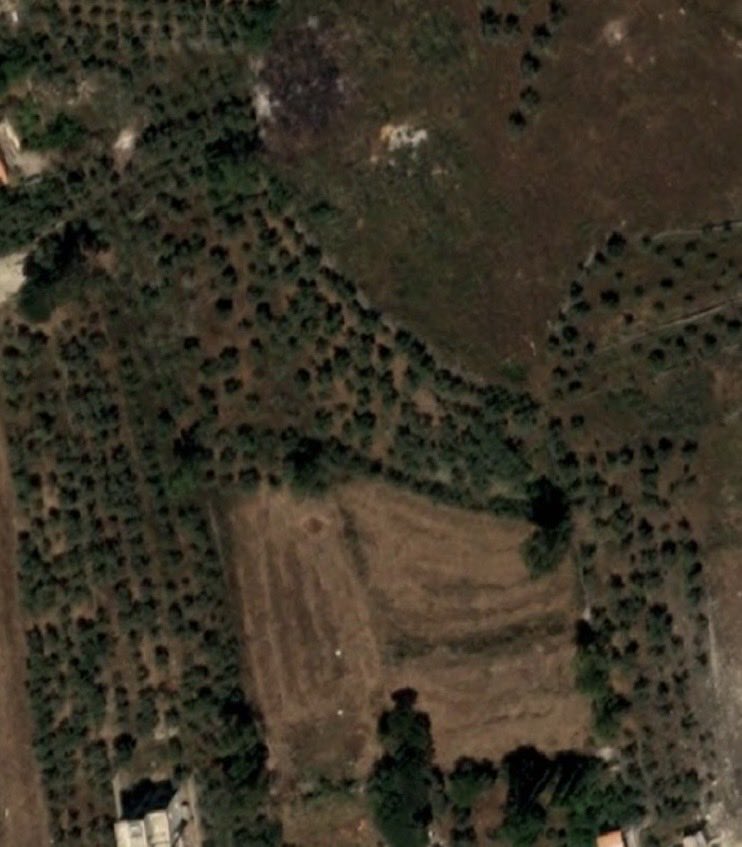
Regardez les deux photos. À gauche, notre terre le 25 juin, la veille de la signature de l'accord entre le Liban et Israël. À droite, la même terre le 20 juillet.
Il ne reste rien. Et c’est justement ça, la preuve. Un incendie laisse des troncs noirs debout. Une frappe laisse des cratères. Ici, pas un tronc calciné, pas une souche, pas un débris. Une terre nue, raclée, griffée par les chenilles des engins. Déterrer un olivier de 500 ans sans le tuer demande des pelleteuses, un savoir-faire, des camions et une destination. Ce n’est pas un dégât de guerre. C’est une opération, sur une terre où il n’y avait ni armes, ni combattants, ni présence militaire. Ma famille n'a jamais été liée de près ou de loin au Hezbollah, et elle ne le sera jamais. Il n'y avait que des arbres, et des gens qui les taillent depuis huit générations.
D'après les témoignages qui nous parviennent, ces arbres auraient été emportés de l'autre côté de la frontière, vers Israël.
L'accord signé entre le Liban et Israël, censé préparer la paix, protège les biens des civils. Je demande simplement qu'il soit appliqué : que le sort des arbres déterrés soit établi, que ceux qui sont encore vivants soient rendus. Si nos arbres sont vivants quelque part, ils peuvent revenir. Je ne cherche pas une vengeance. Je cherche une adresse !
J'ai hésité à écrire ces lignes, pour ne pas provoquer des réactions d'un côté comme de l'autre. Mais je refuse de faire le deuil de ces oliviers. Dans ces arbres vit l'âme de mon grand-père, ancien général de la police libanaise, un homme qui a toujours cru dans la paix, dans les humains et dans la lumière. Il taillait ces arbres à mains nues. Il répétait : “on ne vend pas la terre, on la transmet”
Je lui dois de ne pas me taire.
Just moments ago, President Trump stated that every time Iran strikes a vessel, the United States will destroy a bridge or power plant inside of Iran. At the most basic level, this is what we call "looking for a reason to commit atrocities".
The most likely scenario in the US/Iran War is that the United States continues to waged all-out economic warfare against Iran. This is done via a combination of maximum-pressure sanctions, the US blockade, and the systematic and overwhelming targeting of civilian and economic infrastructure inside of Iran.
The goal is undeniable: maximum civilian suffering.
That IS the goal here. Blowing up a bridge is not going to reopen the Strait of Hormuz. Neither will destroying a power plant. If there is anything we have all learned throughout this conflict, it's that Iran's asymmetric warfare capabilities, when paired with their geographical positioning, borders on insurmountable.
No. The GOAL from targeting economic and civilian infrastructure inside of Iran is to make the civilian population suffer as much as possible, and this is where the Trump Administration has a fundamentally broken understanding of economic warfare.
The best, and perhaps only, chance that the United States has to win this war is by the Iranian civilians rising up in protest and toppling the regime. Unfortunately, this is something that President Trump has made almost a fantasy due to a plethora of missteps throughout this war that have garnered domestic support, and undoubtedly turned the Iranian people against the United States.
It started on the very first day of the war. Not only did we assassinate a religious leader in the Ayatollah, but we also killed 168 children in a triple-tap bombing of the school in Minab. Even worse? We tried to cover it up and sweep it under the rug. Then came President Trump's threat to wipe out Iran's entire civilization. Not "the regime", their entire civilization. Then we bombed pharmaceutical, petrochemical, and steel manufacturing plants that put almost a million people out of work. After this came a blockade specifically meant to cut off Iran's ability to access wheat, medical supplies, cooking oil, and proteins. Then we bombed their water storage facilities, water infrastructure, and water desalination.
There IS NO HOPE for the Iranian people rising up and toppling the regime anymore. President Trump has ensured that this is nothing but a delusion at this point.
So what is the PURPOSE behind striking bridges and power plants? It's certainly not to reopen the Strait of Hormuz at this point. We've tried that for five months with no success. Iran still has a plethora of missiles and drones. They still have divers with limpet mines. They still have fast boats. They still have mines that can be released from boats.
The only purpose that the intentional targeting of bridges and power plants inside of Iran would serve is to make the innocent Iranian civilians suffer. They're not going to rise up and topple the regime. We're not going to be able to reopen the Strait of Hormuz by pursuing this strategy.
This is only about making civilians suffer.
Czyli 22 letni Morawiecki, będąc jeszcze studentem, założył ze znajomymi firmę i wystawiał faktury państwowym podmiotom, kontrolowanym przez znajomych jego ojca z Solidarności, licząc równowartość 2.5mln zł za półroczny cykl szkoleń?
Kurdę, no to jest dopiero rozwój plus.
A ja głupi myślałem, że on się w banku dorobił.
Krzysio jest tak przejęty, że o wyłudzeniu 2 mln złotych wspominał dwa razy wczoraj.
Kasa jest tak olbrzymia, że nie zauważył w ostatnich dniach afery z 40mln (20x więcej) na fundacje Żaryna czy 120 mld nieprawidłowości z lat 2020-2023 wykrytych przez KAS (60000x więcej).
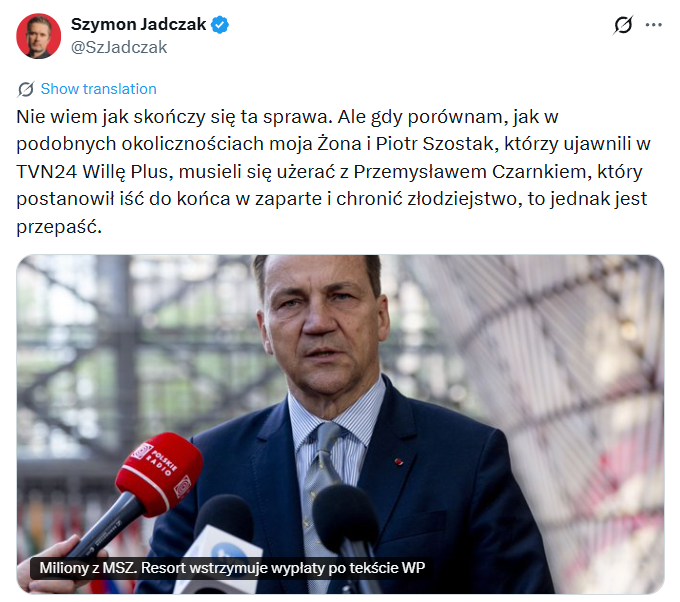
Ba, nawet autor artykułu napisał, że jest pozytywnie zaskoczony reakcją MSZ na tekst i porównał do tego jak w zaparte szedł Czarnek.
Ale to Krzysiowi nie wystarczy - trzeba jeszcze skrytykować rzecznika, za to, że zapowiedział zmianę sposobu kontroli nad wydatkami, by zapobiec takim wyłudzeniom na przyszłość :)
An investigation by Sky News reveals that precision strikes were used in a deadly primary school attack in Minab.
The painstaking search for evidence is part of a major investigation into the tragedy.
Sky's @Chesh reports.
Watch the full documentary: https://t.co/KM3f6pR1GK
Qalibaf has just delivered one of the most comprehensive statements of Iran's strategic thinking since the latest phase of the conflict began.
Few lines here:
- He argues that Iran neither seeks war nor fears it, but must always be prepared to fight while using diplomacy as an equally essential instrument of national security.
- He defends the closure of the Strait of Hormuz during the 40 day war, says it enabled Iran to secure an "Iranian arrangement" for the Strait later reflected in Article 5 of the MoU, warns that the United States is now trying to weaken that achievement through military pressure, and insists that Tehran has no reason to uphold any agreement from which it no longer benefits.
- He rejects any separation between military action and diplomacy, extends the same logic to sanctions, Lebanon, U.S. bases in the region and revenge for Khamenei's assassination, and calls for national unity while reaffirming that Iran's armed forces retain full freedom of action.
- From my point of view, the speech signals something more significant than a reaffirmation of Iran's traditional deterrence doctrine. Qalibaf is publicly describing a strategic framework in which military operations, negotiations, economic pressure and political messaging are no longer treated as separate tracks but as different phases of the same campaign.
- As emerged elsewhere, the battlefield is expected to shape diplomatic outcomes, while diplomacy is expected to preserve and legitimize the gains produced on the battlefield. I guess this is a more integrated conception of statecraft than the one Tehran articulated in previous years.
- The emphasis on the "Iranian arrangement" in the Strait of Hormuz is particularly revealing. It suggests that Tehran increasingly sees the post-war maritime order not as a temporary emergency measure but as a strategic reality that should survive the fighting itself.
- In this narrative, the MoU is valuable only insofar as it protects and institutionalizes that new balance of power. If Washington attempts to reverse it through military coercion or fails to implement its commitments, Iran reserves the right to abandon the agreement while continuing to defend what it now considers an established strategic achievement.
- That is a much broader message than simply threatening retaliation: it is an attempt to redefine the political terms on which any future negotiation with the United States will eventually take place.
#Iran
Everything that I have seen and heard points to the United States planning to launch an economic warfare campaign against Iran that crosses... every possible line.
When the blockade of Iran was announced yesterday, anyone who has followed me will know I had expected this for weeks. That's not surprising.
The PROBLEM I see, is that there is no intention to simply revert back to the dueling blockades. That clearly doesn't work.
I believe, and I truly hope I am wrong, that the United States plans to implement a new economic warfare campaign that is built of five key pillars:
1) The reimposition of the US blockade. This is meant to cut off the import of wheat, medical supplies, and cooking oil, and the export of oil and petrochemical products. This is intended to cause food shortages and medical crises.
2) The return to "maximum pressure" sanctions. This means targeting... any and everything inside Iran, and anything that can even be remotely connected to Iran outside the country.
3) The continuation of Operation Freedom 2.0, which is the attempt by the United States to funnel vessels through the Omani Route.
4) The direct and intentional targeting of key economic infrastructure. This will include oil and gas field, petrochemical facilities, water infrastructure and storage, steel and manufacturing plants, and pharmaceutical facilities.
5) The direct and intentional targeting of civilian infrastructure to include roads, bridges, and rail lines.
The United States needs to realize, very quickly, that causing immense civilian suffering is not going to produce regime change. It is not going to force the regime to make concessions on their nuclear file, their missile and drone program, the funding of their proxy forces, or forfeit their control over the Strait of Hormuz.
Economic devastation for the SAKE of economic devastation is not a strategy. It is evil.
Bo afera na prawicy to dla Polaków po prostu kwestia biologiczna, naturalna – afera jak afera.
A u liberałów to jest absolutny skandal, to powód do dymisji rządu, to metafizyka, to Uśmiechnięta Polska.