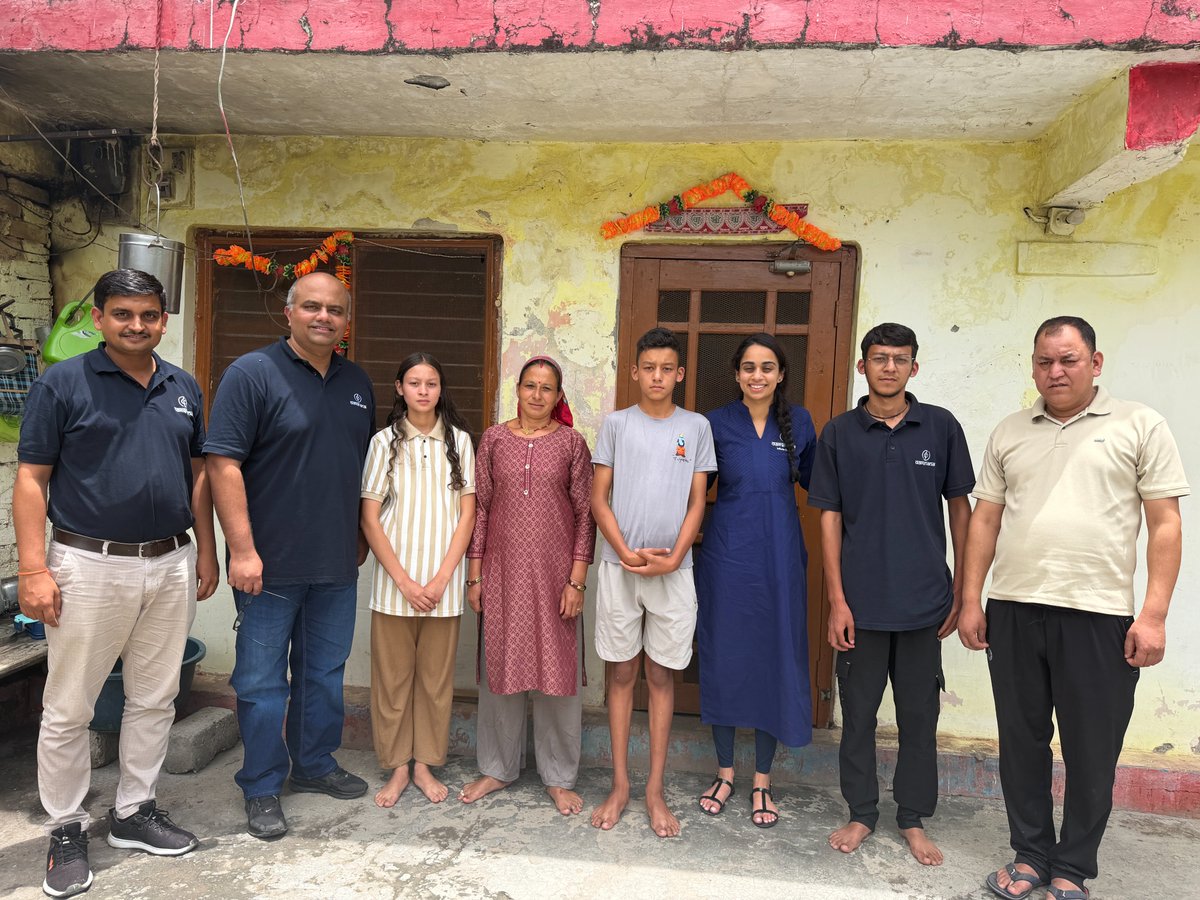
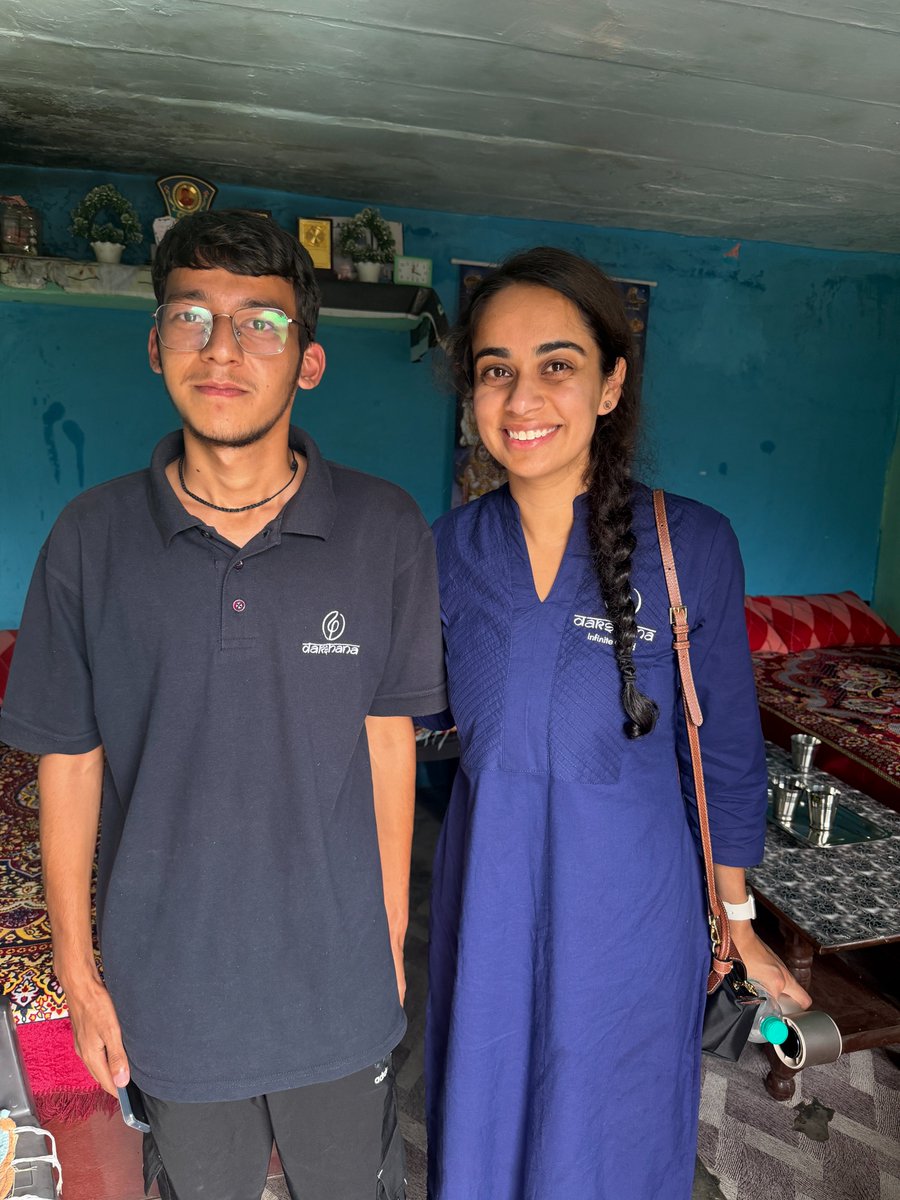
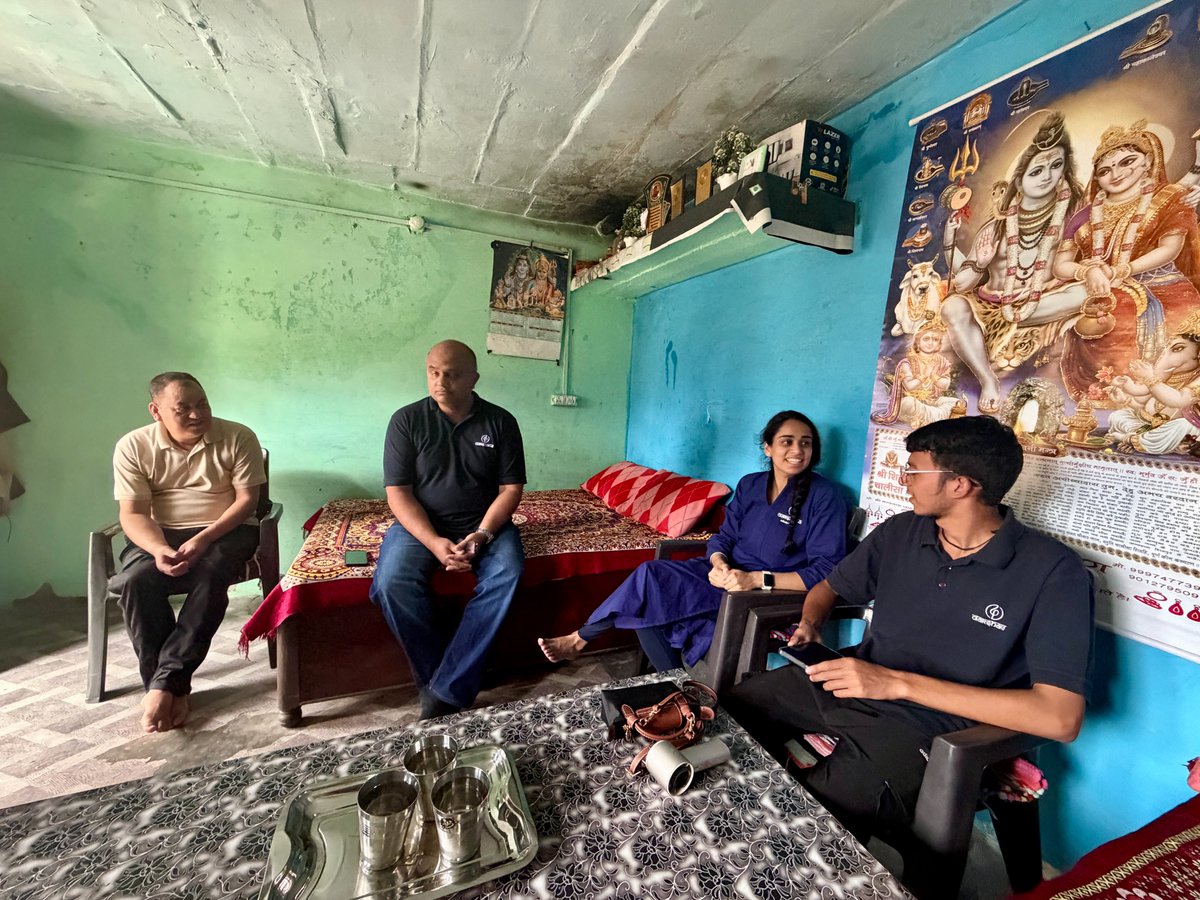
The third student we visited in Uttarakhand was Abhinav.
Abhinav lives in a small village at the foothills of Badrinath with his mother, father, younger sister, younger brother, and both of his grandparents. The family of seven shares a two-bedroom home.
His grandfather runs a small ice cream shop during the tourist season, while his father works at the local electrical plant. Together, they earn less than $160 a month.
Life in this part of Uttarakhand is shaped by the mountains. On the way to school, the local doodhwala gives Abhinav's younger siblings a ride as a courtesy. On the way home, his younger sister walks nearly 7 kilometers back to the village. It takes her about two and a half hours.
Abhinav will be joining IIT Roorkee to study Computer Engineering.
He spent Classes 6 through 12 at Jawahar Navodaya Vidyalaya, Chamoli, after earning admission in Class 5. He had been a top student from a young age, and after years of hard work, he was selected by Dakshana to attend the Valley Pune campus for JEE coaching. Less than a year later, he earned admission to IIT.
When we asked whether the neighbors were excited about his admission, his parents smiled and told us that no one in their region had even heard of IIT.
Abhinav is exceptionally studious and humble. It was easy to see how much his family values education and how proud they are of everything he has accomplished.
The drive to his home was one of the most beautiful parts of our trip. Surrounded by the mountains near Badrinath, it is an absolutely breathtaking part of India.
I'm excited to see what lies ahead for Abhinav, and I wish him and his family all the very best.
@MohnishPabrai@DakshanaIndia
Ages of Founding Fathers in 1776:
James Monroe, 18
Aaron Burr, 20
John Marshall, 20
Alexander Hamilton, 21
James Madison, 25
John Jay, 30
Thomas Jefferson, 33
Thomas Paine, 39
John Adams, 40
George Washington, 44
This nation was built by brilliant young men.
@JuniorBuffett I always focus on free cash flow generation and, more importantly, how management allocates it. Argent is a great example of a company creating long-term value through disciplined capital allocation.
I was 26 years old when Peter Lynch handed me this.
April 28, 1983. I was the auto and retail analyst at Fidelity.
Peter was in his prime, on his way to building the greatest mutual fund track record in history:
29.2% annual returns for 13 YEARS STRAIGHT, growing Magellan from $18 million to $14 billion. The Babe Ruth of investing.
I'm looking at the principles he had typed up on a single sheet of paper that I've kept in my files for 42 years and I believe now is the perfect time to revisit them again.
Let me walk you through a few:
Rule 1B: "You need an edge to make money. Do not rely on a combination of hope and good luck."
Today's retail investor has no edge. He has Reddit, Robinhood, zero-DTE options and a TikTok algorithm pushing him into whatever stock just ripped 200% the day before.
That's hope and good luck wearing a fancy costume.
Rule 1E: "Purchase stocks like one would purchase a business."
Tesla trades at over 360 times earnings on a business deteriorating in real time, Oracle has $206 billion in liabilities against $39 billion in equity, MicroStrategy is a leveraged Bitcoin holding company priced like a software firm, and don't even get me started on SpaceX, that piece of garbage you'll be able to trade tomorrow...
Nobody in their right mind would buy these as actual businesses. They buy them as stories, narratives, and lottery tickets.
Peter would have called it the same way I do - these are not investments. They are speculations. GAMBLING.
Rule 1G: "Study the balance sheet and cash flow statement."
The hyperscalers spent over $380 billion on AI capex in 2025. Goldman says the measurable productivity payoff does not arrive until 2027 at the earliest.
Oracle just reported NEGATIVE $23.7 billion in free cash flow for fiscal 2026 while borrowing at a pace that would make a leveraged buyout firm nervous. The cash flow statements are screaming but nobody is reading them.
Rule 1I: "Avoid the long shot."
This one cuts the deepest.
The entire market has become a long shot.
OpenAI is projected to post roughly $74 billion in operating losses in 2028 ALONE while priced for transformation tomorrow. Bitcoin treasury companies are multiplying off thin air.
The retail investor of 2026 is making one long-shot bet after another and calling it a portfolio.
Rule 3A: "When the fundamentals change, sell your mistakes."
Tesla's fundamentals have changed.
California registrations are down 24% year over year and inventory days went from 10 to 27. Musk himself admitted on the last earnings call that Hardware 3 cannot achieve unsupervised FSD, breaking a promise made to 4 million customers.
The fundamentals have screamed change. But the stock is still at $385.
The mistakes are not being sold. They are literally being doubled down on with leverage.
Rule 3I: "A 30-50% profit in 12 months is great. Mediocre in three years."
Today's retail crowd expects 30-50% in a WEEK. Then they wonder why they get wiped out the second the hype stops.
And my favorite - Rule 3J: "Develop your own style and stick to it."
That is the entire game right there.
I developed mine sitting across the hall from Peter Lynch in 1983, watching him work, reading his notes, getting my own research handed back to me covered in his pencil marks. Then in 1984, my first full year managing money, I ran the #1 mutual fund in America. The Fidelity Overseas Fund was top 2 for the next six years running.
I did not get there by chasing narratives. I got there by following the sheet of paper you are looking at right now.
42 years later, this single page contains more wisdom than every Fintwit thread, CNBC segment, and Wall Street price target combined.
Peter retired in 1990 with the greatest mutual fund record in history. Then he sat down and wrote books explaining exactly how he did it.
Only a few "investors" these days read them.
And almost nobody is reading the balance sheets, the cash flow statements, or studying actual businesses today either.
They are chasing AI, crypto, and whatever pumped yesterday.
The wisdom on this page is timeless and it's more important than ever.
@EugeneChemaly@JSE_Invest I just got a feeling they will be repurchasing more at there shares, last years presentation the executives did say they will consider repurchases at an attractive price. R60 is bloody attractive.
@JSE_Invest I have bought TFG and truworths shares today. I think the problem is more a macroeconomic situation just need margin improvements and revenue growth. There is more upside then downside at these prices.
A 31-year-old primary school teacher with a doctorate was turned down for a senior position at the Western Cape Department of Education.
Devastated but determined, he resigned, took his R240,000 severance package, and on a wet winter morning in July 1998, opened a small school in the vestry of a church in Durbanville. He had 28 learners and three friends helping him.
That modest beginning became Curro — today South Africa’s largest private school network, with 189 schools and over 72,000 learners. It grew into a JSE-listed company valued at R7.2 billion.
But the real story goes far beyond the numbers.
Years later, Dr Chris van der Merwe reflected: “I can tell you without doubt that I never started Curro with the intention of making money. I wanted to serve the country by creating affordable private education.”
He proved those words were genuine.
In 2025, he played a central role in one of the most remarkable moves in South African education history: the Jannie Mouton Foundation acquired Curro for R7.2 billion, took the company private, and converted it into a public benefit organisation. The decision was supported by a 99.98% shareholder vote.
Going forward, 100% of Curro’s surpluses will be reinvested into building more schools, providing bursaries, and expanding access for underprivileged learners.
Not driven by profit, but by purpose.
I think about this story often when working with families who are building wealth. Creating financial success is important, but the families that leave the most meaningful legacies are those who build for something greater than themselves — not merely to accumulate.
What felt like a painful rejection in 1997 turned out to be the very door that led to everything that mattered.
Sometimes the door that closes is the one that changes the entire direction of your life — for the better.
Can you imagine that such an amazing man is not wanted by his country, simply because he is white?