LIMIT/OFFSET doesn't make a query cheap. The DB still sorts every row, then throws most away.
GitHub hit this on star history: ~6M rows scanned for react/react. Filtering by an indexed time range first: ~251K rows, 24 requests.
Offset or keyset pagination: which do you ship?
@Nuplay_AI (formerly Nurix) is hiring a Lead DevOps & Platform Engineer in Bengaluru: cloud, Kubernetes, observability, multi-tenant SaaS. 8-12 yrs, on-site.
JD: https://t.co/dAymEXGx7p
DM me a 2-line intro + resume and I'll pass it to the team.
Voice AI folks in Bengaluru: @Nuplay_AI (formerly Nurix) is hiring an ML Engineer for speech. ASR, TTS, low-latency voice systems. 2-7 yrs, on-site.
JD: https://t.co/do6hOHi0w2
DM me a 2-line intro + resume and I'll pass it to the team.
@Nuplay_AI (formerly Nurix) is hiring in Bengaluru:
• ML Engineer, voice (2-7 yrs): https://t.co/do6hOHi0w2
• Lead DevOps & Platform Engineer (8-12 yrs): https://t.co/dAymEXGx7p
I'll pass strong profiles to the team: DM me a 2-line intro + resume.
@posthog "Stop at a report, not a PR" is the underrated bit. 72 reports → 11 merged fixes still beats 72 tickets nobody starts.
I run my X content the same way now: a scheduled agent drafts, I approve.
@DanielleMorrill Cloudflare saw the same with their AI code reviewer: picking the right model and effort per sub-agent was the biggest chunk of a 68% cost cut ($2.43 → $0.77 per review).
Routing by task is the cheapest win in an agent fleet.
@mayuri_3015 Next.js + Postgres. One deploy, one database.
Postgres also covers your job queue (SKIP LOCKED), search (full text) and JSON until you have real scale problems. MVPs die from too many moving parts, not too few.
@aslambeg84 Redis can persist, but the whole dataset has to fit in RAM and durability is a config choice (AOF fsync), not the default.
Postgres gives you constraints, joins and transactions on data far bigger than memory. Redis is the fast copy, Postgres is the truth.
@eatonphil Hit this benchmarking a Postgres-backed job queue. Driving it at a fixed 1,200 steps/s for 10 min is what showed the real ceiling (~1.3k, WAL flush bound).
A closed loop would have just slowed down politely and hidden it.
@ChShersh Mostly agree on the thinking part. The difference I keep hitting: in DSA the input is fixed.
In system design the input is a traffic spike, a dead node and a retry storm at the same time. That's where it stops feeling like LeetCode.
Unpopular opinion: most teams add Kafka before they've pushed a single Postgres anywhere near its limit.
One Postgres did 1,199 workflow steps/sec for 10 minutes in my Relay benchmark. That's sized for 1M runs/day at 10x peak.
What do you reach for first?
@suraj_sharma14 I'd add durability to the list: what happens when the agent crashes halfway through step 7.
Most agent demos just start over. Journaling each step and replaying it is what makes them safe to run for hours.
@Akintola_steve I'd put idempotency keys right next to retry + backoff. Retries without them are how you charge a card twice.
Outbox + idempotent consumers covers a lot of real-world pain.
@DominikTornow At this point everything is a table. I built Relay, a durable workflow engine, on just Postgres too: a journal plus a SKIP LOCKED queue, ~1.2k steps/s on one box.
Postgres keeps winning.
@gkcs_ Half of that harness is plain backend work: batching, caching, indexes, traces. Agents write the code, but system design still decides the AWS bill.
Curious why traces came last? I'd have put them first.
Most distributed systems bugs I've hit come down to three things:
1. a retry that wasn't idempotent
2. a clock someone trusted
3. a lock nobody released
Which one got you last?
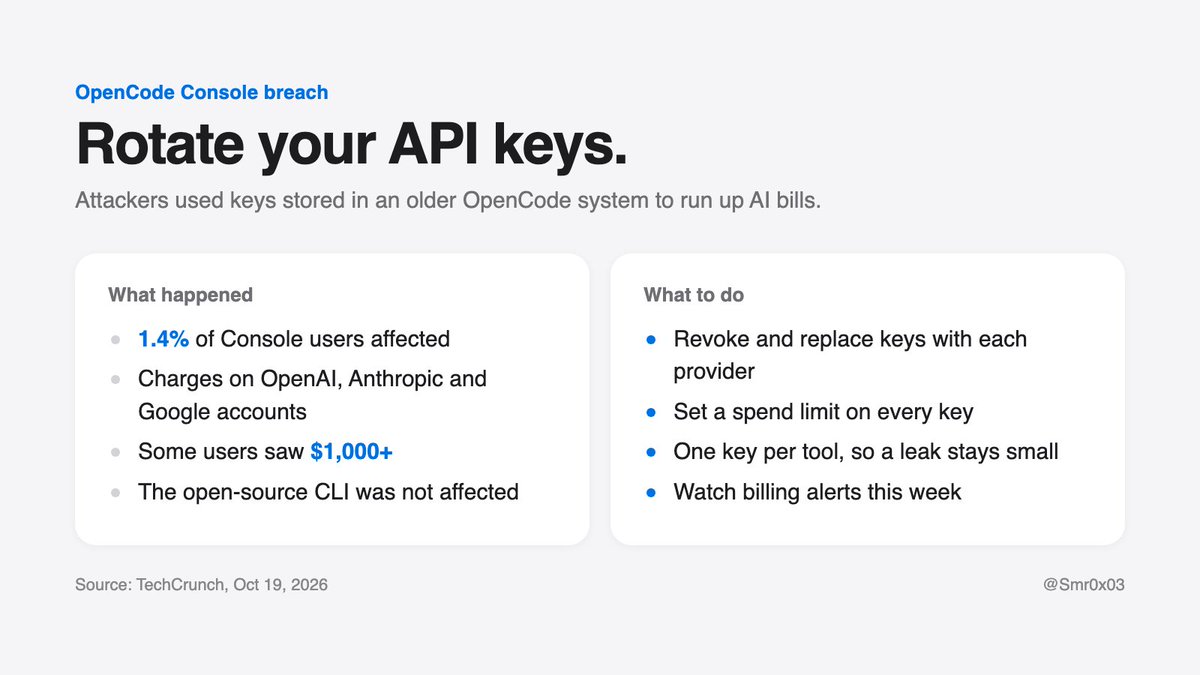
If you saved API keys in OpenCode Console, rotate them today.
Attackers got into an older OpenCode system and used stored keys to run up OpenAI, Anthropic and Google bills. Some saw $1,000+.
The CLI wasn't hit. Put a spend limit on every key you hand to a tool.
Cloudflare cut their AI code reviewer's cost 68%. $2.43 → $0.77 per review.
One fix: the first call hit the prompt cache only 14-26% of the time, because repo-specific stuff sat before the cache breakpoint. Shared part first → 91-99.5% hits.